- Title
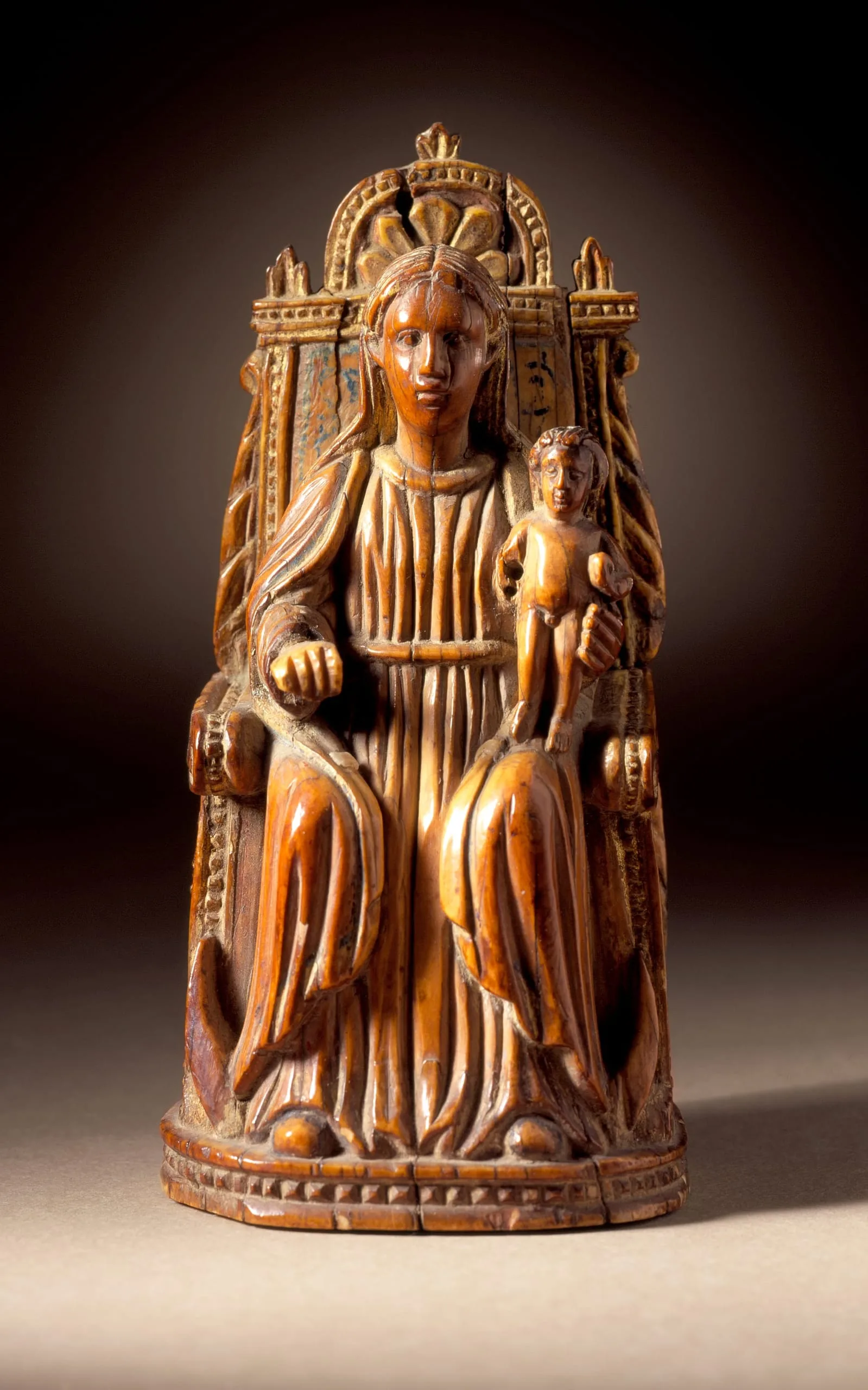
- Enthroned Madonna and Christ Child (Virgin in Majesty)
- Date Made
- circa 1700
- Medium
- Patinated ivory with traces of paint
- Dimensions
- 4 7/8 x 2 1/2 x 1 3/4 in. (12.38 x 6.35 x 4.44 cm)
- Accession Number
- M.87.224
- Curatorial Notes
This Goan ivory image of the Enthroned Madonna and Christ Child presumably represents an iconic type known also as the "Virgin in Majesty," which was particularly popular in medieval and early Renaissance theological paintings and sculpture. The Virgin sits formally upon the Throne of Wisdom (Latin: sedes sapientiae), befitting her role as the Queen of Heaven (Latin: Regina Coeli). The tall armchair has a high back with a crest rail in the form of radiating lotus leaves with a pearl border and flamelike finials. Its hemispherical form centered behind the Virgin’s head may have been intended to evoke her halo. Unusual for this iconographic type of image, the Virgin is uncrowned and unveiled. Her long hair is pulled behind her uncovered ears, which may symbolize her divine perception. She wears a pleated robe and mantle. Her right hand is clenched by her thigh and may have once held a scepter. The crescent moon beneath the Virgin’s feet is an ancient symbol of chastity. The Christ Child is nude and standing on the Virgin’s thigh, rather than seated on her lap as is more common for this image type. His left hand may hold an orb, symbolic of his spiritual mastery of the world. His right hand is now missing. Traces of painted designs survive on the chairback. The back of the ivory is unadorned.
- Selected Bibliography
- Pal, Pratapaditya. Indian Sculpture, vol.2. Los Angeles: Los Angeles County Museum of Art; University of California Press, 1988.
- Pal, Pratapaditya. Elephants and Ivories in South Asia. Los Angeles: Los Angeles County Museum of Art, 1981.
- Larson, Gerald et al. In Her Image: The Great Goddess in Indian Asia and the Madonna in Christian Culture. Santa Barbara: UCSB Art Museum, University of California, 1980.