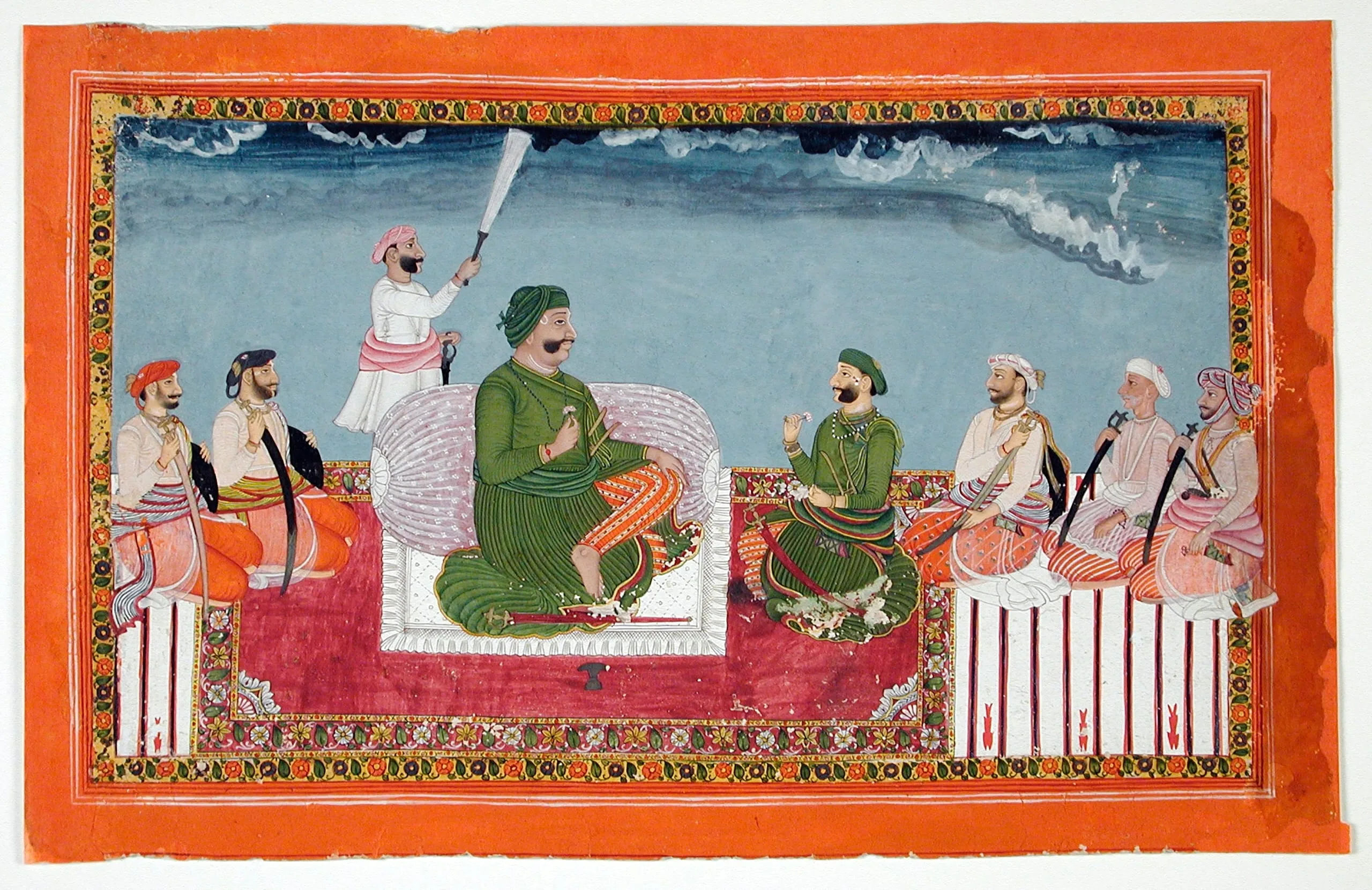
Two devanagari inscriptions in different handwriting on the reverse of this painting identify the figures depicted on the obverse. The primary subject is the crown prince (maharajkumar) Ajit Singh of Orchha, a Princely State in present-day Madhya Pradesh. Beside him is an attendant carrying an honorific fly whisk, and behind him are two figures identified as Jawaharsingh, the chief secretary (diwan), and Prince Ramchandra. Seated in front of him are four men who are presumably officials or courtiers: Kunwar Ghana Singh, Kisari Singh, Panna Kanasvanir, and Lala Amarsingh. The inscription also furnishes the name of the artist, Vijna, and the date, 1808. Inexplicably, however, at that time Ajit Singh was no longer the crown prince of Orchha because in 1765 Raja Mahendra Sawant Singh Ju Deo of Orchha (r. 1752-1765) had declared the jagir (feudatory estate) of Bijna as an independent state and named his eldest son, Ajit Singh, as the first ruler of Bijna as Raja Mahendra Ajit Singh Ju Deo (r. 1765-1823).
In this painting, Ajit Singh sits on a carpeted terrace with his aforementioned companions. He holds a rose symbolic of his cultural refinement. He has the standard royal accoutrements of a sword and a punch dagger (katar) tucked into his waist sash. Beside him is a spittoon that would have been used while chewing beetle nut quids (pan).