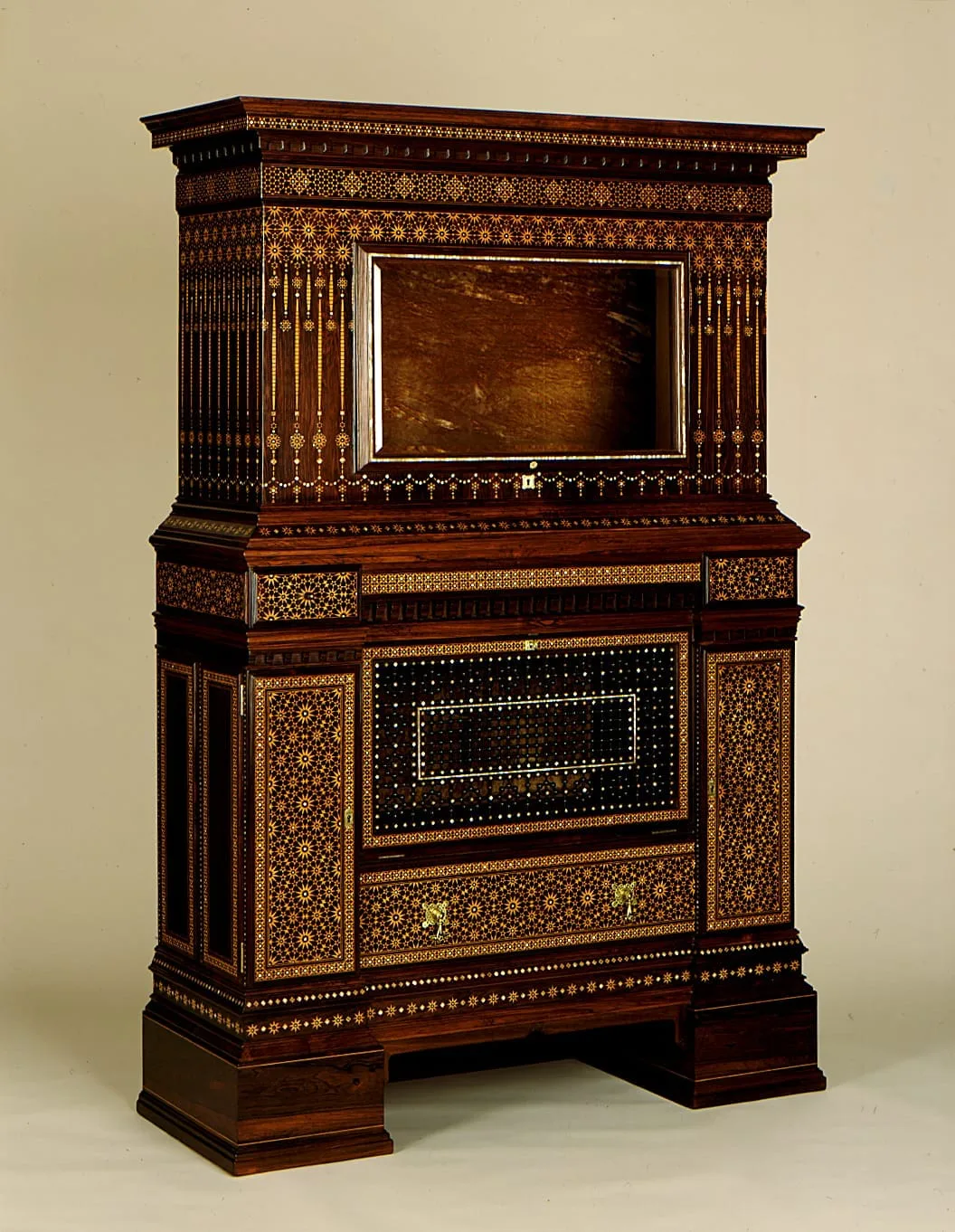
The brothers Christian (1840—83) and Gustave (1830—98) Herter were German immigrants to New York. In 1865 they established a cabinetmaking and decorating firm that attracted wealthy clients in New York , Boston , Minneapolis , Chicago , and San Francisco . This new American upper class, its fortunes founded in commerce, proved eager to demonstrate a cosmopolitan awareness of both history and good taste. Families such as the Rockefellers and Vanderbilts commissioned Herter Brothers to decorate and furnish rooms, even entire houses, with beautifully crafted home furnishings comparable in luxury with the finest European productions.
In both America and Europe the taste of the late nineteenth century favored historicism and exoticism; decorative arts and architecture often quote from styles of the Near and Far East. This cabinet typifies both the oriental taste and extraordinary craftsmanship of the so-called aesthetic movement. Its Moorish elements include inlaid star and rosette shapes from Near Eastern tile patterns, the grillework of the drop-leaf door, and the geometric inlay bands framing the panels. The cabinet form recalls Islamic cabinets used from the thirteenth through sixteenth centuries as lecterns for the Qu'ran and to store liturgical objects and texts.
From the 1870s onward prestigious Victorian upper-class homes might have included elements of Near Eastern design, such as Persian-style "cozy corners" and smoking rooms. This lavishly inlaid cabinet would certainly have suited such an exotic environment.