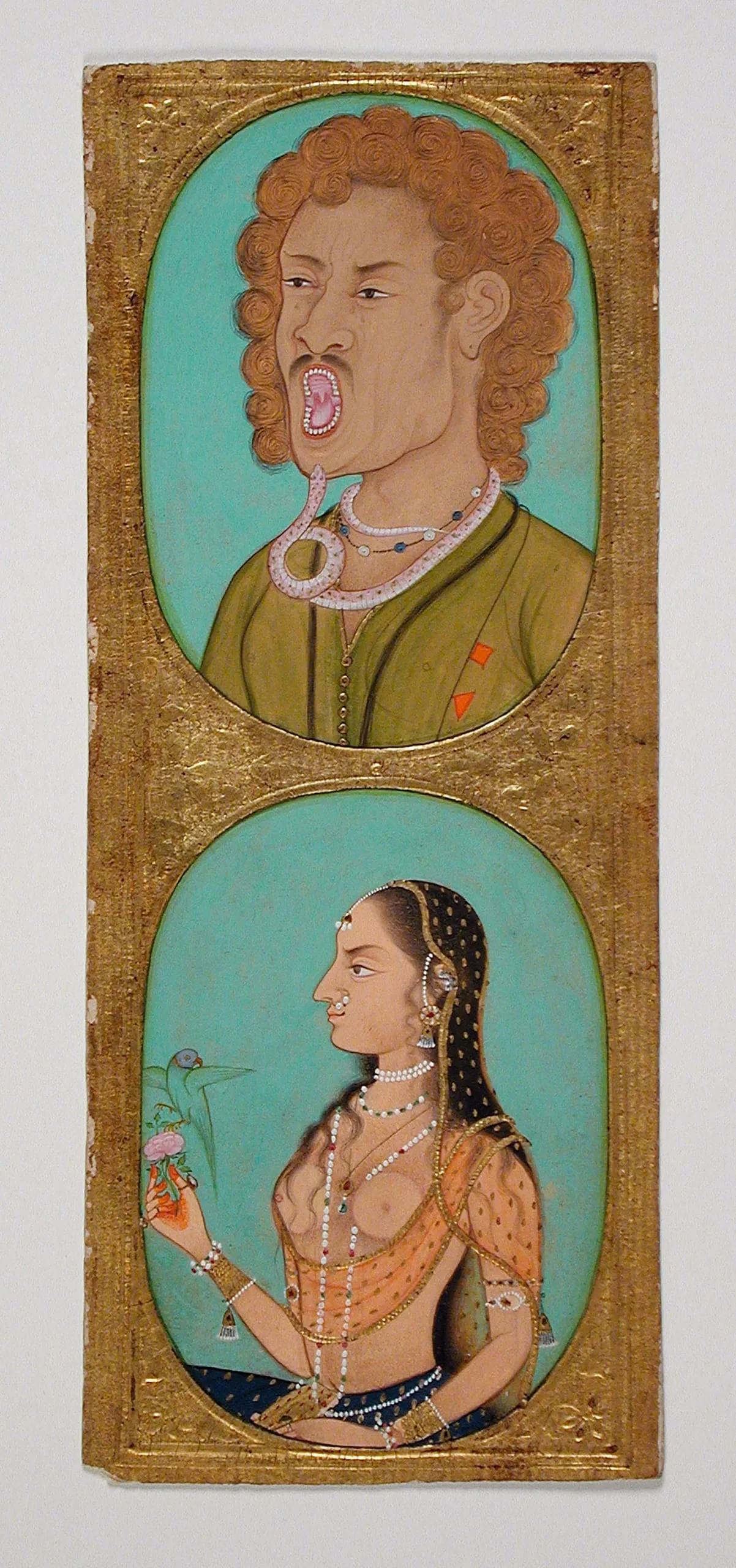
The Indian interest in portraying exotic foreigners during the Mughal period in the late 16th and early 17th centuries was reinvigorated in the painting traditions of the Rajasthan courts of Mewar and Bundi in the early 18th century. The impetus for these representations is believed to have been the visit in 1711 to the Mewar court of Maharana Sangram Singh II (r. 1710-1734) by the embassy of the Dutch East India Company led by Johan Josua Ketelaar (1659-1718), the director of the Dutch trading post in the port of Surat in Gujarat. Several contemporaneous Mewar paintings depict the Dutch delegation, the members of which are shown as distinct individuals wearing the common uniform of wide-brimmed black hats, periwigs, and knee-length redcoats. Images of the Dutchmen from these historical paintings were soon conflated into the genre of Indian court paintings portraying exotic Europeans (farangis) as isolated subjects, which due to their exaggerated features and loss of historical context may have come to be viewed as parodies (see M.85.147 and M.2001.229.3). See Stephen Markel, "The Enigmatic Image: Curious Subjects in Indian Art," Asianart.com (July 30, 2015), http://asianart.com/articles/enigmatic.
One particularly bizarre outlander, depicted here in the top oval portrait, is the shrieking curly-haired European man being bitten on the chin by a snake. He is shown in at least three additional representations attributed to Mewar, circa 1760–1775. See A European Concoction, attributed to circa 1760, in the Philadelphia Museum of Art (2004-149-59), and two unpublished paintings in the Goenka Collection, Kolkata and the Jagdish and Kamala Mittal Museum, Hyderabad. See Darielle Mason, Intimate Worlds: Indian Paintings from the Alvin O. Bellak Collection (Philadelphia: Philadelphia Museum of Art, 2001), pp. 154–155, no. 63.
Another double oval portrait in the same distinctive dispersed series is published in a Christie's auction catalogue. The top portrait portrays one of the stock parodies recast as an elderly woman (identified as such for the first time in Markel 2015). See Christie's, Indian and Southeast Asian Art (New York: Christie's, September 17, 1999), p. 184, lot 267.