LACMA

ShopMembershipMyLACMATickets
LACMA
Los Angeles County Museum of Art
5905 Wilshire Blvd.
Los Angeles, CA 90036
info@lacma.org
(323) 857-6000
Sign up to receive emails
Subscribe
© Museum Associates 2025

Museum Hours

Monday

11 am–6 pm

Tuesday

11 am–6 pm

Wednesday

Closed

Thursday

11 am–6 pm

Friday

11 am–8 pm

Saturday

10 am–7 pm

Sunday

10 am–7 pm


  • About LACMA
  • Jobs
  • Building LACMA
  • Host An Event
  • Unframed
  • Press
  • FAQs
  • Log in to MyLACMA
  • Privacy Policy
© Museum Associates 2025
Collections

Unknown
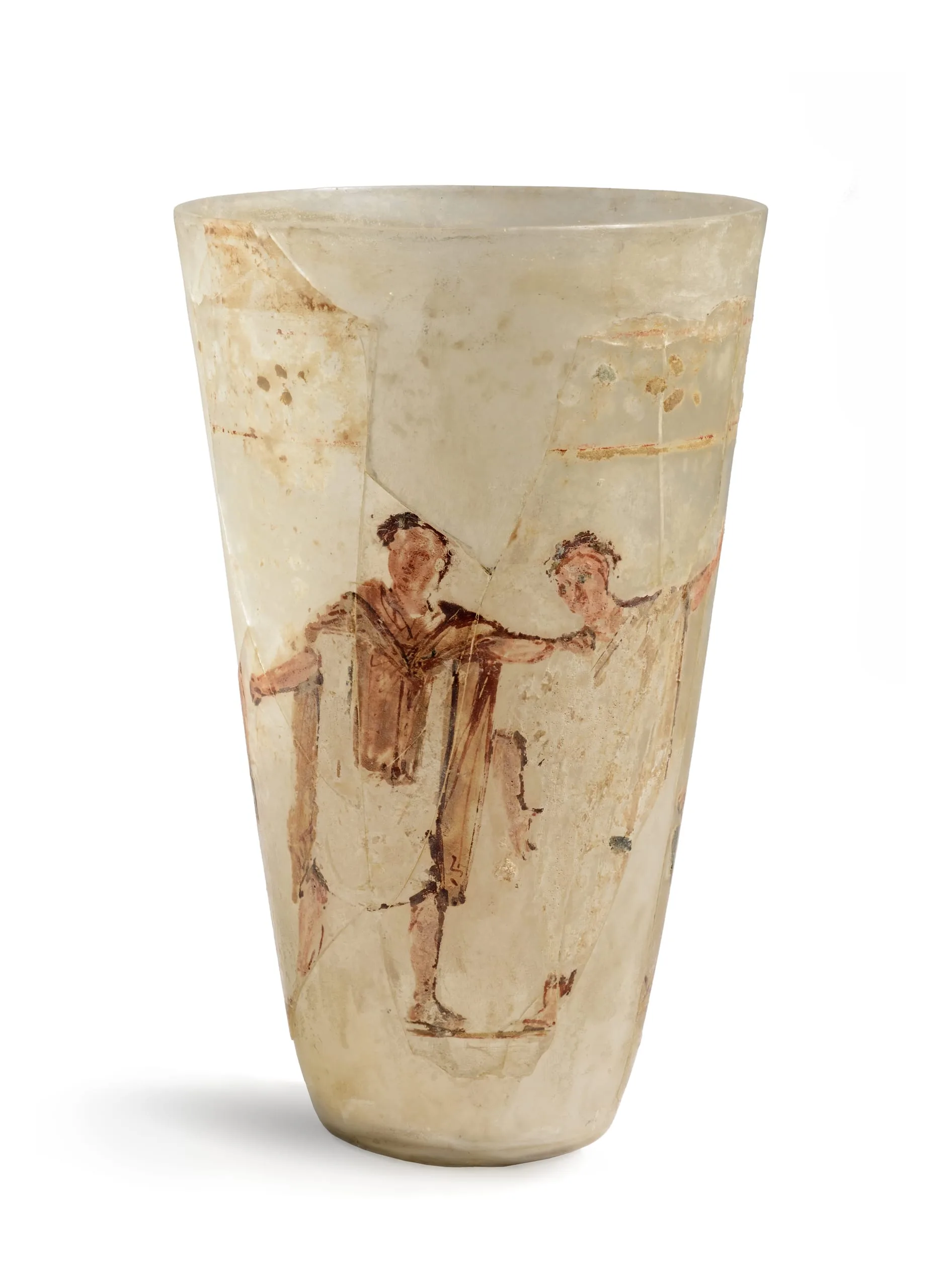
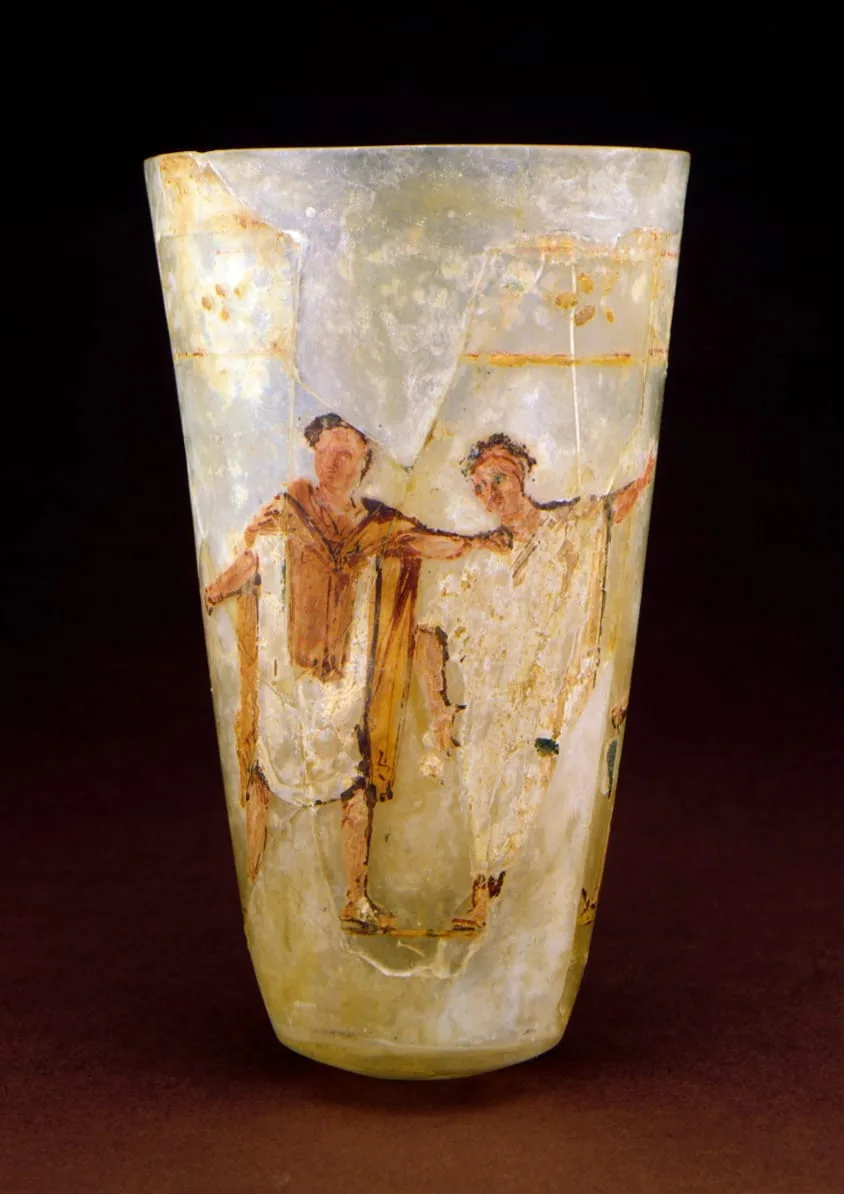
Beaker with a Theatrical Scene50-100

Not on view
Tall alabaster beaker with tapered form, painted with two draped figures in rust-brown pigment reaching toward each other, with visible crack repairs across the surface
Ancient glass beaker with translucent pale green body, decorated with painted figural scene showing two standing figures in Roman-style draped garments rendered in ochre and brown, with traces of gold detail; surface shows iridescent weathering and minor chips.
Maker
Unknown
Title
Beaker with a Theatrical Scene
Place Made
Roman Empire, probably from Syria, Palestine, or Egypt
Date Made
50-100
Medium
Free-blown, painted, and gilt glass
Dimensions
Diameter: 3 1/2 in. (8.89 cm) Height: 5 5/8 in. (14.29 cm)
Credit Line
Gift of Hans Cohn
Accession Number
M.87.113
Classification
Furnishings
Collecting Area
European Painting and Sculpture: Greek and Roman
Curatorial Notes
The technique of glass-blowing was developed in the late first century B.C., and radically transformed the glass industry, making production quicker and easier, and glassware more readily available. Glassworkers employed numerous techniques to decorate their vessels - tooling whilst they were hot, engraving or carving when cold. Rarely preserved are examples of painted glass. This beaker is therefore particularly valuable, and was doubtless a luxury vessel – the rim preserves traces of gilding - made for a cultured and high-class elite. It would be remarkable for its good state of preservation alone, but the enigmatic scene and fragmentary inscription render it the most fascinating vessel within LACMA’s significant collection of ancient glass.
At the center of the scene are a youth and a woman, both wearing heavy cloaks. The woman seems to sway and her companion supports her; given that they both wear wreaths, we may interpret them as symposiasts. They look towards a closed door, and are flanked by a grown-up and a boy. Both hold what might be lanterns, and so the scene looks like a night-time incident after a symposium. Much depends on the reading of the Greek inscription that fills the spaces between the figures, now partially lost or damaged. It should refer to the action or the dialogue of the characters, but even though some hundred letters have been read with certainty, nothing that has been discerned finds parallels in known textual sources. The door is a staple prop in the comic plots of plays of Terence, often adapted from Greek comedies such as those by Menander, and it is tempting to see this as a climactic moment in a now-unknown comedy. Another interpretation retains the idea of theatrical inspiration, but based on a restoration of the inscription, takes the scene to depict an encounter at a brothel. The grown male beside the door would be the protagonist, frustrated at the high price of courtesans, and the man in the center, the brothel-keeper, offering him a different woman.
David Saunders, Ancient Greek & Roman Art, 2008
Selected Bibliography
  • Los Angeles County Museum of Art. New York: Thames and Hudson, 2003.
  • Saldern, Axel von. Glass 500 B.C. to A.D. 1900: The Hans Cohn Collection. Mainz: Philipp von Zabern, 1980.
  • Thomas, Nancy, and Constantina Oldknow, eds. By Judgment of the Eye: The Varya and Hans Cohn Collection. Los Angeles: Hans Cohn, 1991.
  • Price, Lorna. Masterpieces from the Los Angeles County Museum of Art. Los Angeles: Los Angeles County Museum of Art, 1988.
  • Beckett, Sister Wendy. Sister Wendy's American Collection, Toby Eady Associates, ed. Harper Collins Publishers, 2000.