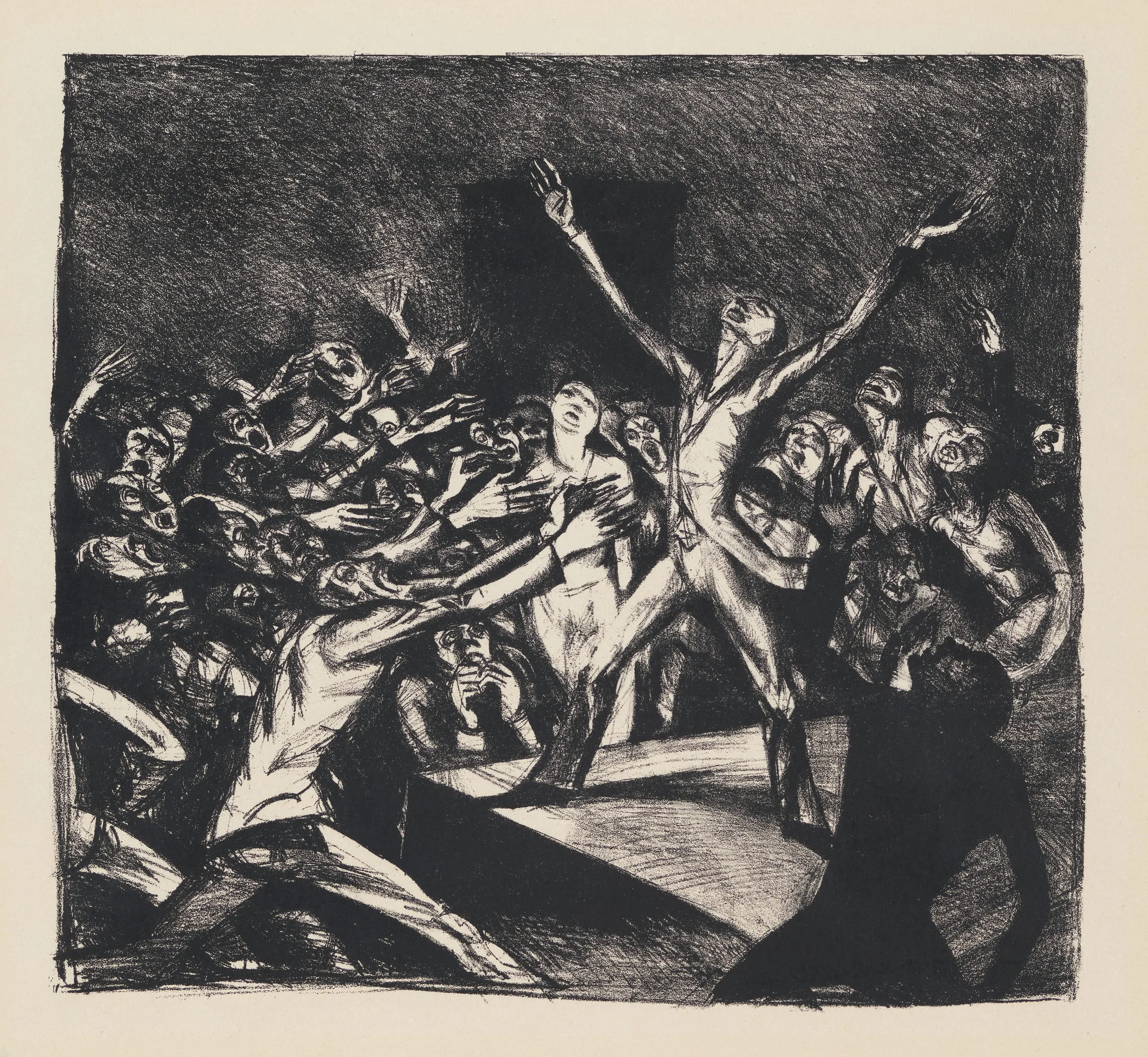
Magnus Zeller experienced professional success prior to World War I as a member of the Berlin Secession and the Verein Berliner Künstler (Union of Berlin Artists). Radicalized by his experiences as a soldier on the Eastern Front, Zeller became a member of Berlin’s Soldiers’ Council (modeled on workers’ councils in the Soviet Union) during the German Revolution. He disengaged soon after, however, disillusioned by the political process undermining the revolution. The Orator (Der Volkredner), part of Zeller’s seven-sheet portfolio Time of Revolution (Revolutionszeit), reflects his pessimism in the revolution’s aftermath.
The prints in this series are a cross-section of revolutionary characters and conduct, both idealistic and opportunistic. Their subjects include demonstrators and victims of counterrevolutionary violence, as well as thieves, gamblers, and drunken revelers. In The Orator, the first sheet in the portfolio, Zeller portrays the religious dimension of modern politics, which incites ecstatic devotion in its followers. The German title more directly translates to “people’s speaker,” suggesting the subjectʼs populist appeal. Here, the charismatic figure may have been inspired by the rhetorical style of Spartacist leader Karl Liebknecht, whom Zeller saw speak in Berlin before the politician’s murder in January 1919. (See 86.4 for the artist’s oil on canvas of the same subject.)
Zeller’s art was branded entartet, or “degenerate,” during the Nazi period. State authorities prevented him from purchasing art materials, and opportunities to exhibit his work were severely curtailed. In resistance, he privately created art that was critical of the Nazi regime.
Erin Sullivan Maynes
2022 (adapted from Pressing Politics: Revolutionary Graphics from Mexico and Germany, 46)