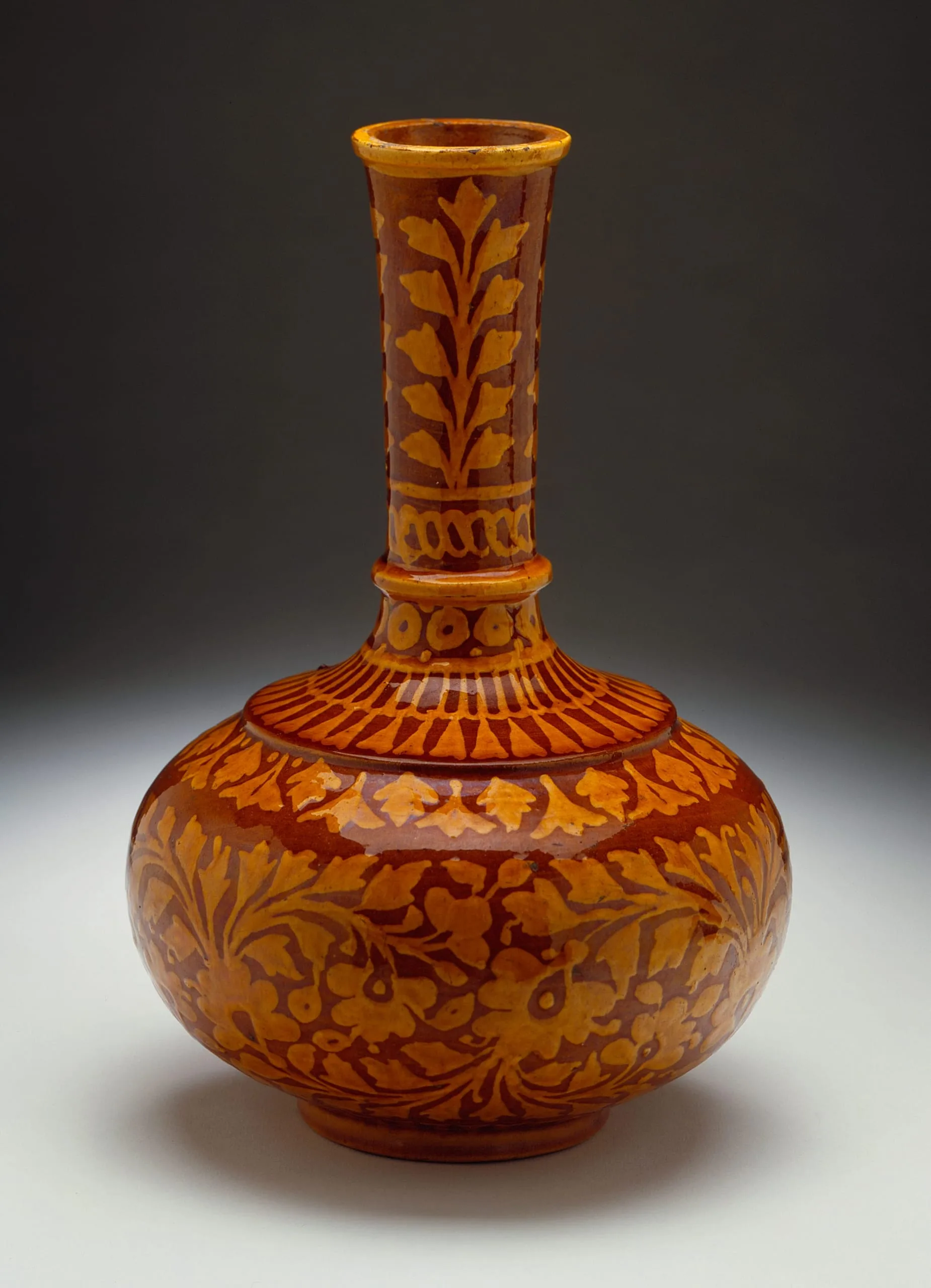
This traditionally shaped surahi (water or wine vessel) features a compressed spherical body supported by a circular foot. It has a slightly stepped shoulder and a tall, slightly flaring neck with a low collar. Glazes in two colors are used: burnt orange for the background, and ochre for the vessel's floral decoration. A meandering flowering plant encircles the body. An alternating series of two pendant leaf forms runs beneath the stepped shoulder, which is embellished with bands of petals, leaves, and open blossoms. The neck above the collar is graced with an interlinking vine and floral sprays.
The surahi (Urdu, from Arabic surah: clear) was originally an Islamic long-necked flask for serving both water and wine. It was used ubiquitously across northern India, the Deccan, and present-day Pakistan. Images of surahis and other important vessels were also represented in architectural niches as painted wall decoration. Surahis were made in various media, including gold, silver, bronze, brass, bidri-ware, jade, glass, and ceramic. This vessel is attributed to Hala, Sindh based on its stylistic similarities with Hala ceramics in the collection of the Indian Museum, Kolkata.