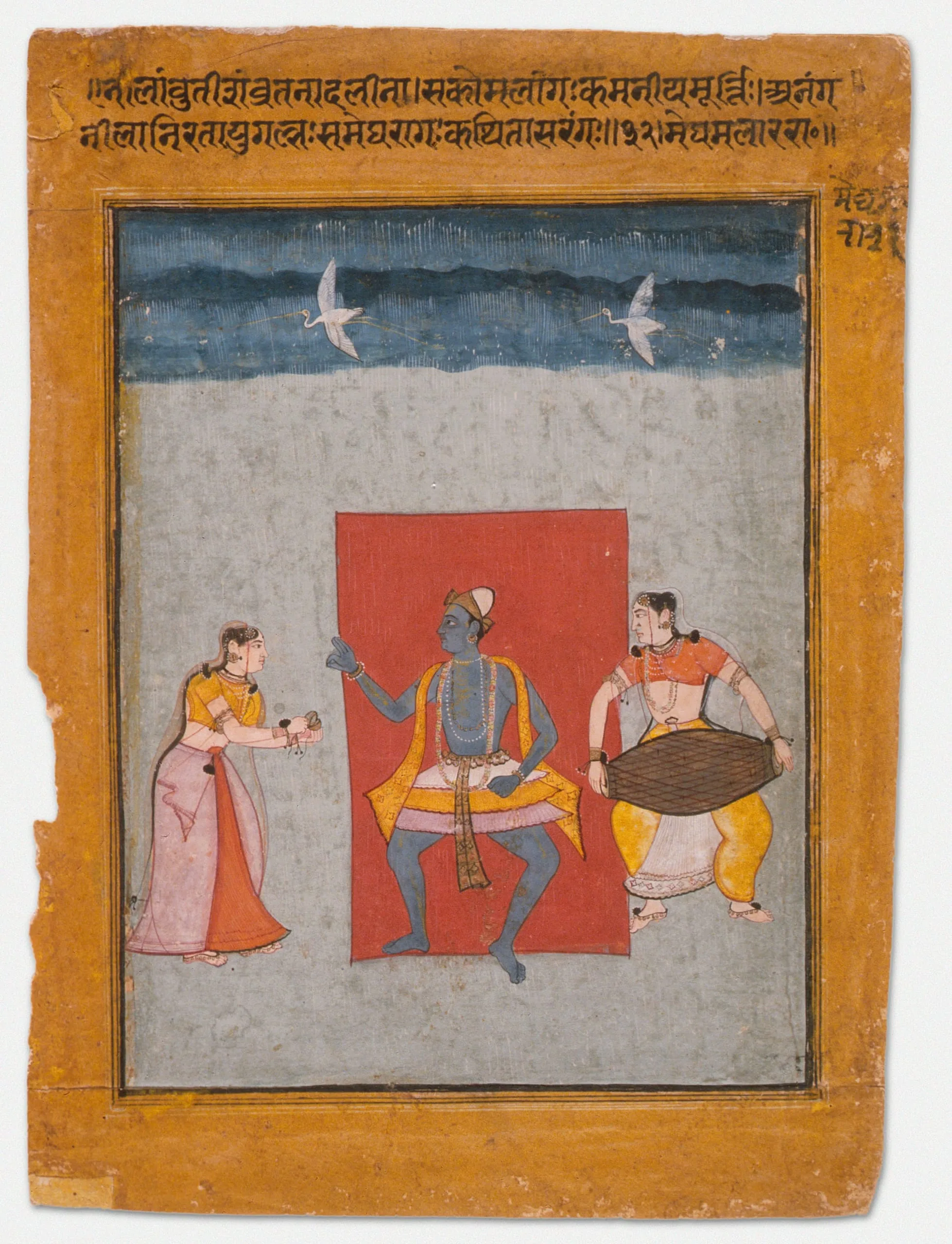
The poetic Sanskrit inscription in the upper border reads, “Of blue splendor, attached to the roar of the raincloud; of tender body and lovely form, proud, and playful be – the god of love – is said to be Megha Mallar Raga.” (Translation from Klaus Ebeling, Ragamala Painting (1973), p. 126.) The verses are from the Sangita Ratnakara (Ocean of Music and Dance), a treatise on music and drama composed by Sharngadeva (or Sarngadeva, 1175–1247) in the 13th century.
Megha Mallar Raga is the fifth raga in the predominant ragamala (garland of melodies) classification system generally known as the Rajasthani system. It is a joyful melody associated with nighttime and the monsoon rains in July–August. Here, the blue-skinned hero (sometimes represented as Krishna) is dancing in the rain accompanied by two female musicians, one playing a pair of hand cymbals and the other a drum (mridangam). See also M.71.1.24.
Previously attributed to Popular Mughal (Pal 1993), this painting and its series mate M.74.5.14 are now believed to be from Bikaner, Rajasthan. Other folios from this dispersed series are in the Metropolitan Museum of Art, New York (1981.460.3, 1981.464.1, 1987.417.2), and Museum für Asiatische Kunst, Berlin.