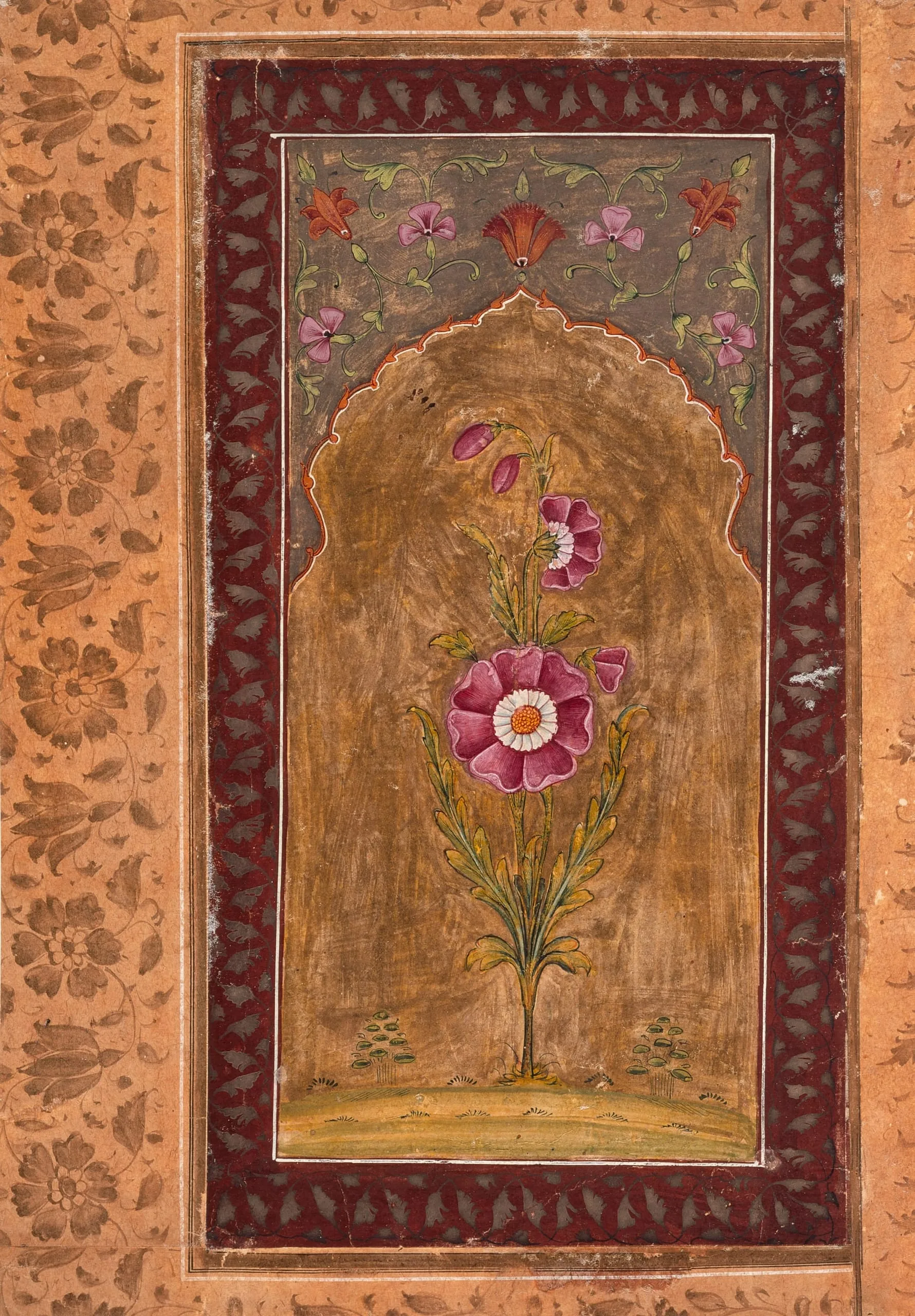
Floral imagery is found in some of the earliest Mughal art and architecture, such as the exuberant flowering plants sculpted on the interior panels of the so-called House of the Turkish Sultana beside the Anup Talao tank at Fatehpur Sikri near Agra, which was built by the Mughal Emperor Akbar (r.1556-1605) in 1571-1585. During the reign of Emperor Jahangir (r. 1605-1627), the motif of naturalistic flowers formally arranged against a plain background first appeared in textiles and painting. The specific stylistic stimuli for Jahangir's flowers were twofold. First, the exposure of Jahangir and Mughal artists to the engravings and painted borders in northern European herbal books and religious manuscripts brought to India by early Western visitors to the Mughal court. Second, Jahangir’s awe-inspiring springtime visit to the lush, flower-filled valleys of Kashmir in March of 1620. By the early reign of Emperor Shah Jahan (r. 1628-1658), as epitomized on the Taj Mahal (1632-1643), the formalized flowering plant had become the Mughal dynastic leitmotif.
In the Deccan, however, more complex or imaginary flowers were popular, such as this image of what may be a stylized opium poppy (Papaver somniferum). Set against a gold background under a lobed arch or mihrab (prayer niche), it has a large central open blossom, two flowers shown in profile, two flower buds, and elongated leaves with broadly serrated edges. In the spandrels are flowering vines with irises, poppies, and a dianthus.