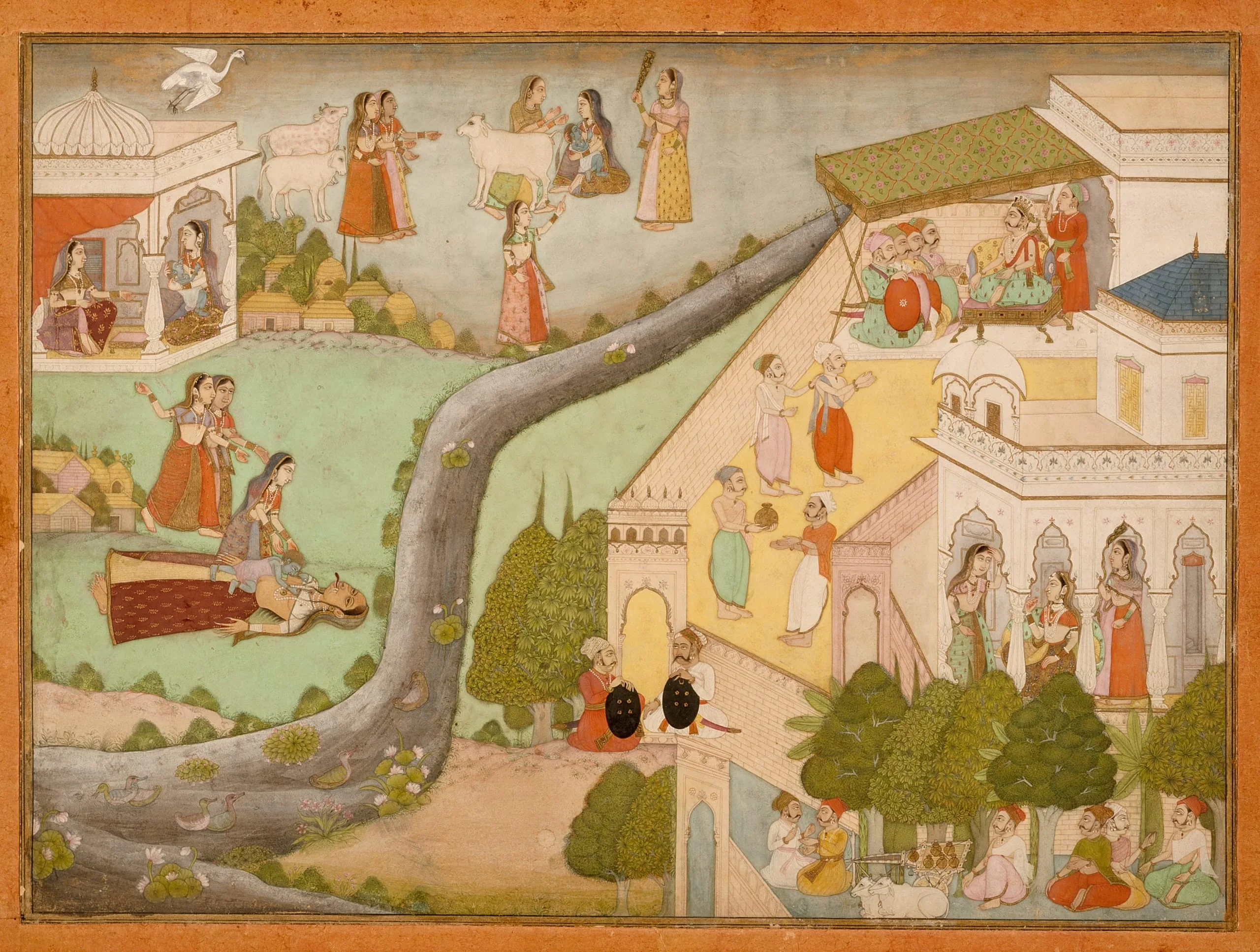
The Bhagavata Purana (Ancient Stories of the Lord) is traditionally ascribed to the legendary poet-sage Vyasa in the 8th-10th century CE. It stresses the path of devotion (bhakti) to Krishna, the eighth incarnation of Vishnu, the Hindu God of Preservation. To fulfill his role as the guardian of the world and savior of humanity, Vishnu appears as a succession of heroic animals and semi-mortal saviors, called avatars, through which he intervenes in times of unrighteousness.
A Marwari inscription on the reverse describes the subject: Nanda, the foster-father of Krishna, had gone to Mathura to his taxes to the evil King Kamsa. There, Vasudeva, Nanda’s brother and Krishna’s biological father, advises him to return home to Vrindavan because the ogress Putana had been sent by Kamsa to kill the infant Krishna. Putana had assumed the form of a beautiful nursemaid and attempted to suckle Krishna with poisoned nipples. Knowing her insidious intent, Krishna sucked out both the poison and her life. Putana reverted to her gigantic demonic form and fell dead to the ground (Bhagavata Purana 10:5-6). Here, Putana is shown thrice in continuous narration.
This illustration is from a large and widely dispersed series that was once part of the Bikaner Royal Collection. Additional folios are in the Fralin Museum of Art, Charlottesville (1997.15), Metropolitan Museum of Art, New York (1974.219 and 2005.361), National Museum of Asian Art, Washington (S2018.1.46), and San Diego Museum of Art (1990.785).