- Title
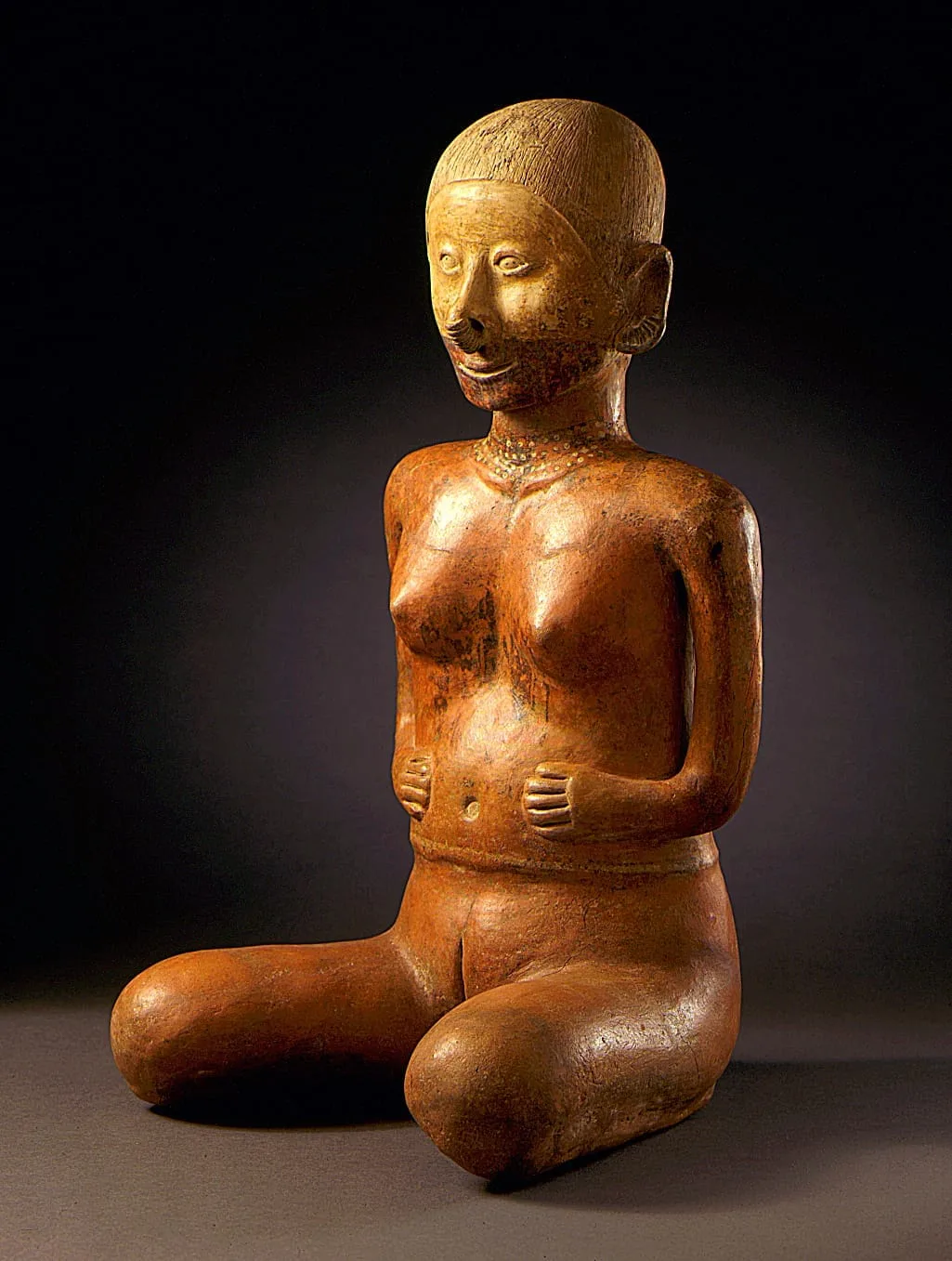
- Kneeling Woman
- Date Made
- 200 BCE–400 CE
- Medium
- Slip-painted earthenware
- Dimensions
- 24 x 15 x 12 in. (60.96 x 38.1 x 30.48 cm)
- Accession Number
- M.86.296.1
- Curatorial Notes
Ceramic sculptures like this graceful kneeling female figure, which seems imbued with spiritual significance, played a central role in Nayarit funerary rituals and possibly other ceremonies. While their exact purpose is lost to us, each figure was carefully and individually crafted to embody specific qualities and symbolism, reflecting particular beliefs and aspirations of the Nayarit people. Here, the jewelry and face paint allude to her social and perhaps ceremonial status; rows and rows of rings adorn her nose and ears, and around her neck is a delicate multistrand necklace. Traces of paint on her body remind us that many of these figures were once decorated with elaborate colors and patterns. With her hands placed on her slightly bulging abdomen and her genitalia exposed, there is a strong assertion of femininity and fertility in her posture. In Nayarit art, separate gender roles appear to be clearly defined; however, we must be careful not to make assumptions based on our own experience with gender structures. Nayarit individuals—male and female—occupied a range of social and spiritual roles beyond simple binaries.
Julia Burtenshaw
2024
- Selected Bibliography
- Kan, Michael, Meighan, Clement, Nicholson, H.B. and Rexford Stead. Sculpture of Ancient West Mexico: Nayarit, Jalisco, Colima. Los Angeles: Los Angeles County Museum of Art, 1970.
- Los Angeles County Museum of Art. New York: Thames and Hudson, 2003.
- Mexico en el Mundo de las Colecciones de Arte: Mesoamerica. Vol.2. Mexico: Secretaría de Relaciones Exteriores, 1994.