- Title
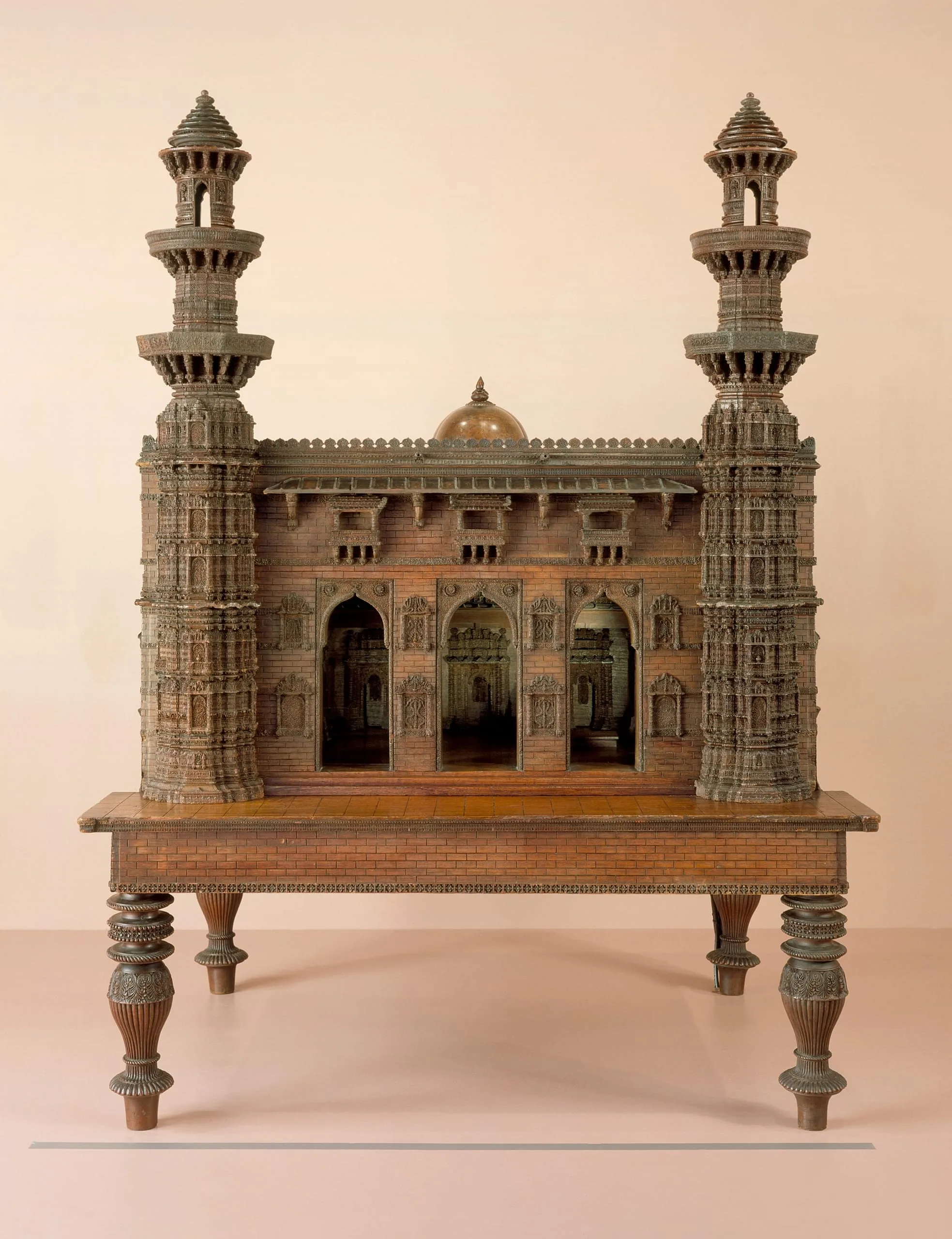
- Model of Muhafiz Khan's Mosque (Ahmedabad, 1492)
- Date Made
- dated 1838
- Medium
- Wood
- Dimensions
- 57 1/4 × 42 3/4 × 33 1/8 in. (145.42 × 108.59 × 84.14 cm)
- Accession Number
- M.86.260a-ff
- Curatorial Notes
This is a scale model of the Mosque of Muhafiz Khan built in Ahmedabad in 1492. Muhafiz Khan was the court title of the high noble Jamalu’din Silahdar, the Chief Magistrate of Ahmedabad. According to its reported original documentation (now missing), the model was built in 1838 for a British officer in the East India Company. During the 19th century there was an extensive tradition of portraying the monuments and rulers of Mughal India in both painting and models, which were taken home by European visitors as mementos of their sojourn in India. The carving of this model is especially well executed and, apart from the addition of the flanking windows on the facade, is a faithful representation of the original, still extant edifice.
A mosque is the Muslim place of public prayer. Mosques are architecturally arranged so that one wall, the qibla, is oriented in the direction of the holy Ka’bah in the sacred city of Mecca in Saudi Arabia. In this model the qibla wall is directly opposite the entrance and is indicated by an inset arch called a mihrab. Smaller arches mark the qibla directions at the end of each of the subsidiary aisles. Alongside the mihrab is a pulpit (mimbar) from which the Friday sermon is delivered on the Muslim’s day of rest and worship. The two towers (minarets) on the exterior front corners are used to call the faithful to prayer five times a day by the mosque’s Islamic religious leader (imam) or official summoner (mu’azzin).