LACMA

ShopMembershipMyLACMATickets
LACMA
Los Angeles County Museum of Art
5905 Wilshire Blvd.
Los Angeles, CA 90036
info@lacma.org
(323) 857-6000
Sign up to receive emails
Subscribe
© Museum Associates 2025

Museum Hours

Monday

11 am–6 pm

Tuesday

11 am–6 pm

Wednesday

Closed

Thursday

11 am–6 pm

Friday

11 am–8 pm

Saturday

10 am–7 pm

Sunday

10 am–7 pm


  • About LACMA
  • Jobs
  • Building LACMA
  • Host An Event
  • Unframed
  • Press
  • FAQs
  • Log in to MyLACMA
  • Privacy Policy
© Museum Associates 2025
Collections

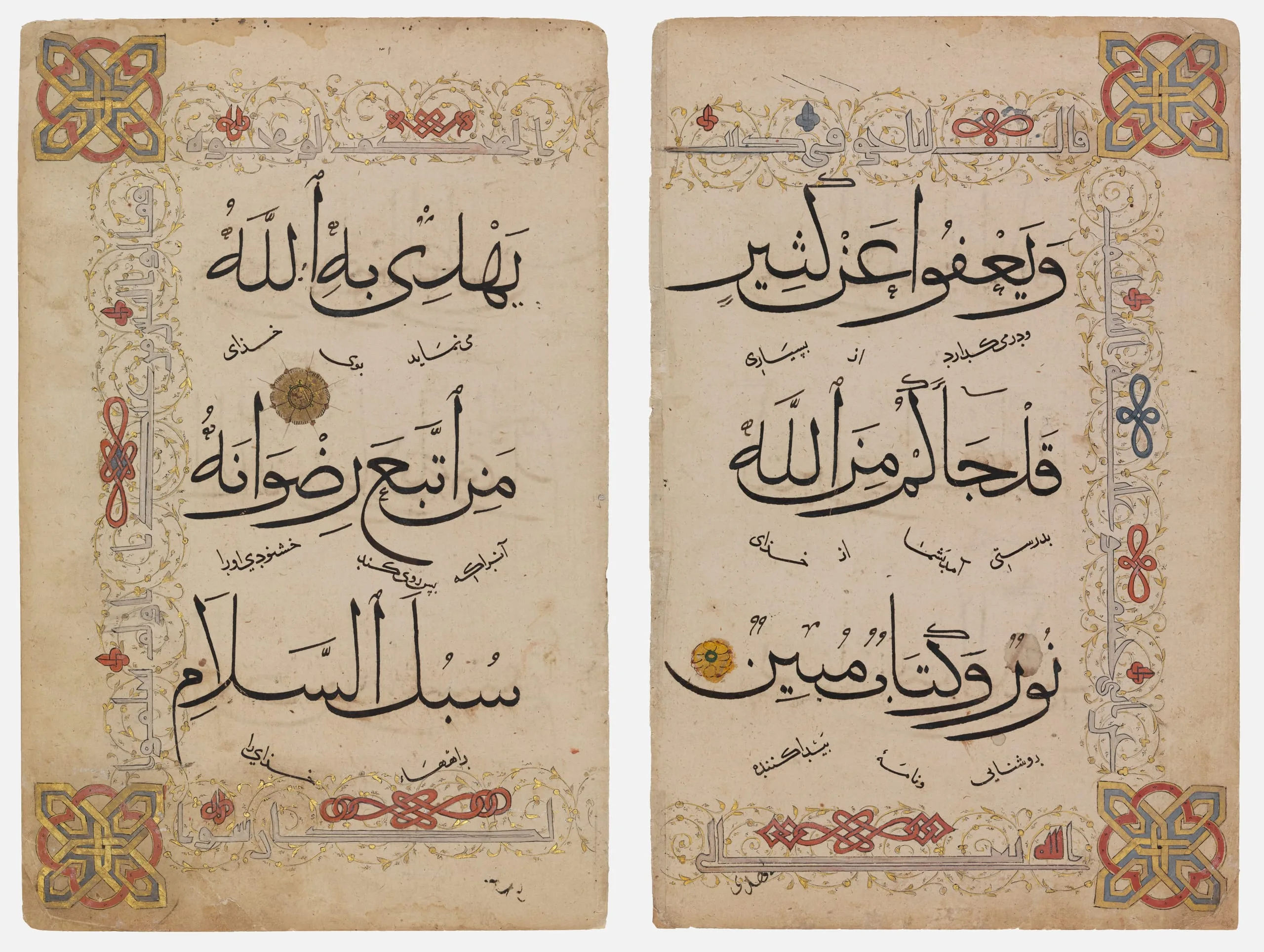
Facing Pages from a Manuscript of the Qur'an (5:15; 5:16)circa 1300

Not on view
Two illuminated Quran manuscript pages with large bold Arabic calligraphy in black ink, interlinear script, gold vine-scroll borders, and geometric corner medallions in red, blue, and gold
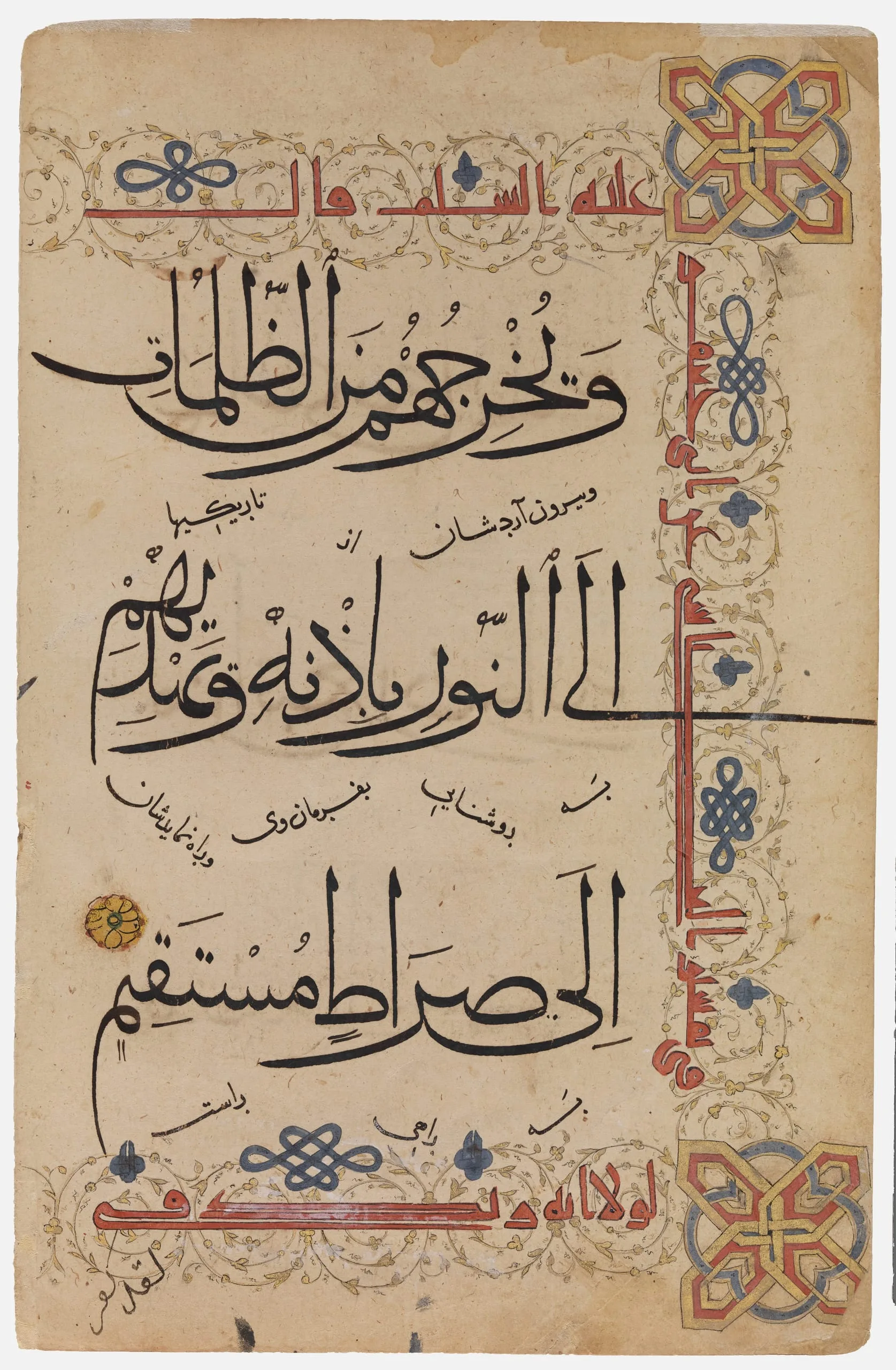
Manuscript page with large Arabic calligraphy in black ink, interlined with smaller red and black script. Decorated borders feature interlaced geometric knot-work medallions in red, blue, and gold at corners and margins, with delicate vine-scroll ornament on aged cream paper.
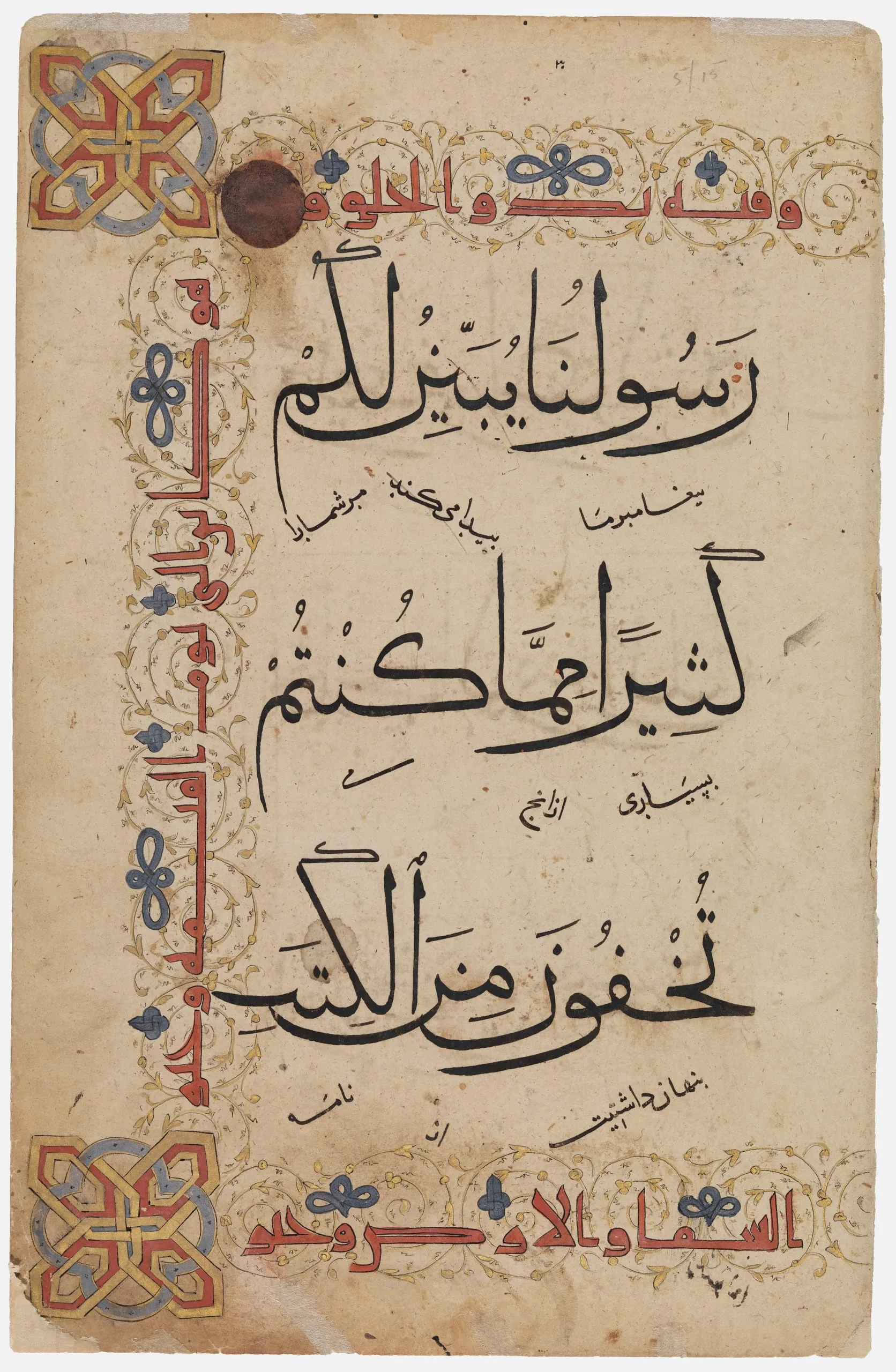
Illuminated manuscript page with large Arabic calligraphy in black naskh script, three main lines of text with smaller interlinear annotations. Decorative border on the left with interlaced geometric medallions in red, blue, and gold on a cream ground, with floral vine ornaments. Red and gold header and footer bands with additional Arabic text.
Title
Facing Pages from a Manuscript of the Qur'an (5:15; 5:16)
Place Made
Anatolia or Central Asia
Date Made
circa 1300
Medium
Ink, opaque watercolor, and gold on paper
Dimensions
unspecified (M.86.186.1): 11 3/8 × 7 3/8 in. (28.89 × 18.73 cm) unspecified (M.86.186.2): 11 3/8 × 7 3/8 in. (28.89 × 18.73 cm)
Credit Line
Christian Humann Asian Art Fund
Accession Number
M.86.186.1-.2
Classification
Manuscripts
Collecting Area
Art of the Middle East: Islamic
Curatorial Notes

These pages belong to a now dispersed thirty-volume manuscript of the Qur’an of uncertain provenance. They are written in a highly idiosyncratic manner, combining elements of both the thuluth and muhaqqaq scripts, which for some scholars suggests a provincial center in Anatolia or possibly Central Asia. The fact that these and related pages bear an interlinear rendition in Persian does not, however, enhance an attribution to Anatolia. These folios are also distinguished by their colorful knot-like illuminations in the corners and golden scrolling leaf design overlaid with Kufic text, which frames the pages.

Selected Bibliography
  • Komaroff, Linda. Beauty and Identity: Islamic Art from the Los Angeles County Museum of Art. Los Angeles: Los Angeles County Museum of Art, 2016.