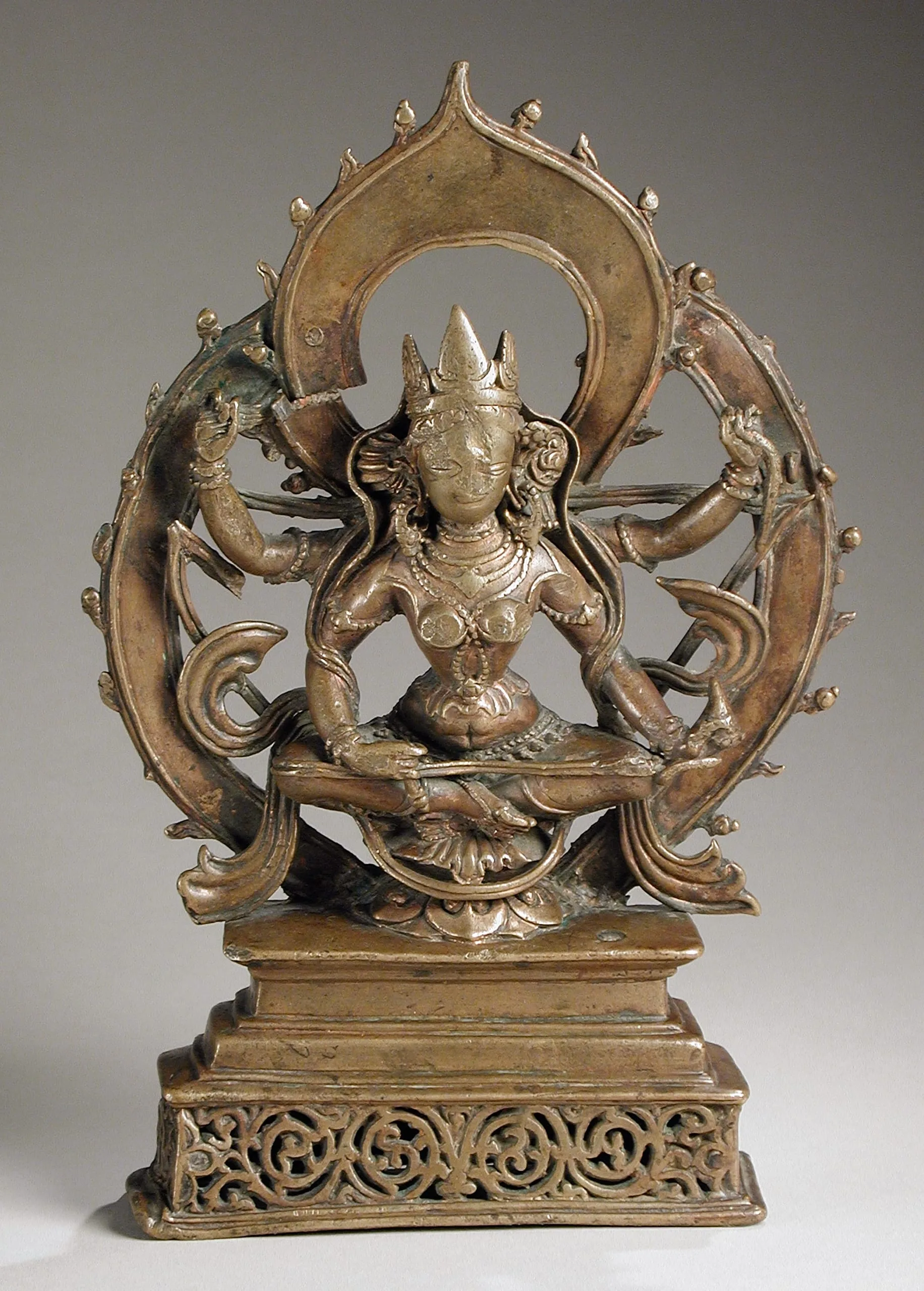
The Buddhist meditational deity Kurukulla (Family of Kuru [the North Continent]) is a semi-peaceful wrathful red Dakini (mystical female "sky-goer") who embodies the subjugation and control of all passions, both internal and external. She is also regarded as an Ishta Devata (cherished divinity), one’s personal chosen deity in Buddhism and Hinduism. Kurukulla is believed to restrain sensual desires and transform egocentric hindrances into energizing insight. She is believed to attract and magnetize wisdom, health, and wealth.
Kurukulla has various iconographic forms that vary in skin-color, posture, number of arms, and attributes. She is often depicted as dancing but can also be seated as in this representation. Here, she sits on a lotus base with her ankles crossed in the adamantine posture (vajra paryanka asana). She has four arms holding all now-partial attributes. Her upper two arms carry a bow (proper left) and arrows of flowers (proper right). Her lower left hand holds a red utpala lotus, while her lower right hand holds a goad. She wears a Kashmiri-style three-lobed crown and cruciform over her navel, a tailored blouse, yogic band around her knees (yogapatta), and copious jewelry. Her unusual ear ornaments are a foliate gander (proper left) and a ribbed Indian gooseberry (amalaka; proper right). Behind the goddess is a downward-pointing triangular diagram (yantra) representing feminine energy (shakti). Kurukulla is graced with a nimbus and flaming aureola (prabhavali). Her throne base is decorated with an atypical open-work band of scrolling lotuses
This representation of Kurukulla was previously attributed stylistically to Jammu and Kashmir, Kashmir region or Western Himalayas, circa 1000 (Pal 1988, p. 83, no. 25). It was reattributed on technical grounds to Himachal Pradesh, 11th century (Reedy 1997, pp. 178-179, no. H109). See also Himalayan Buddhist Art, https://himalayanbuddhistart.wordpress.com/2012/12/12/himachal-pradesh-kurukulla/