LACMA

ShopMembershipMyLACMATickets
LACMA
Los Angeles County Museum of Art
5905 Wilshire Blvd.
Los Angeles, CA 90036
info@lacma.org
(323) 857-6000
Sign up to receive emails
Subscribe
© Museum Associates 2025

Museum Hours

Monday

11 am–6 pm

Tuesday

11 am–6 pm

Wednesday

Closed

Thursday

11 am–6 pm

Friday

11 am–8 pm

Saturday

10 am–7 pm

Sunday

10 am–7 pm


  • About LACMA
  • Jobs
  • Building LACMA
  • Host An Event
  • Unframed
  • Press
  • FAQs
  • Log in to MyLACMA
  • Privacy Policy
© Museum Associates 2025
Collections

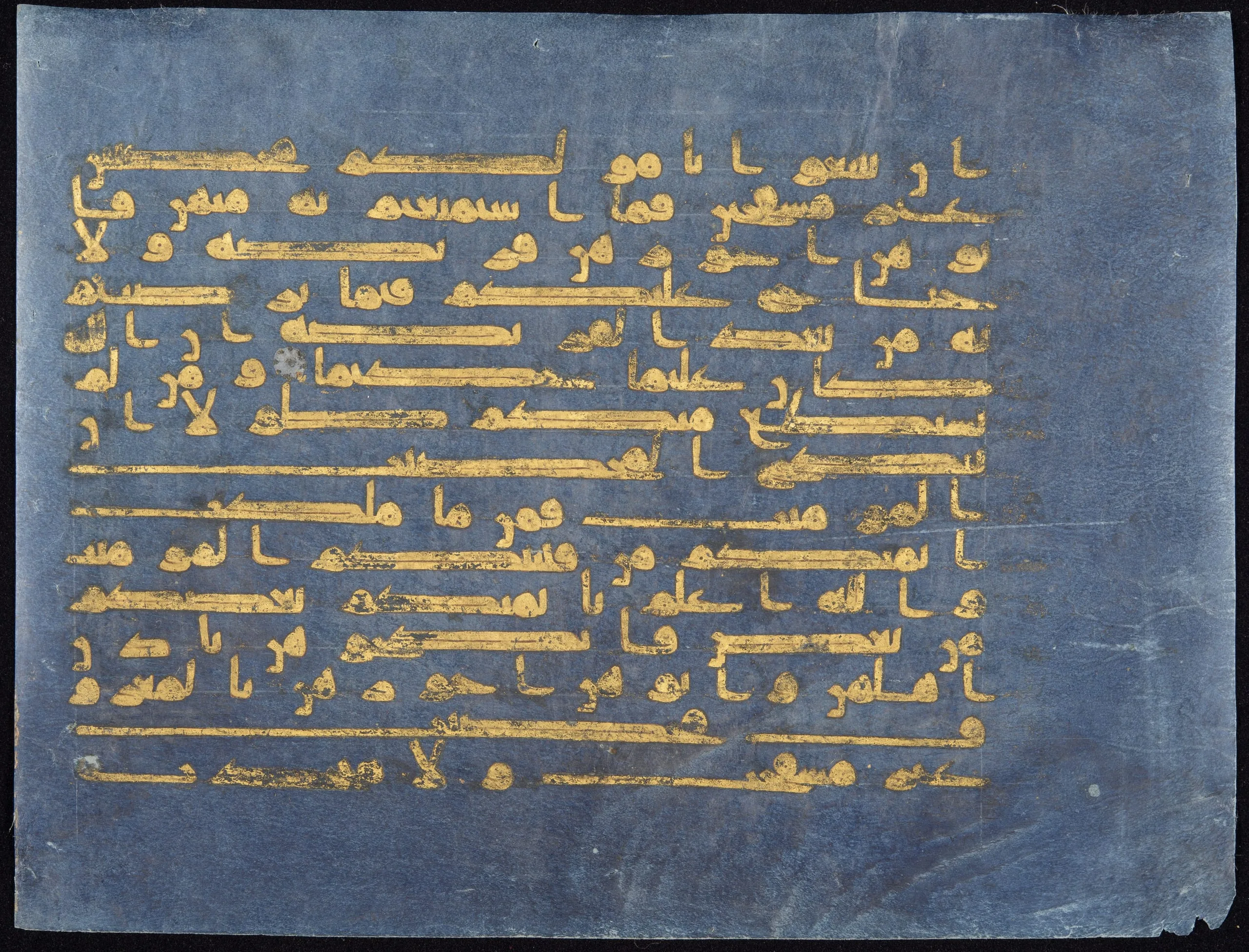
Page from a Manuscript of the Qur'an (4:23-24; 4:24-25)late 9th-early 10th century

Not on view
Horizontal manuscript folio with bold gold Kufic Arabic script on deep slate-blue parchment, fifteen lines of text with extended horizontal strokes and gold verse markers
Manuscript folio with gold Kufic Arabic calligraphy on deep blue-dyed vellum, arranged in horizontal lines across the full page, with visible wear at edges and corners.
Title
Page from a Manuscript of the Qur'an (4:23-24; 4:24-25)
Place Made
Tunisia, probably Qairawan
Date Made
late 9th-early 10th century
Period
Fatimid (909-1171)
Medium
Gold leaf, silver, and ink on parchment colored with indigo
Dimensions
Sheet: 19 3/8 × 24 in. (49.21 × 60.96 cm) Image: 11 1/4 × 14 5/8 in. (28.58 × 37.15 cm)
Credit Line
The Nasli M. Heeramaneck Collection, gift of Joan Palevsky
Accession Number
M.86.196
Classification
Manuscripts
Collecting Area
Art of the Middle East: Islamic
Curatorial Notes


With its distinctive blue color and use of gold and silver ink for the script, this page can be readily identified as part of a manuscript known as the Blue Qur’an, which is dispersed among several collections in North America, Europe, and the Middle East but survives primarily in Tunisia, where it was probably made. While this Qur’an is unique among Islamic manuscripts due to its coloration, it shares similarities with Byzantine bibles and imperial edits that used purple parchment with metallic inks. Silver rosettes (now tarnished) separate each verse, which once added further luminosity to contrast the deep blue of the page. The scribe took care to elongate several letters in each verse, effectively justifying the margins of the text block. As with many early Qur’ans, the Kufic script here does not feature dots or diacritics. Nor would its reader have necessarily needed such markers to recognize the verses before them since many worshippers learned verses by oral transmission and memorization.
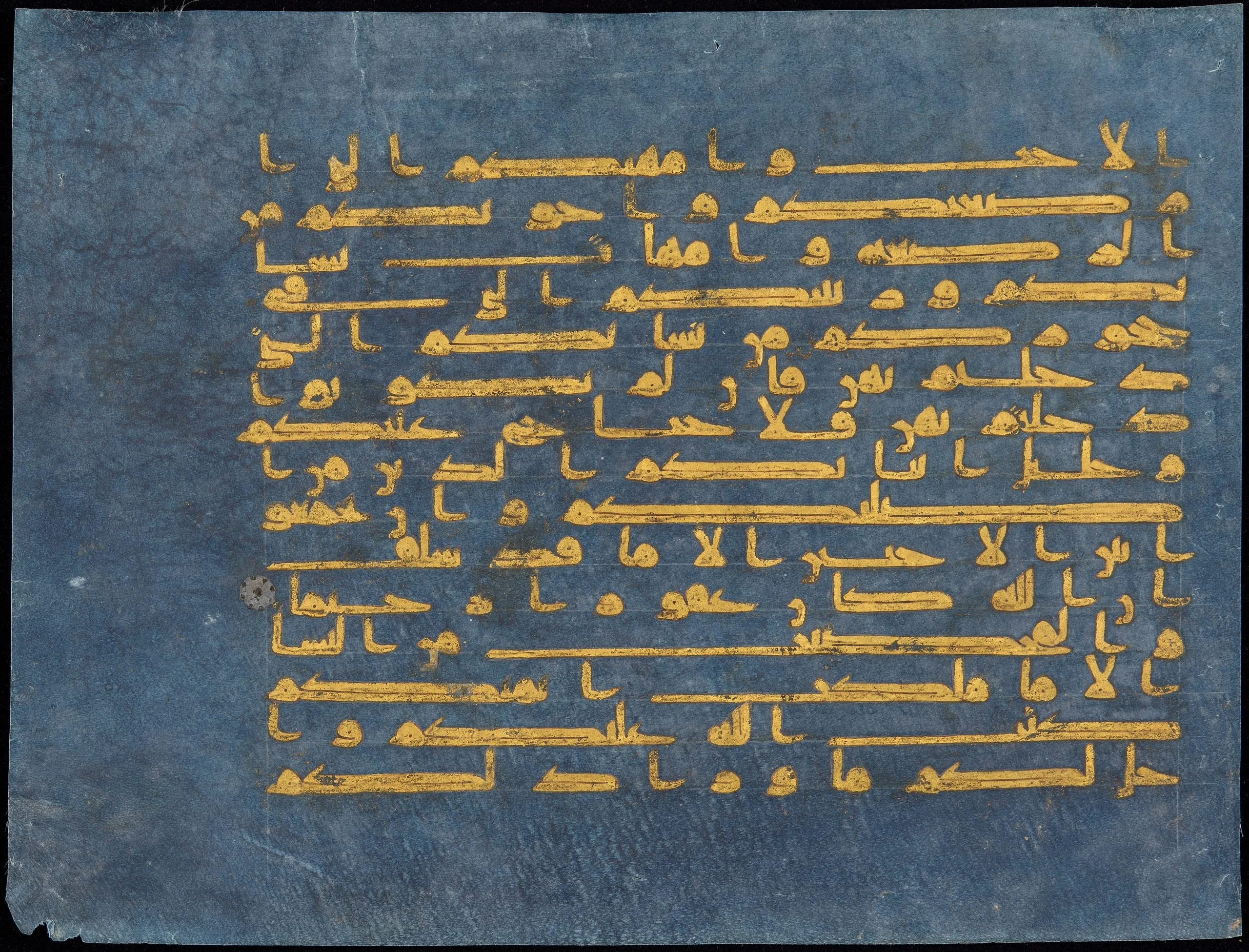

Only a small number of Qur’ans on colored vellum survive from the medieval period. This manuscript, however, also marks one of the most sumptuous Qur’ans ever produced, thanks to two exceptional features combined in its folios: continuous writing in gold (chrysography), and its remarkable blue parchment, both of which have sparked numerous debates regarding the production methods of their artists. While many scholars initially believed that the blue parchment was dyed, recent studies have achieved results similar to surviving folios with brushed indigo. As for its radiant ink, some believe that illuminators formulated the ink from powdered gold suspended in solution, as described in the eleventh-century manual on calligraphy by Muʿizz ibn Bādīs (d. 1061), then outlined the text in reddish-brown ink. However, the vast quantities of powdered gold needed, along with the opacity and current cracking of the text, have led others to posit that gold leaf was applied to letters formed with gum Arabic or another adhesive.


From its material traits, this folio once belonged to a manuscript that was originally around 650 folios in length, likely divided into seven-volumes. Numerous scholars have hypothesized the origins of this codex covering Andalusian patronage, to that of Fatimid or Abbasid caliphs, among others. Given the luxurious materials required for its production, this manuscript required no less than a royal patron, whose illustrious workshop was well-versed in the visual codes of prestige of their imperial competitors. A Qur’an matching this description also survives in the inventory records of the library at the Great Mosque of Qayrawan from 1294, though it is difficult to verify if it is the same codex.

Selected Bibliography
  • Bloom, Jonathan and Sheila Blair, eds. And Diverse Are Their Hues: Color in Islamic Art and Culture. New Haven: Yale University Press, 2011.

  • Keene, Bryan C., editor. Toward a Global Middle Ages: Encountering the World Through Illuminated Manuscripts. Los Angeles: The J. Paul Getty Museum, 2019.