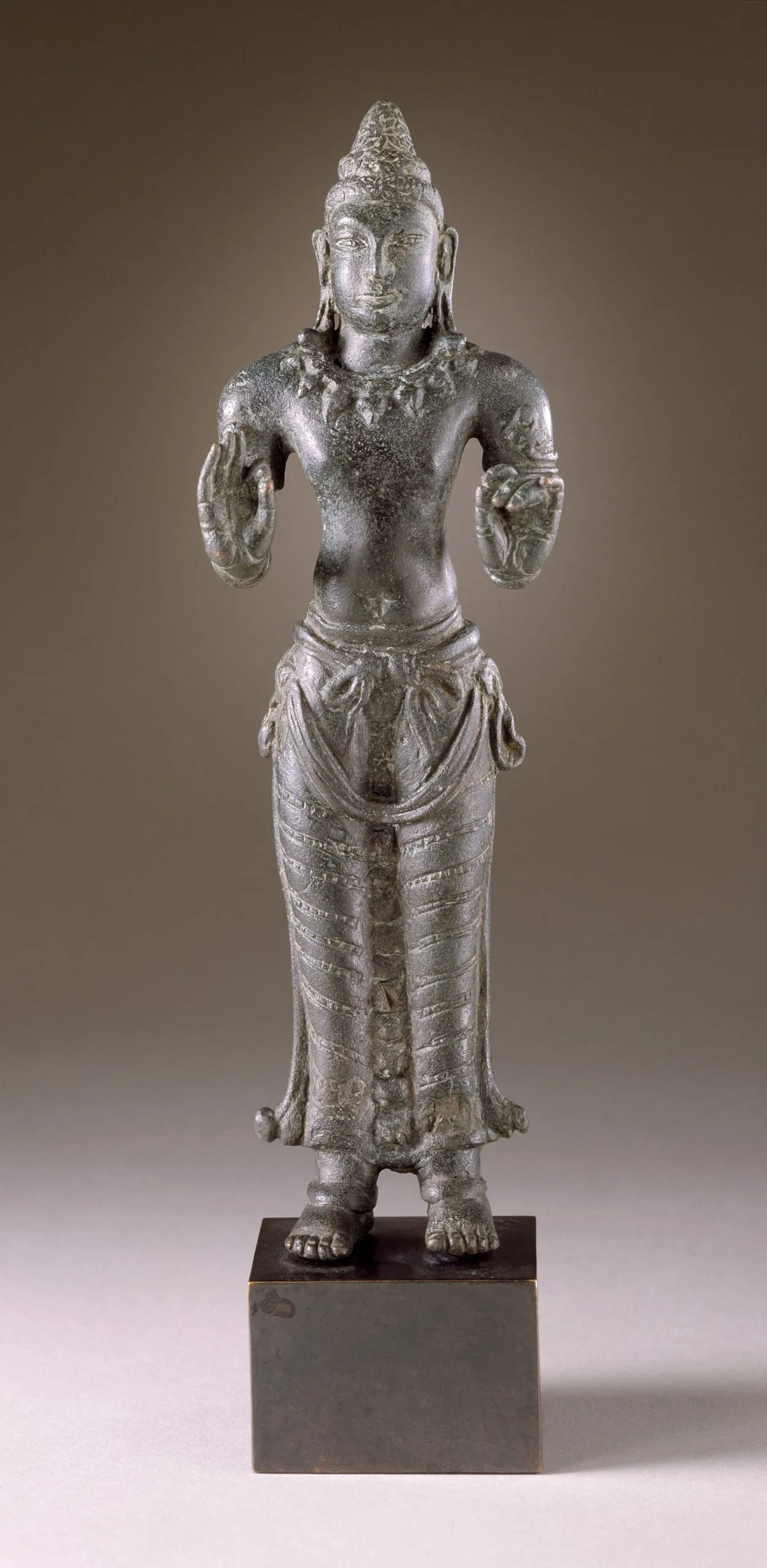
- Title
- The Bodhisattva Manjushri (?)
- Date Made
- 11th century
- Medium
- Copper alloy
- Dimensions
- 9 x 3 x 2 in. (22.8 x 7.6 x 5.1 cm)
- Accession Number
- M.86.189
- Curatorial Notes
A Bodhisattva is an enlightened being who postpones their Enlightenment and attainment of nirvana in order to help all sentient beings become enlightened. There are many bodhisattvas in Mahayana Buddhism, but only the future Buddha Maitreya and Buddha Shakyamuni before his Enlightenment are recognized as bodhisattvas in Theravada Buddhism, which became dominant in Sri Lanka in the 12th century. Thus, this representation of a bodhisattva attributed to the 11th century is among the final bodhisattva images made before the wane of Mahayana Buddhism.
This bodhisattva had been previously unidentified because of his unusual conical bun headdress and the absence of a deity-specific headdress or idiosyncratic iconographic gestures. His right hand in held in a standard gesture of teaching (vitarka mudra). His left hand is in the ring gesture (kataka mudra) used by several deities to hold various attributes. However, he may be plausibly identified as Manjushri, the Bodhisattva of Transcendent Wisdom, who often wears a distinctive tiger-claw (vyaghra nakha) necklace such as what may be depicted here. Accordingly, his left hand likely once held his separately-cast attribute of a blue lotus (nilotpala).
- Selected Bibliography
- Brown, Robert L., Tushara Bindu Gude, Donald Stadtner, and Lakshika Senarath Gamage. The Jeweled Isle: Art from Sri Lanka. Los Angeles: Los Angeles County Museum of Art, 2018.