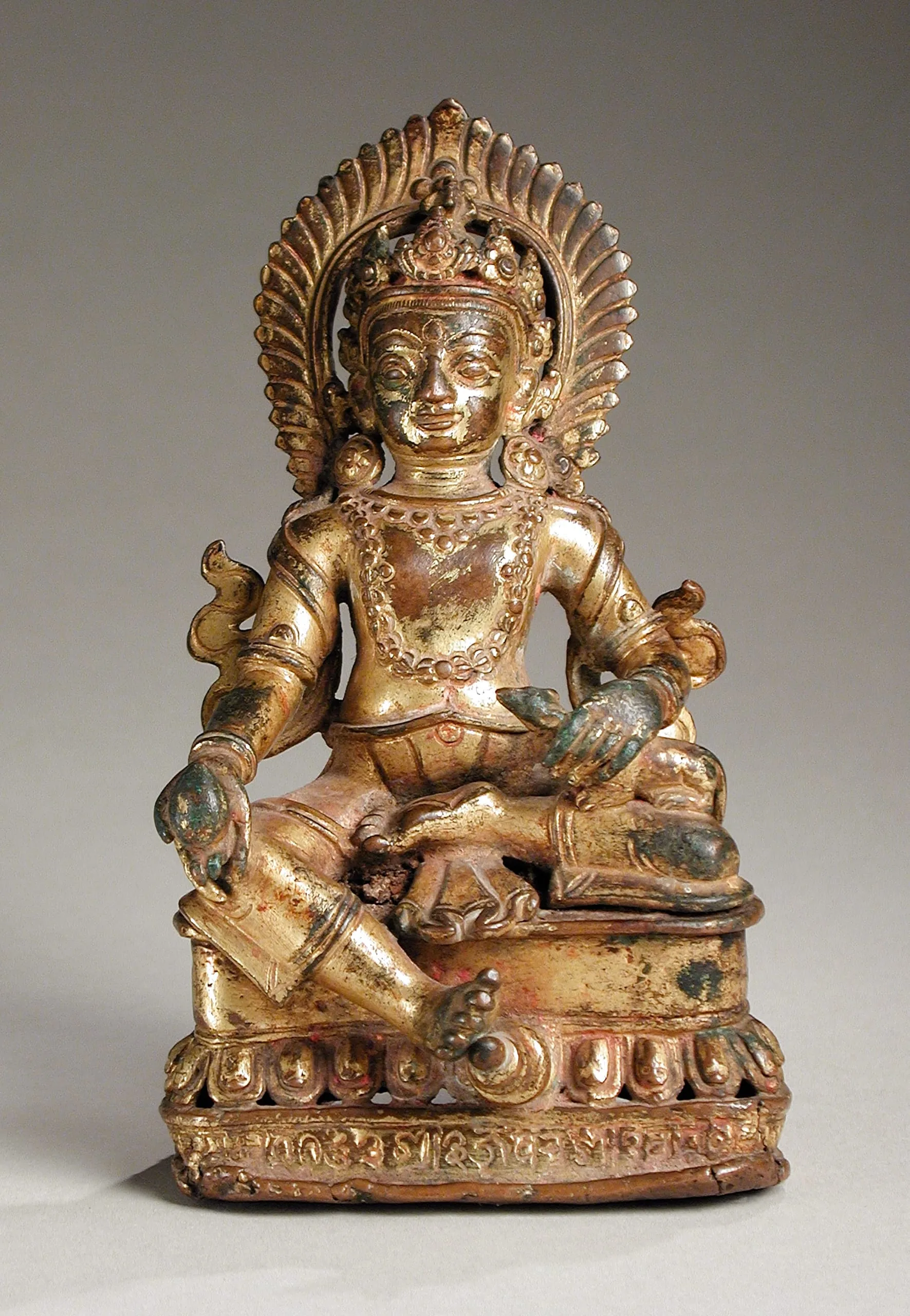
Yellow Jambhala is a Buddhist God of Wealth. According to Vajrayana Buddhist theological belief, there are five Jambhalas differentiated by color, invocation mantra, proprietary function, Buddha family, and iconography. They represent distinct aspects of enlightened prosperity and generosity, collectively forming a mandala of wealth deities. Yellow Jambhala is a frequently propitiated emanation of the Jina Buddha Ratnasambhava. He removes the obstacles of poverty by increasing virtue, wisdom, and longevity. Jambhala can be equated with Kubera, the Hindu God of Riches who is also venereated by Jains. Kubera was originally the chief of the demigods and guardians of treasures (yakshas). He is also the Regent of the Northern Direction (dikpala).
This Nepalese representation of Yellow Jambhala exhibits his characteristic iconography of being potbellied (tundila). He is crowned, nimbate, has a third eye of wisdom (jñana netra), and wears copious princely ornaments (bodhisattva abharana) and a billowing scarf. He is seated on a lotus base in a relaxed posture (lalita asana) with his right leg pendant and supported by the pericarp of a lotus flower (karnika). His right hand is held in the gesture of charity (varada mudra) carrying his attribute of a citron (jambhira). In his left hand, he holds a mythical jewel-spewing mongoose (nehulay or nakula). A Newari inscription encircles the base.
See also M.91.293.2, M.2010.78.2, M.2010.81.2.