LACMA

ShopMembershipMyLACMATickets
LACMA
Los Angeles County Museum of Art
5905 Wilshire Blvd.
Los Angeles, CA 90036
info@lacma.org
(323) 857-6000
Sign up to receive emails
Subscribe
© Museum Associates 2026
  • About LACMA
  • Jobs
  • Building LACMA
  • Host An Event
  • Unframed
  • Press
  • FAQs
  • Log in to MyLACMA
  • Privacy Policy
© Museum Associates 2026
Collections

Abraham van Beyeren
Banquet Still Life1667

Not on view
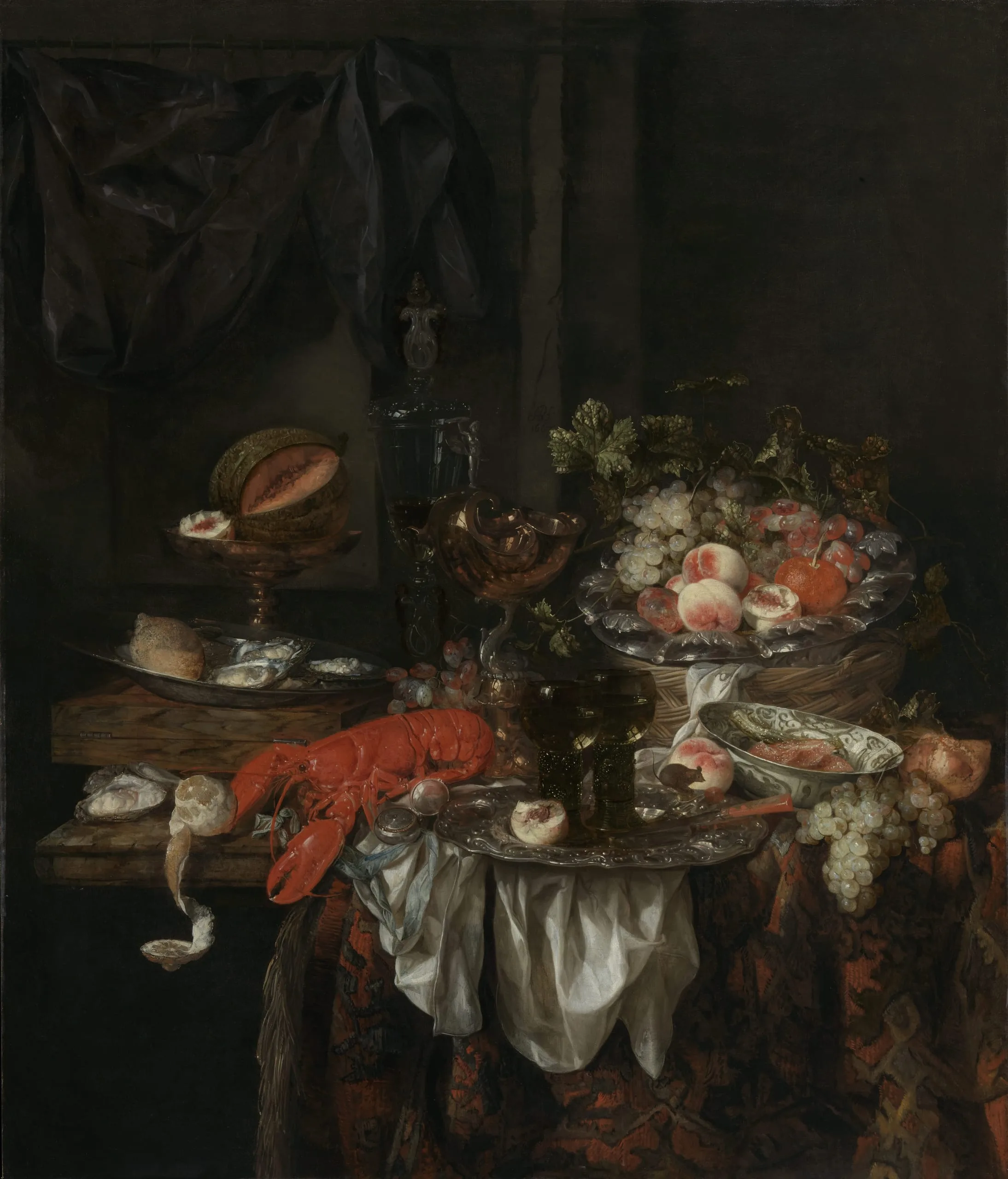
Oil painting still life with lobster, oysters, fruit, grapes, and glassware crowded on a draped table against a dark background

Abraham van Beyeren, Banquet Still Life, 1667, Los Angeles County Museum of Art, Gift of The Ahmanson Foundation, photo © Museum Associates / LACMA

Artist or Maker
Abraham van Beyeren
Northern Netherlands, 1620/21-1690
Title
Banquet Still Life
Place Made
Holland
Date Made
1667
Medium
Oil on canvas
Dimensions
Canvas: 55 1/2 × 48 in. (140.97 × 121.92 cm) Framed: 67 1/2 × 59 × 4 in. (171.45 × 149.86 × 10.16 cm)
Credit Line
Gift of The Ahmanson Foundation
Accession Number
M.86.96
Classification
Paintings
Collecting Area
European Painting and Sculpture
Curatorial Notes

A pronk is a type of still-life painting that assembles a large and diverse group of luxury objects and foodstuffs. The Dutch term pronken roughly translates as “to display” or “to show off,” capturing the primary function of these paintings: to showcase wealth. Van Beyeren’s array includes a porcelain bowl that holds candied fruit, a covered Venetian glass, and a golden cup in the shape of a shell, topped by a small silver statuette of Fortuna, the Roman goddess of fortune. The expensive serving ware is juxtaposed with affordable, locally available foods, like the lobster and oysters, or European imports, such as the Mediterranean grapes. The lavish, dense arrangement, set precariously on a draped white cloth and a Turkish carpet, seems to spill out toward the viewer.

These types of pictures signaled socioeconomic status and a sense of pride in material prosperity, and items like the costly Turkish carpet and Chinese porcelain, which add a tinge of foreignness, denoted access to global goods. Pronk paintings were produced largely in the second half of the seventeenth century, when wealthy Dutch accumulated ever greater collections of luxury objects circulating through the global market. These markets were reliant on the exploitation of enslaved labor and the occupation of colonial outposts on Indigenous lands. The presentation of goods piled high on Dutch tables in still-life paintings—and the way such images have been uncritically celebrated in the centuries that followed—erases the violence of forced labor that facilitated their arrival in Dutch markets and the growing wealth of the emergent republic.

2025

Provenance

Pietro Camuccini (1760–1833), Rome, bequeathed 1833 to his nephew;(1) Giovanni Battista Camuccini, Rome, as Jan Davidsz. de Heem, sold 1853 with the collection to;(2) Algernon Percy (1792–1865), 4th Duke of Northumberland, Alnwick Castle, Northumberland, as Jan Davidsz. de Heem, by inheritance 1865 to his cousin;(3) George Percy (1778–1867), 5th Duke of Northumberland, Alnwick Castle, Northumberland, direct descent to; Henry George Alan Percy (1912–1940), 9th Duke of Northumberland, Alnwick Castle, Northumberland, by inheritance 1940 to his brother;(4) Hugh Algernon Percy (1914–1988), 10th Duke of Northumberland, Alnwick Castle, Northumberland, sold 1978 to; [Thomas Agnew and Sons, London, sold ca. 1978 to];(5) [Robert Noortman Gallery, London and Maastricht]. [H(erman) Schickman Gallery, New York, sold 1986 to]; LACMA.

Footnotes

(1) The Camuccini Gallery, Rome, was formed during the early nineteenth century by two brothers, Pietro and Baron Vincenzo Camuccini (1771–1884). Both brothers were painters and printmakers by training, although Pietro became one of the most important art dealers in Rome during the early nineteenth century, when his younger brother Vincenzo Camuccini was one of the most important painters in the city. A Neoclassical painter, Vincenzo was closely associated with the papacy throughout his career: Pius VII appointed him director of the Vatican mosaic studios, superintendent of the Vatican picture galleries, and from 1814 until 1843, Camuccini served as inspector of public paintings for Rome and the Papal States. See Hiesinger 1978.

(2) Giovanni Battista was the son of Vincenzo Camuccini (1771–1844). The collection of seventy-four paintings, including Bellini’s Feast of the Gods, was mostly acquired from Roman palaces. The MS catalogue of the Camuccini collection at Alnwick Castle, "Catalogo ragionato della Galleria Camuccini in Roma descritto da Tito Barberi," Cenno Storico (copy in Collectors Files, Getty Provenance Index), does not include a painting by Van Beyeren. LACMA’s painting, which was lent to the British Institute in 1859 as Jan Davidsz. de Heem, is probably no. 4, described as Giovanni David Deheem, "Una Ragusta, frutti & . . . Da Rotterdam venuto in Italia, condusse questo quadro durante la sua dimora in Roma" (p. 5 of typescript).

(3) The fourth duke was responsible for renovating the castle. As a patron and collector, he sought to inspire English painting by the introduction of examples of Italian art.

(4) Henry George Alan Percy was killed in action in 1940 during World War II.

(5) According to email from Jane Hamilton, Agnews Gallery, to the author, 30 June 2007.
Selected Bibliography
  • Schaefer, Scott, and Peter Fusco. European Painting and Sculpture in the Los Angeles County Museum of Art: an Illustrated Summary Catalogue. Los Angeles: Los Angeles County Museum of Art, 1987.
  • Conisbee, Philip et al. The Ahmanson Gifts: European Masterpieces in the Collection of the Los Angeles County Museum of Art. Los Angeles: Los Angeles County Museum of Art, 1991.


  • Duvernay, Bénédicte. "Des Objets Ordinaires à l'Objet de Fernand Léger." Les Cahiers du Musée National d'Art Moderne 130 (2015): 14-35.
  • Lehmbeck, Leah, editor. Gifts of European Art from The Ahmanson Foundation. Vol. 3, Dutch Painting, Flemish Painting, Spanish Painting and Sculpture. Los Angeles: Los Angeles County Museum of Art, 2019.
  • Zumaya, Diva. The World Made Wondrous: the Dutch Collector's Cabinet and the Politics of Possession. Los Angeles: Los Angeles County Museum of Art, 2023.

Related Unframed

Related Unframed

Meet Our Staff: Stephen Little, Part Two
  • August 25, 2016
  • Chi-Young Kim
50 Ways to Love LACMA
  • June 2, 2015
  • Jane Burrell
Taming the Emotions While Filling the Belly
  • November 23, 2010