In the fifteenth and sixteenth centuries the republic of Venice was the hub of Europe's trade with the East and a dominant power in the Mediterranean. The collaboration of bankers, merchants, and fine craftsmen had made the city the center for a number of luxury trades, among them the manufacture of silk and fine lace. Lace making in Venice maintained its high quality into the seventeenth century, even after the industry, challenged by competition in France and Spain, had declined in the rest of Italy. In Venice it was sustained by wealthy patrons and the strength of the lace-makers guilds.
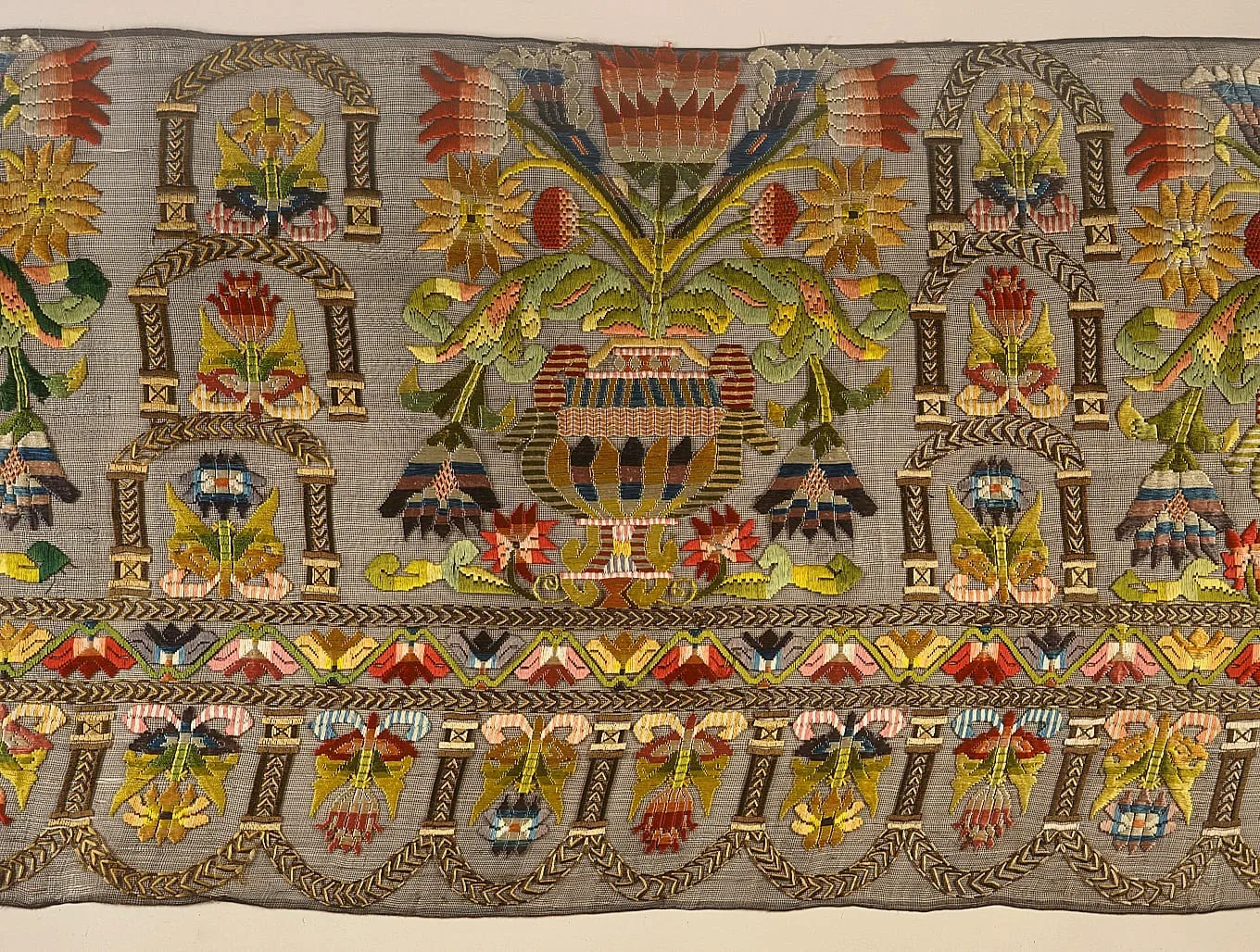
In buratto work, darning stitches are worked with a needle on fine gauze or net (called lacis) to create the pattern. A form of counted canvas embroidery, it is finer, looser, and more flexible than needlepoint. Buratto was used as border trim on clothing and various draperies. Stitched onto velvet, the gauze backing would sink into the pile and disappear from view, leaving the impression that the embroidered pattern was floating on the surface of the fabric.
Bright colors and a vase-and-niche motif reveal a strong Turkish influence in the ten repeats of pattern in this length of buratto. It is still stitched to its original backing of blue paper, which protected the gauze from distortion when handled or rolled.