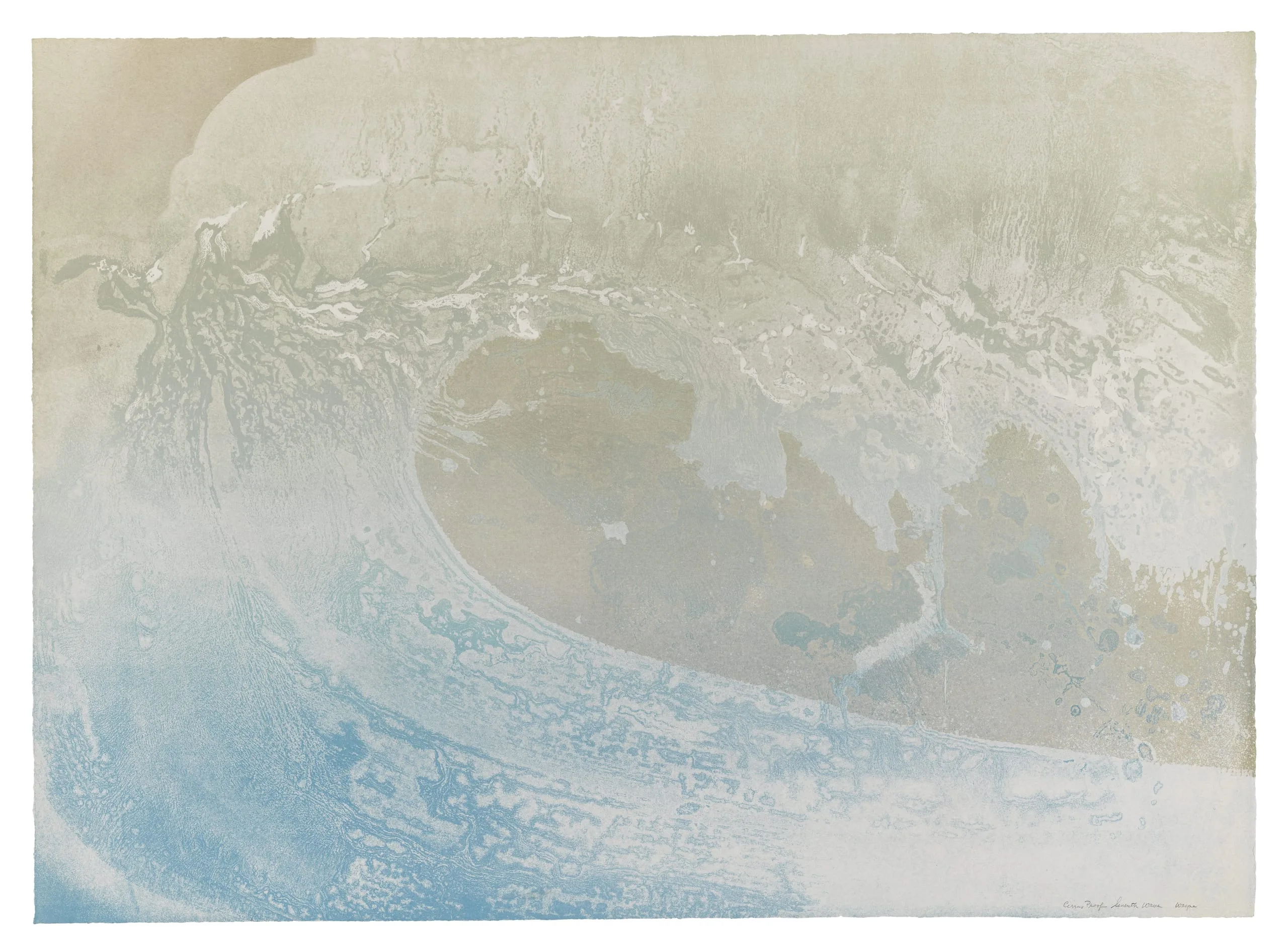
Seventh Wave II, made in 1971, is the second state of one of June Wayne’s earliest investigations into wave imagery, in which she experimented with different ranges of color. “There are two states of this [lithograph], one very pale and one in orange and blue,” she explained. “I prefer the pale one, the second state. It’s a very lovely print, subliminal. That is a very transparent black ink over the underside of the wave, and it lays down in there so nicely” (Conway 2007: 205). The transparent ink enhances both the sense of movement and the definition of the wave’s form. The viewer can easily imagine their own placement within the calm center of the maelstrom, akin to the eye of a hurricane—a haven from the untamed force of the water surrounding it.
Wayne’s commitment to feminism and her deep interest in scientific subjects such as DNA, quantum physics, and the cosmos were expressed in a multifaceted visual practice that encompassed painting, printmaking, and tapestry design. Her bold depictions of planetary forces merged art and science, utilizing formal abstraction and often vibrant color, and presenting viewers with original ways of seeing the world. Inspired by her training with printmakers in Paris in the 1950s, Wayne championed the resurgence of lithography as a fine-art form in the United States. In 1960, she established the Tamarind Workshop for Lithography in Los Angeles; the workshop relocated to the University of New Mexico at Albuquerque in 1970 and is still thriving.
Claudine Dixon
2025
Selected Bibliography
Conway, Robert P. June Wayne: The Art of Everything: A Catalogue Raisonné 1936−2006. New Brunswick, N.J.: Rutgers University Press, 2007.