LACMA

ShopMembershipMyLACMATickets
LACMA
Los Angeles County Museum of Art
5905 Wilshire Blvd.
Los Angeles, CA 90036
info@lacma.org
(323) 857-6000
Sign up to receive emails
Subscribe
© Museum Associates 2025
  • About LACMA
  • Jobs
  • Building LACMA
  • Host An Event
  • Unframed
  • Press
  • FAQs
  • Log in to MyLACMA
  • Privacy Policy
© Museum Associates 2025
Collections

Unknown
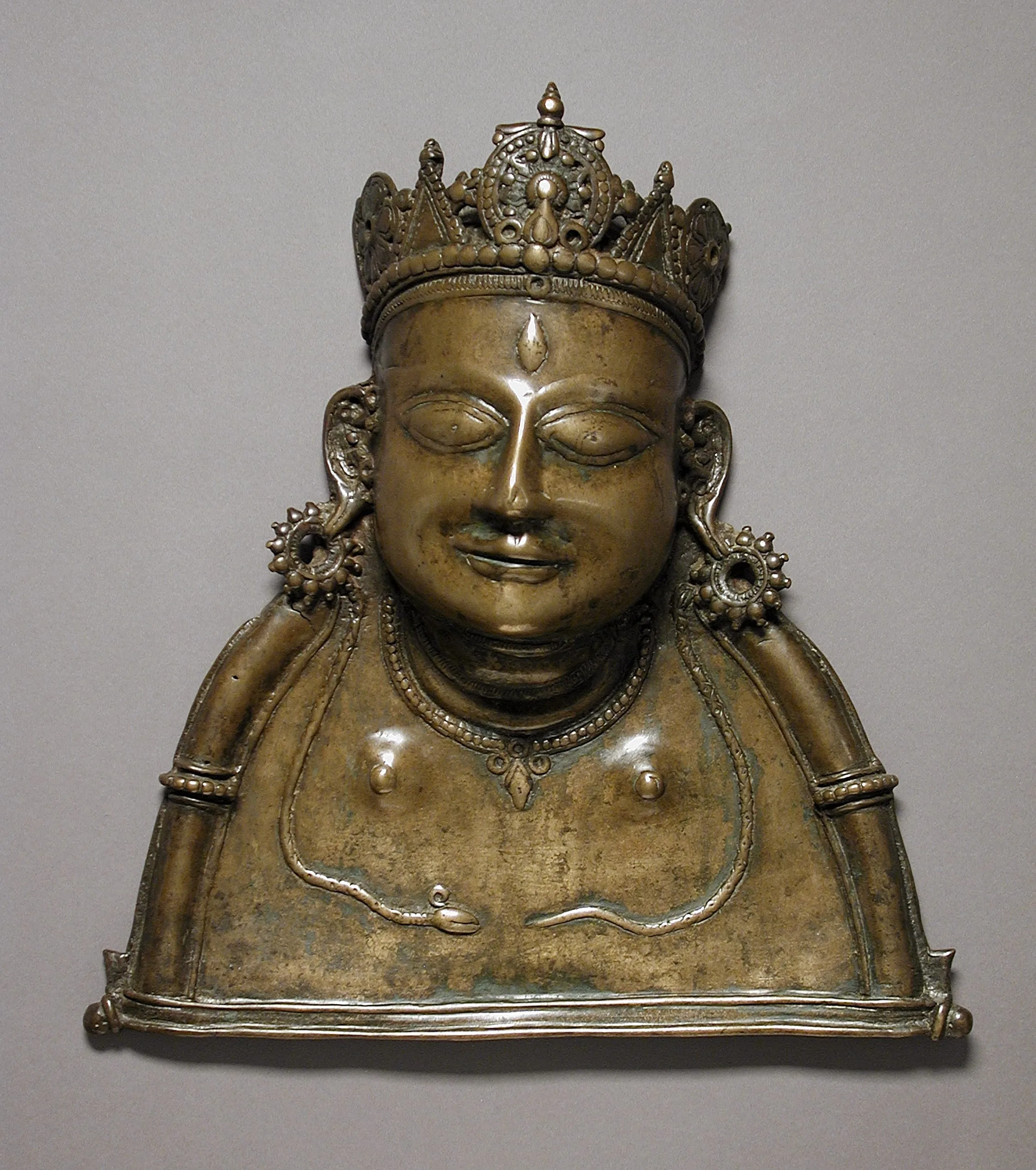
Processional Mask (Mohra) of the Goddess Mujuni Devicirca 1400

Not on view
Bronze relief sculpture of a crowned bust-length figure, frontal view, with smooth rounded features, downcast eyes, large circular ear ornaments, and a beaded necklace, on an aged golden-olive patinated surface

Unknown, Processional Mask (Mohra) of the Goddess Mujuni Devi, circa 1400, Los Angeles County Museum of Art, Gift of Dr. and Mrs. Pratapaditya Pal, photo © Museum Associates/LACMA

Artist or Maker
Unknown
Title
Processional Mask (Mohra) of the Goddess Mujuni Devi
Place Made
India, Panjab, Cis-Sutlej region (?)
Date Made
circa 1400
Medium
Brass
Dimensions
11 1/2 x 10 1/2 in. (29.21 x 26.67 cm)
Credit Line
Gift of Dr. and Mrs. Pratapaditya Pal
Accession Number
M.76.147.1
Classification
Jewelry and Adornments
Collecting Area
South and Southeast Asian Art
Curatorial Notes

Processional busts, popularly known as masks (mohra), are carried on palanquins in Hindu religious fairs in Himachal Pradesh, particularly during the Dussehra festival held in October in Kullu. They are displayed in groups on wooden frames covered with brocaded silk and cotton. This bust of the Hindu goddess Mujuni Devi (variant name of Mahadevi) depicts her wearing an elaborate crown with lotus medallions alternating with pyramidal forms, circular studded ear ornaments, a beaded necklace with a quadripartite pendant, armlets on her thin arms along the outer sides, and a serpent draped around her neck. She has a wide face, large almond-shaped eyes, a third eye in her forehead, and pronounced nipples. The bust has been stylistically attributed to the Cis-Sutlej region (?), in present-day Panjab, India, circa 1400. (M. Postel, A. Neven, and K. Mankodi, Antiquities of Himachal (Bombay: Franco-Indian Pharmaceuticals, 1985): 208, fig. 328).
Selected Bibliography
  • Pal, Pratapaditya. Indian Sculpture, vol.2. Los Angeles: Los Angeles County Museum of Art; University of California Press, 1988.
  • Reedy, Chandra L. Himalayan Bronzes: Technology, Style and Choices. Newark: University of Delaware Press, 1997.