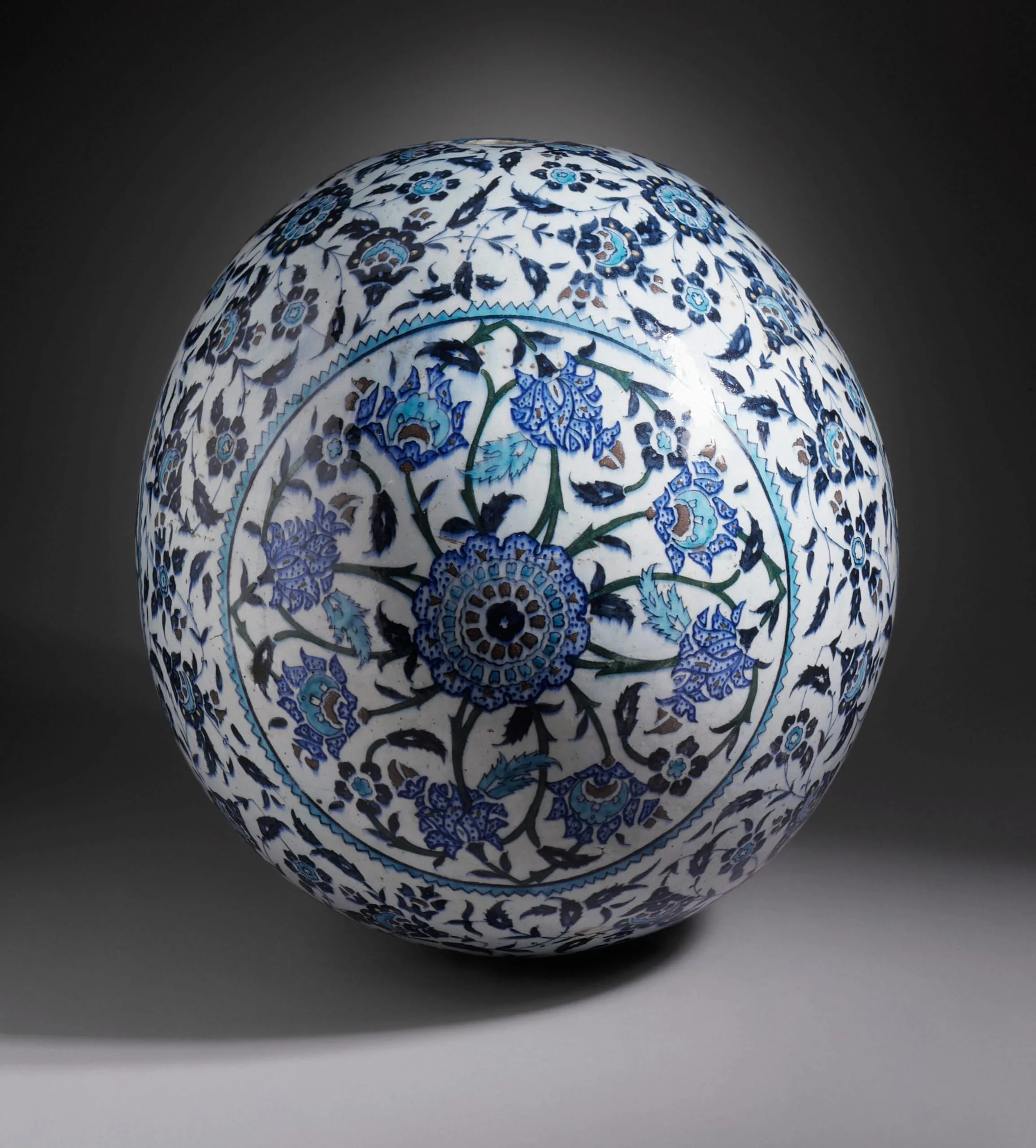
Adorned in blue and turquoise patterns of stylized flowers on saz-leaf vines, the surface of this spherical ornament recreates the most iconic designs associated with Iznik ceramics from the Ottoman empire during the mid-sixteenth century. Yet, in actuality, this work originates from a much later period of production. During the late nineteenth century to early twentieth, Armenian ceramicists from Kütahya revived classic Iznik designs on a wide range of objects and tile revetments that found admirers among both Ottoman elites and wealthy Europeans.
Though its function may at first seem obscure, the small opening at the top of this sphere once featured a metal bracket that would have enabled this work to hang suspended from another surface, like a ceiling or arch. Many other Ottoman orbs, produced during the nineteenth century and earlier, only bear floral designs on their underside, suggesting that some were likely suspended above standing height, only intended to be viewed from below. Given the large size of LACMA’s spherical ornament, and the full-coverage of its floral patterns, the artists may have envisioned that this work would be placed in an area of maximum visibility.
As to where one might hang these colorful orbs, today a visitor can still find spherical ornaments of glass, metal, or ceramic in both Muslim and Christian spaces of worship throughout the Middle East. As early as the fourteenth century in Mamluk Egypt, such ornaments in glass appear as common complements to mosque lamps, complete with matching enameled designs. By the Ottoman period, large ceramic spheres, such as this example, may have hung independently or surmounting a ceramic mosque lamp like their older counterparts, though their function remained largely symbolic as these versions were completely opaque. For historical models for this type of work, one lamp set with a matching orb was dedicated to the Dome of the Rock in Jerusalem to honor the site’s extensive renovation by Suleyman the Magnificent in 1549. Some scholars have suggested that their presence in these spaces may have symbolized the orb of heaven. However, even if their viewers did not ascribe such fixed meanings to these works, they made impressive additions to the lofty spaces of an Ottoman mosque, which could harmoniously complement the colorful tile revetments of a structure’s interiors from this period. Whether intended for a mosque renovation or exported to find a home in one of the many “Turkish” rooms of foreign buyers in the West, the later revival spheres demonstrate how Iznik designs found a new generation of enthusiasts.