LACMA

ShopMembershipMyLACMATickets
LACMA
Los Angeles County Museum of Art
5905 Wilshire Blvd.
Los Angeles, CA 90036
info@lacma.org
(323) 857-6000
Sign up to receive emails
Subscribe
© Museum Associates 2026
  • About LACMA
  • Jobs
  • Host An Event
  • Unframed
  • Press
  • FAQs
  • Log in to MyLACMA
  • Privacy Policy
© Museum Associates 2026
Collections

Unknown
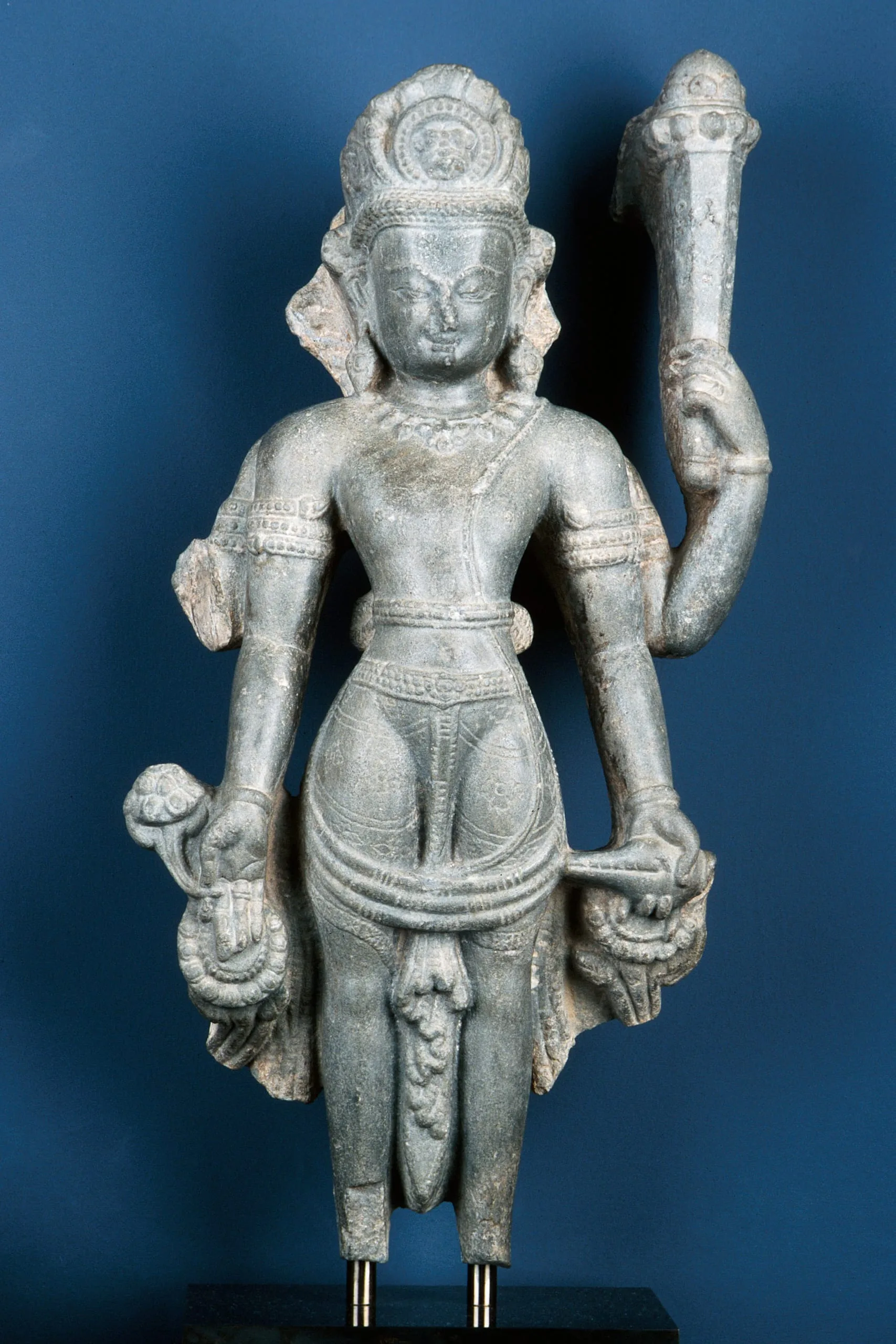
The Hindu God Vishnu13th-14th century

Not on view
Gray stone sculpture of a four-armed standing deity with tall cylindrical crown, holding a mace, conch, and coiled objects, mounted on a black base

Unknown, The Hindu God Vishnu, 13th-14th century, Los Angeles County Museum of Art, Gift of James H. Coburn III, photo © Museum Associates/LACMA

Artist or Maker
Unknown
Title
The Hindu God Vishnu
Place Made
Nepal
Date Made
13th-14th century
Medium
Stone
Dimensions
24 x 11 1/2 x 5 in. (60.96 x 29.21 x 12.7 cm)
Credit Line
Gift of James H. Coburn III
Accession Number
M.85.279.4
Classification
Sculpture
Collecting Area
South and Southeast Asian Art
Curatorial Notes

Vishnu, the Hindu God of Preservation, has twenty-four philosophical aspects or emanations (chaturvinshati-murtis) as described in several important iconographic texts, ranging from the late 3rd-century BCE devotional text, the Pancharatra (Five Nights), to the Rupamandana (Beautifying of Forms) compiled in the 15th century by Sutradhara Mandana, the renowned royal chief architect of Maharana Kumbha of Mewar (r. 1433-1468). The various forms have different names and are differentiated iconographically by the position of Vishnu’s standard attributes held in his four-armed (chaturbhuja) images starting in his upper right hand and proceeding in a circular manner to the upper left, lower left, and lower right. See T. A. Gopinatha Rao, "The Twenty-Four Images of Vishnu," Elements of Hindu Iconography, vol. 1, part 1; 2nd ed. (Varanasi: Indological Book House, 1971), pp. 227-244.

This representation accords with the identification in the Rupamandana of the emanation of Shridhara (Bearer of Fortune). The now-missing discus (cakra or Sudarshana) would have been held in his upper right hand, the mace (gada or Kaumodaki) in his upper left, the conch (shankha or Panchajanya) in his lower left, and the lotus (padma) in his lower right. Vishnu is crowned and wears a patterned dhoti and copious jewelry, including his long forest garland (vanamala) that hangs above his knees. He stands in a stiff, frontal pose (samapada sthanaka).

See also M.91.294.1, The Hindu God Vishnu in his Emanation as Narayana.

Selected Bibliography
  • King, Jennifer, ed. Vera Lutter: Museum in the Camera. Los Angeles: Los Angeles County Museum of Art; Munich: DelMonico Books-Prestel, 2020.

Related Unframed

Related Unframed

Art as Solace: Pinaree Sanpitak
  • September 27, 2013
Why Are There Hammocks in the Southeast Asian Gallery?
  • June 25, 2013
What You're Looking For
  • March 18, 2013
The Earth Quakes, but the Art Stays Still
  • April 13, 2010
  • Scott Tennent