LACMA

ShopMembershipMyLACMATickets
LACMA
Los Angeles County Museum of Art
5905 Wilshire Blvd.
Los Angeles, CA 90036
info@lacma.org
(323) 857-6000
Sign up to receive emails
Subscribe
© Museum Associates 2025

Museum Hours

Monday

11 am–6 pm

Tuesday

11 am–6 pm

Wednesday

Closed

Thursday

11 am–6 pm

Friday

11 am–8 pm

Saturday

10 am–7 pm

Sunday

10 am–7 pm


  • About LACMA
  • Jobs
  • Building LACMA
  • Host An Event
  • Unframed
  • Press
  • FAQs
  • Log in to MyLACMA
  • Privacy Policy
© Museum Associates 2025
Collections

Unknown
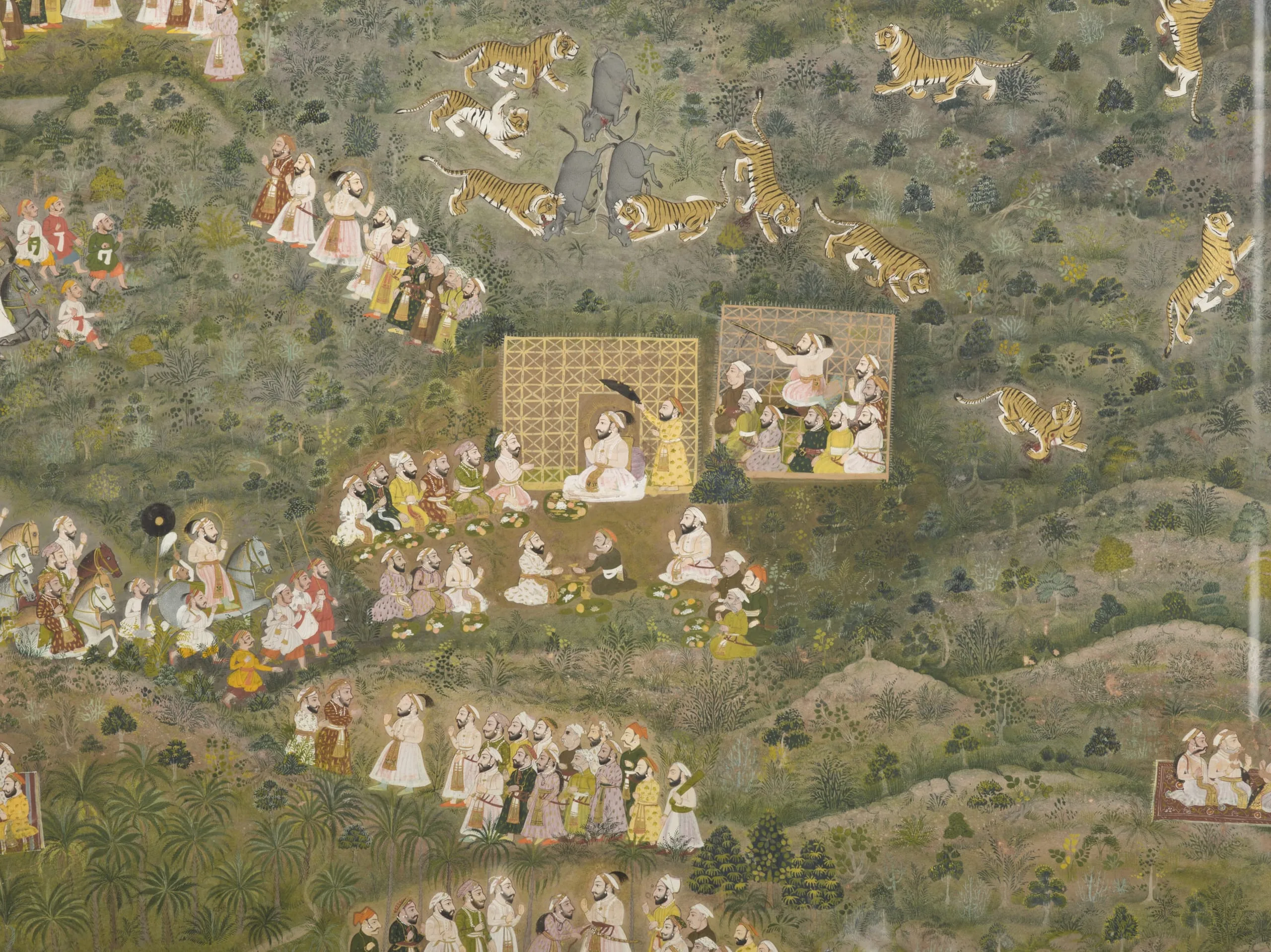
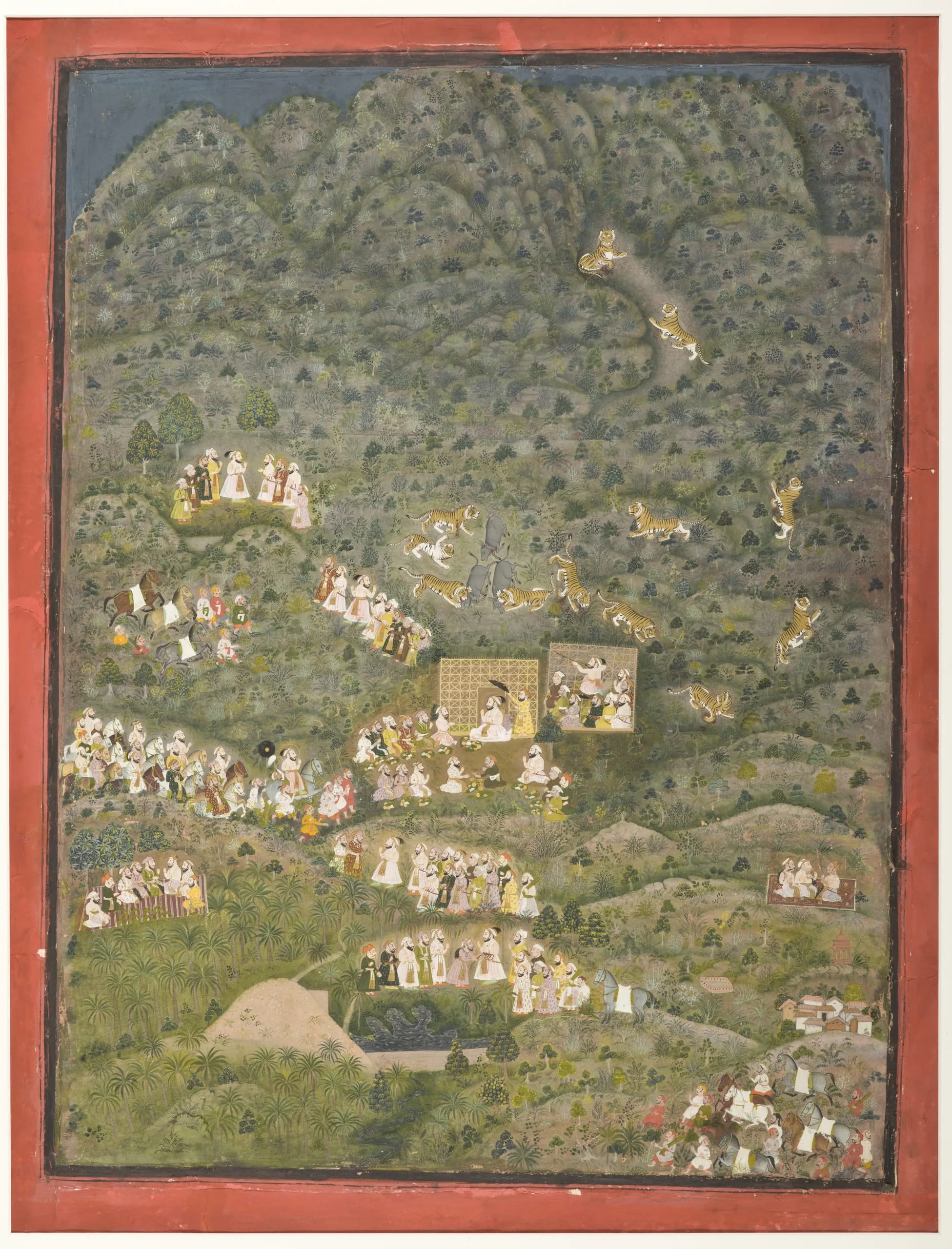
Maharana Sangram Singh II of Udaipur (r. 1710-1734) Hunting Tigerscirca 1725

Not on view
Vertical Indian miniature painting of a royal tiger hunt on densely wooded hillside, with dozens of tiny figures, leaping tigers, and a central viewing pavilion across terraced green landscape
Mughal-style opaque watercolor painting depicting a hunt scene across a dense green landscape, with multiple tigers and elephants in the upper portion, and large groups of courtly figures in white and colored garments gathered around a latticed enclosure at center, rendered in fine detail with scattered trees and rolling terrain.
Artist or Maker
Unknown
Title
Maharana Sangram Singh II of Udaipur (r. 1710-1734) Hunting Tigers
Place Made
India, Rajasthan, Mewar, Udaipur
Date Made
circa 1725
Medium
Opaque watercolor, gold, and silver on paper
Dimensions
Sheet: 28 3/4 x 22 3/8 in. (73.03 x 56.83 cm); Image: 25 1/2 x 19 in. (64.77 x 48.26 cm)
Credit Line
Gift of Paul F. Walter
Accession Number
M.85.297.3
Classification
Drawings
Collecting Area
South and Southeast Asian Art
Curatorial Notes
Maharana Sangram Singh II of Udaipur (r. 1710-1734) was born in 1690 and died in 1734. Sangram Singh II, whose name means "the lion of battle," was named after his renowned ancestor, Maharana Sangram Singh I (r. 1508-1527), who won acclaim as an ardent foe of the Mughal Emperor Babur (r. 1526-1530). During his own reign Sangram Singh II reclaimed territory previously lost to the Mughals and fought the Maratha armies encroaching upon his kingdom from the south. Sangram Singh II was a prolific patron of the arts and architecture. His painters not only produced illuminated manuscripts, but also large-scale paintings that documented the ruler’s public life. Depictions of the hunt, a great pastime of the Rajput courts, were viewed as testimonies of the ruler’s strength and bravery. In this painting, the nimbate Sangram Singh II appears seven times in a continuous narrative that illustrates various stages and activities of the royal hunt held at his favorite hunting ground, Nahar Magra (Tiger Hill), located east of Udaipur. In the right center, he is on a shooting platform (machan) shooting a tiger that had been lured by tethered buffaloes. The wounded tiger then retreats to its mountain lair. A long Hindi inscription on the reverse records that he shot the tiger with one bullet and then a feast was held. It also identifies the many chieftains and courtiers who accompanied him on the hunt, including the Rajput chiefs (sardars) Umed Singh, Takhat Singh, Daulat Singh and Pratap Singh.
Selected Bibliography
  • El Universo de la India: Obras Maestras del Museo de Arte del Condado de Los Angeles. Santiago: Centro Cultural Palacio La Moneda, 2012.