- Title
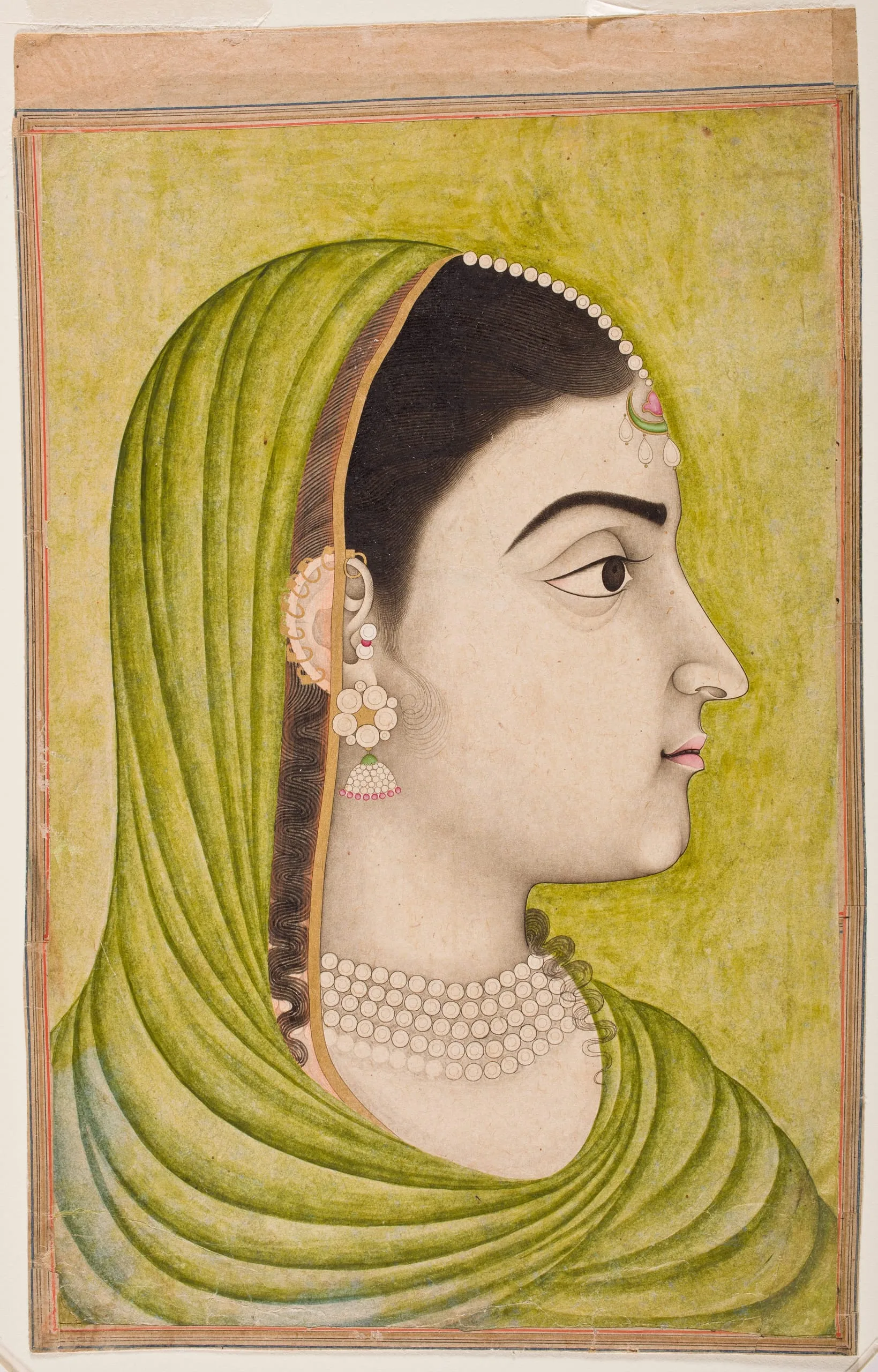
- Portrait of a Muslim Woman
- Date Made
- circa 1725
- Medium
- Opaque watercolor and gold on paper
- Dimensions
- Image: 11 3/8 x 7 1/4 in. (28.89 x 18.41 cm); Sheet: 12 1/2 x 7 7/8 in. (31.75 x 20 cm)
- Accession Number
- M.85.284.1
- Curatorial Notes
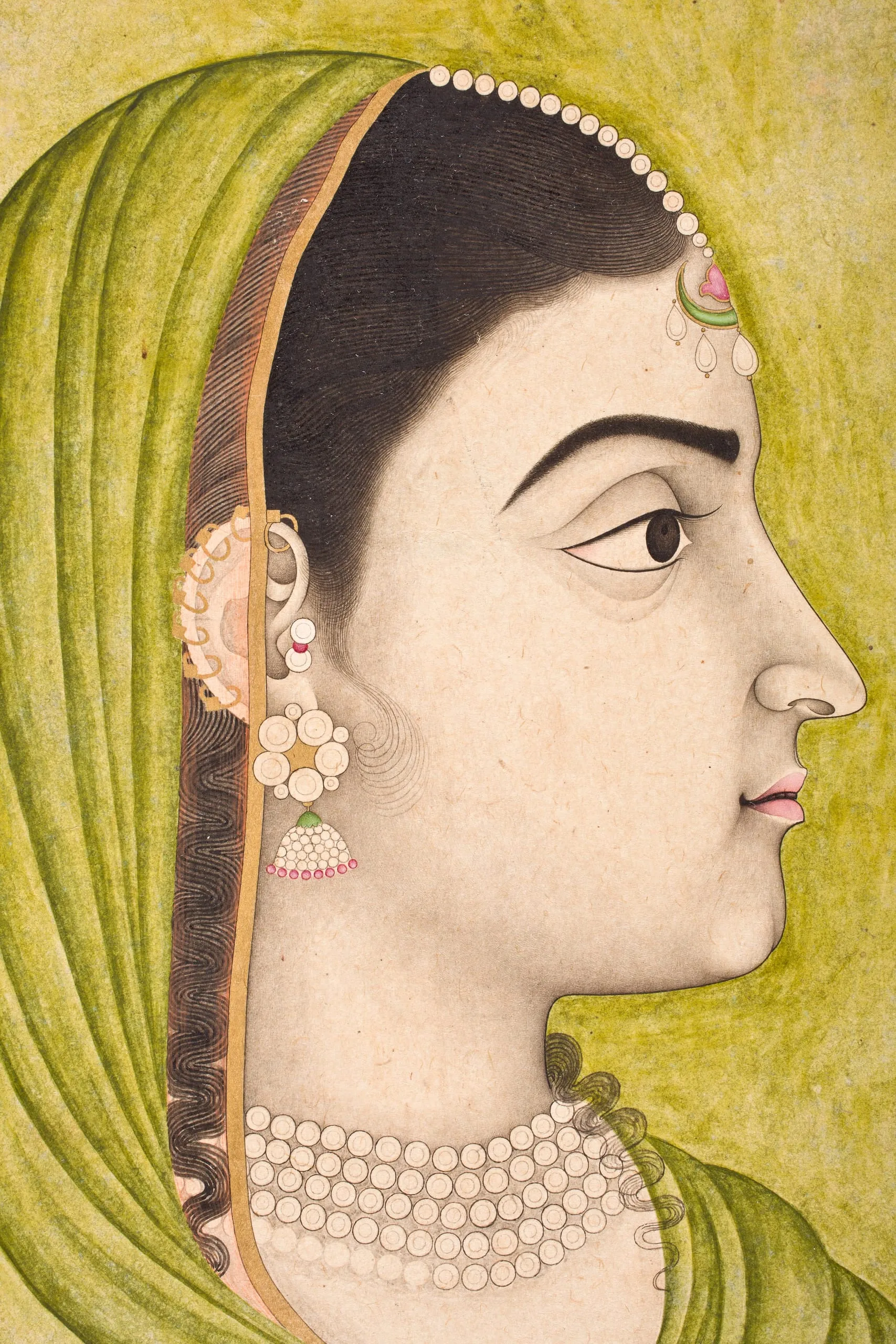
The unknown woman wearing a headscarf in this sensitive portrait can be identified as a Muslim by her jewelry. She wears a forehead ornament (mang tikka) with a green (emerald or enamel) crescent moon (hilal) and a red (ruby or enamel) star, symbolic of Islamic caliphal authority. It has pendant pearls and a pearl-strung support (mang patti) over the parting line of the hair to the top of the head. Along the perimeter of the ear are eight (or sometimes ten or twelve) small gold hoop earrings (bali) often worn by Muslim women. In her ear lobe is a non-sectarian northern Indian earring (karanphul jhumka, “ear flower earring”) consisting of a gold roundel with a pearl border and, suspended by a green enamel fitting, a dome-shaped pendant with a cluster of pearls and rubies. She also has a pearl-and-ruby ear stud. Around her neck are five strands of pearls.
The delicate shading and anatomical accuracy of this Bikaner portrait is stylistically derived from 17th-century Mughal realistic portraiture. Whereas the Mughal emperors and Rajput kings are often recognizable as individuals with idiosyncratic features, their queens and princesses are usually stereotypical depictions, reflecting the severe cultural restrictions on the public appearance of high-status women in both Islamic and Hindu society. Thus, this realistic portrait may be a highly refined courtesan (tawaif) employed by elite patrons as singers, dancers, thespians, and teachers of social etiquette. See also M.2001.103.