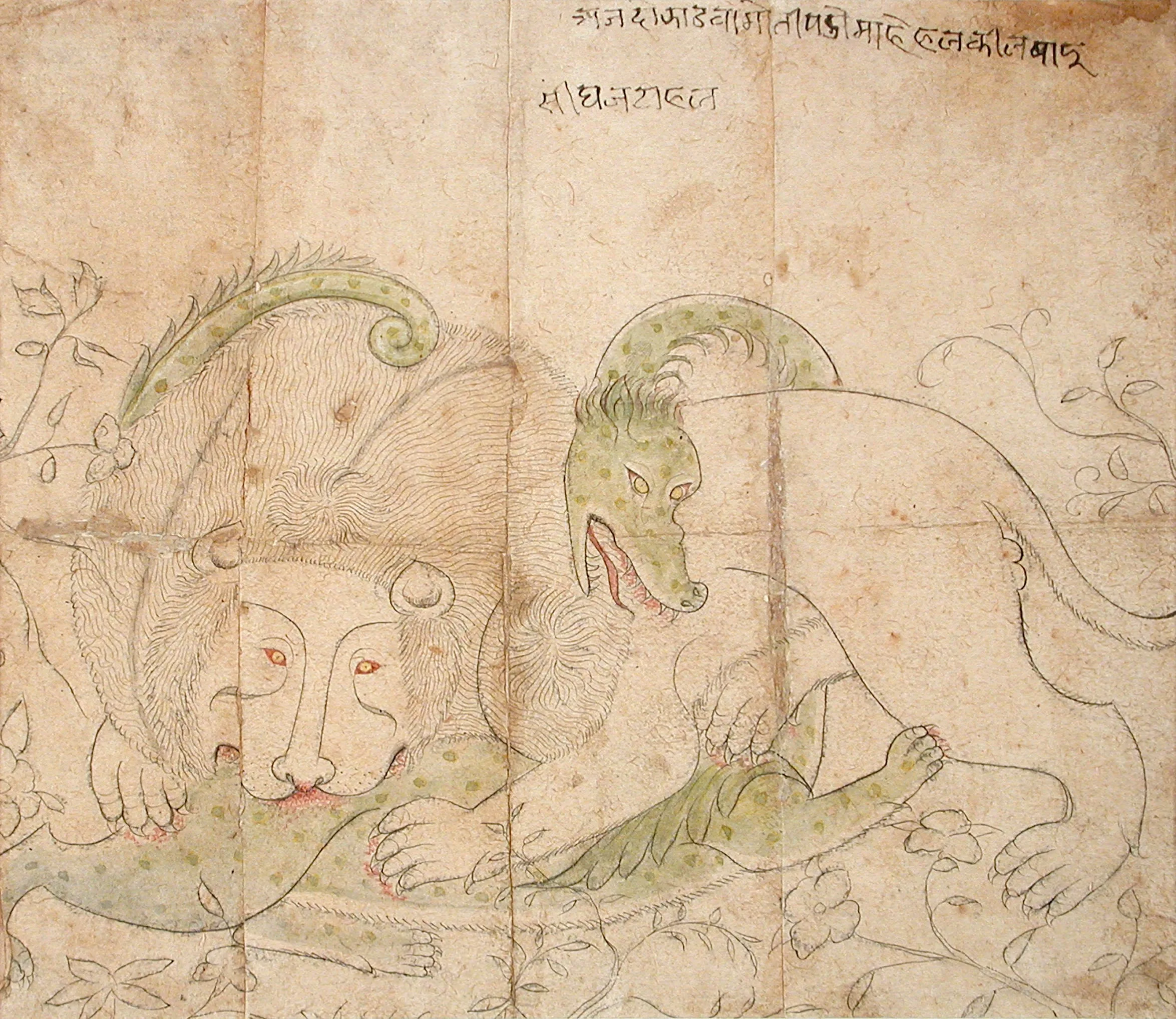
The motif of a lion/tiger writhing in combat with a dragon/crocodile has a complex cross-cultural visual history that merged ancient Near Eastern, Central Asian, East Asian, and South Asian mythology and multimedia imagery. Contrary to narrative hunting scenes where a hero vanquishes a great beast, depictions of a lion-and-dragon combat, or analogous archetypal nemeses, presents two opposing universal forces locked in an eternal struggle. The lion, traditionally a symbol of royal power, courage, and the sun, clashes directly with the dragon, associated with the moon, darkness, chaos, and the volatile forces of nature. In East Asian art, the dragon represents the heavens and active cosmic force (yang), while the tiger is the grounding element of the earth (yin). In Persian, Ottoman, and Mughal art, the lion-and-dragon motif symbolizing Chaos vs. Order is known as girift-o-gir (catch and grip). In European art and Christian theology, the struggle of Good vs. Evil is envisioned by the lion [of Judah] denoting Christ/Goodness battling the dragon symbolizing Satan/Evil.
In this preparatory drawing, a lion bites and claws the hind quarters of a quadrupedal dragon. The red blood from the wounds is accentuated by the red sclera in the eyes of the lion. The lion attacks the lion in a similar fashion, with the red blood from its claws and teeth mirrored by its red serpentine tongue.
The Hindi inscription reads, The fighting of the dragon and the lion, with their nimble tongue [in mid-snarl]. Lion in combat. (Translation by Google. subject to verification.)
Comparable studies of a lion/tiger and dragon/crocodile paired or in combat, attributed respectively to China, 1220–1280; Italy, circa 1500–1510; Turkey, circa 1540–1550; India, Bundi, early 19th century; Iran, 1750–1800, are in the Metropolitan Museum of Art, New York (1958.427, 2013.202, 57.51.26, 2008.359.18, 1974.20).