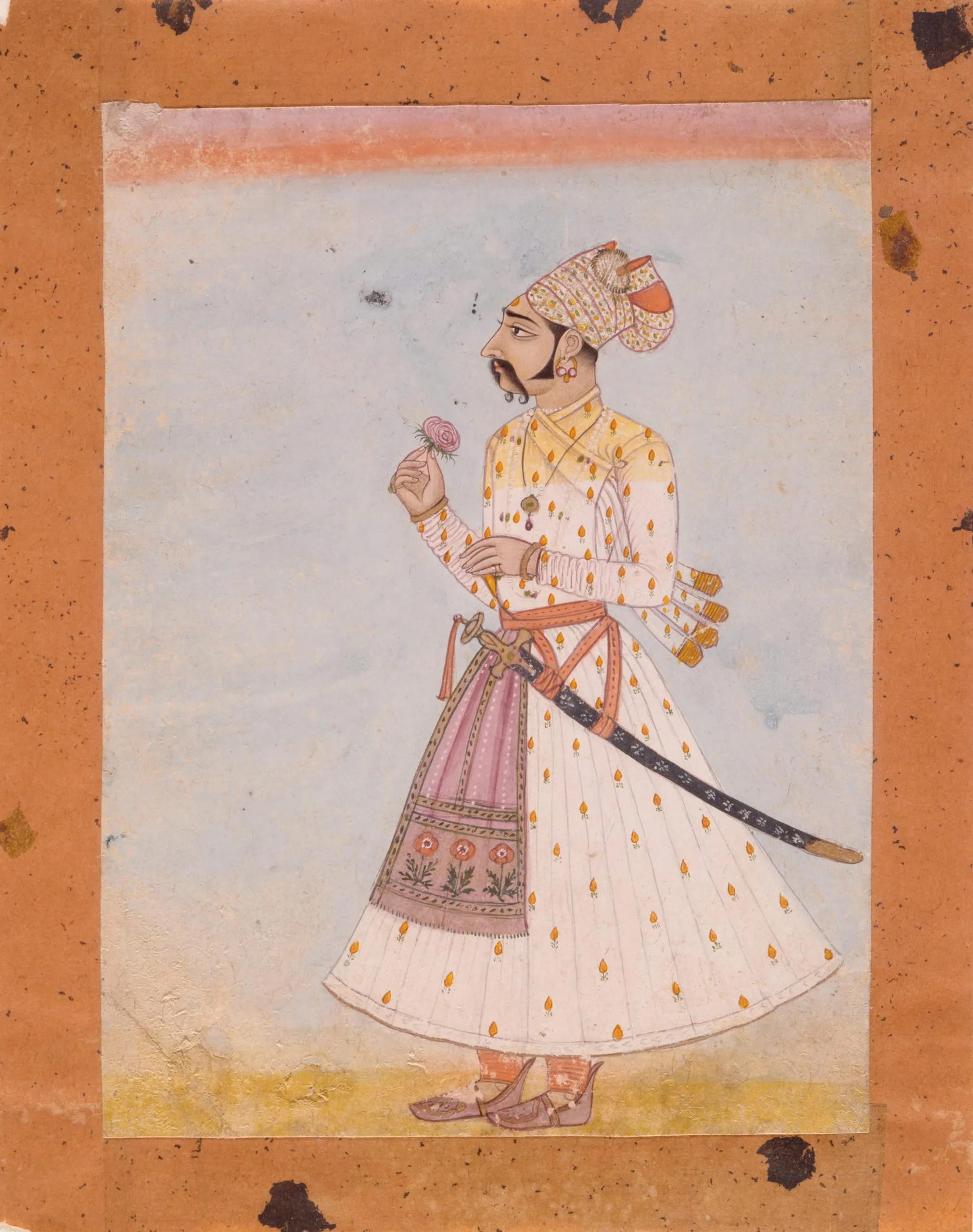
A devanagari inscription on the reverse identifies the subject as Jujhar [or Jhujar] Singh, son [or lineage] of Sujan Singh, from Pisa [likely Pisangan]. Jhujhar Singh (dates unknown) was the first Thakur (chieftain) of the fiefdom (jagir) of Pisangan, near Ajmer, Rajasthan. Sujan Singh (dates unknown) was the Thakur of Junian and Mehrun, near Ajmer. He is a different Sujan Singh than his homonymous contemporary, Maharaja Sujan Singh of Bikaner (r. 1700-1736). A comparable portrait identified as “Rathor Jhujhar Singh, son of Sujan Singh from the village of Phluyai [Phulya?],” attributed to Marwar or Bikaner, circa 1720, is in the Metropolitan Museum of Art, New York (2002.349).
Jhujhar Singh is depicted standing in profile. He wears a multicolored turban tied in the Bikaner style, strands of pearls with a gold and ruby pendant, a white outer garment (jama) with flaring pleats and decorated with yellow floral sprays, orange trousers and sword belt with a Delhi-style sword and scabbard, and a mauve waist sash (patka) and shoes. He holds a rose symbolic of his cultural refinement.