- Title
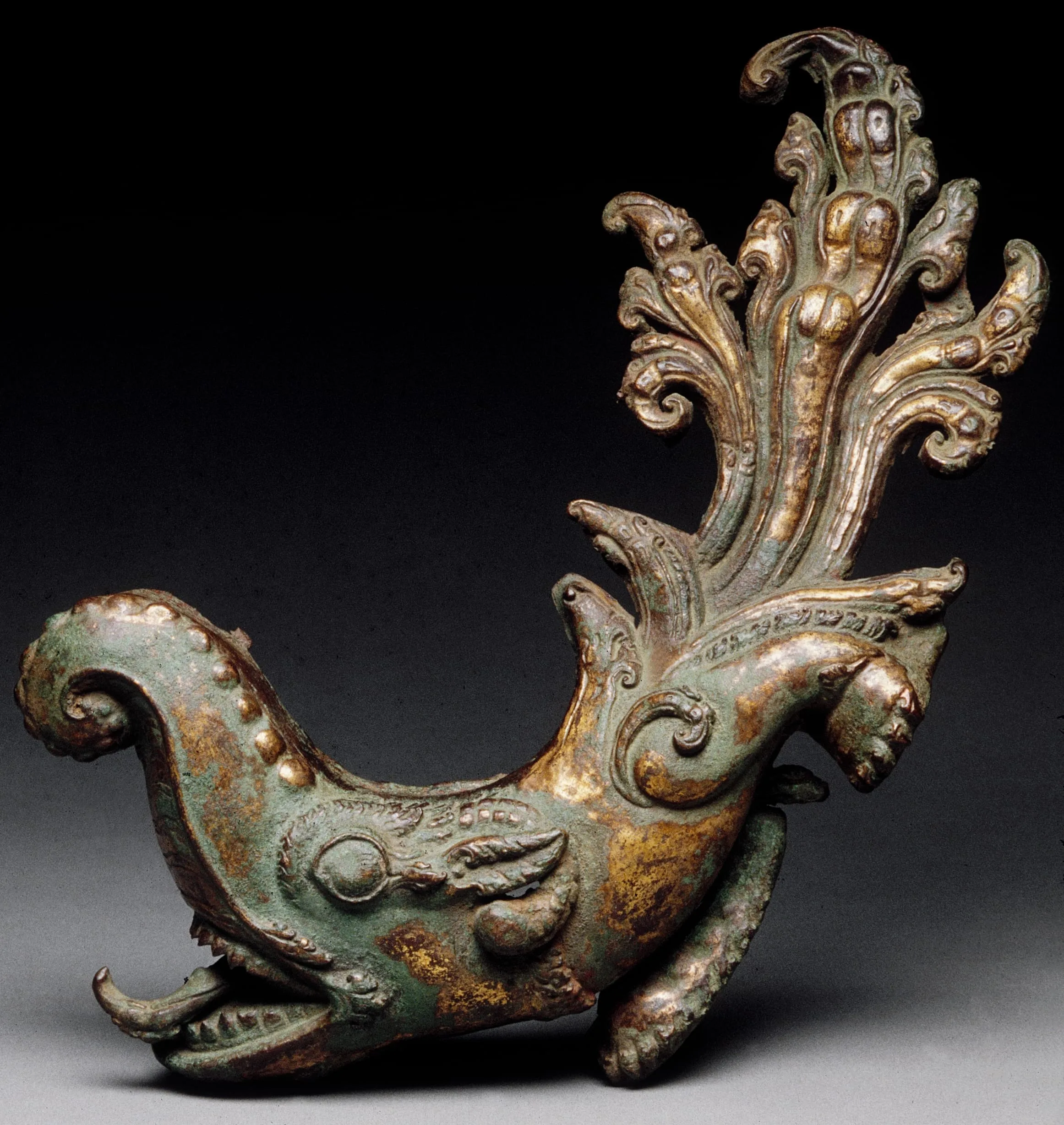
- Mythical Aquatic Creature (Makara)
- Date Made
- 10th century
- Medium
- Repoussé gilt copper alloy
- Dimensions
- 14 x 6 1/4 x 2 3/4 in. (35.56 x 15.88 x 6.99 cm)
- Accession Number
- M.85.279.6
- Curatorial Notes
A makara (sea monster) is a mythical aquatic creature symbolic of fecundity that is a varying composite of diverse animals. The most common hybrid form, as represented in this Nepalese repoussé gilt copper alloy sculpture, has the snout and head of an elephant, the body and feet of a crocodile, and the foliated tail of a fish or peacock. Makaras have an extremely rich heritage in Southern Asian and Himalayan art and culture. A makara is identified as the mount (vahana) of the god Varuna in the Vedic (proto-Hindu) scriptures of the second millennium BCE (see M.72.4.2). Architectural makaras survive in India from at least as early as the second century BCE. Makara forms are used in architecture for waterspouts, and as structural and design components of archways (torana) (see M.79.34a-b, M.91.350.3, and AC1999.127.20) and thronebacks (see M.81.90.5 and M.2001.1). They are ubiquitous in the ritual and decorative arts, particularly as ornate terminals on sacramental implements such as thunderbolts (vajra or dorje; see M.81.4, AC1994.176.1, M.2001.158.1); jewelry, especially earrings and necklaces (see M.83.105.1); and weaponry (see M.79.243.1, M.79.243.3, and AC1997.276.1).