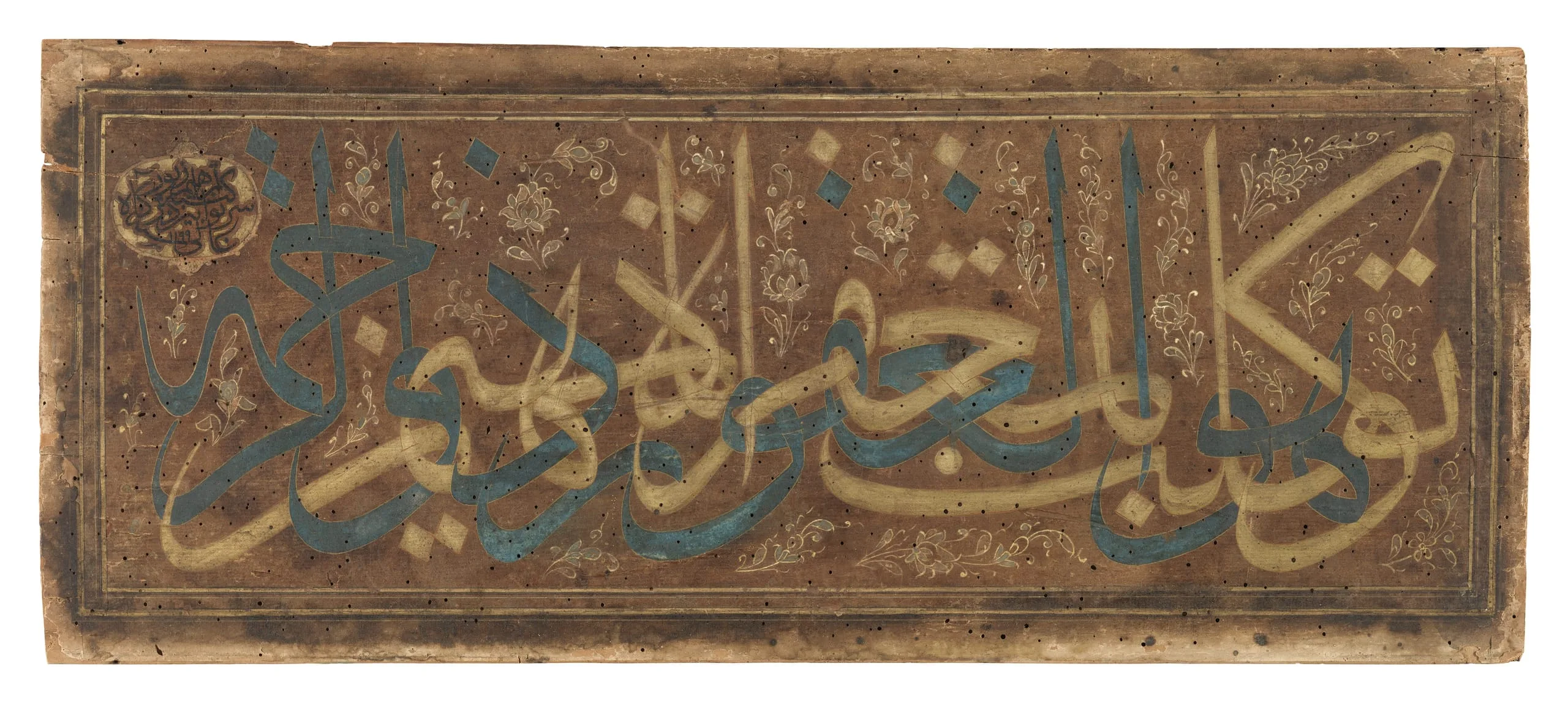
- Title
- Levha (calligraphy intended to be framed and hung as decoration)
- Date Made
- 1784-1785/A.H. 1199
- Medium
- Opaque watercolor and gold on paper mounted on wood
- Dimensions
- 11 1/2 x 26 x 1/2 in. (29.21 x 66.04 x 1.27 cm)
- Accession Number
- M.85.237.94
- Curatorial Notes
Levha, meaning “tablet” in Turkish, refers to calligraphy on paper featuring religious texts or poetry mounted on wood or cardboard and framed. These panels, which were especially popular in Ottoman Turkey during the eighteenth and nineteenth centuries, were commonly used as wall decoration. This rectangular panel features two artfully interlaced phrases rendered in gold and blue on a dark brown ground. As is typical, the texts are written in a large-scale thuluth script, known in Turkish as celi sulus, which read: “I rely on the forgiveness of the Guardian (Allah)” (in gold) and “He is the Lord of Mercy” (in blue). A small cartouche in the upper left corner bears the signature of the calligrapher, Ibrahim Zivar. Generally, an illuminator prepared the levha using a stencil (kalip) that the calligrapher wrote in orpiment (yellow arsenic) ink on dark brown or black paper. In some instances, such stencils have survived, while occasionally the finished levha includes the name of the illuminator.
2024
- Selected Bibliography
- Denny, Walter B. Turkish Treasures from the Collection of Edward Binney, 3rd. Portland, OR: Portland Art Museum, 1979.