- Title
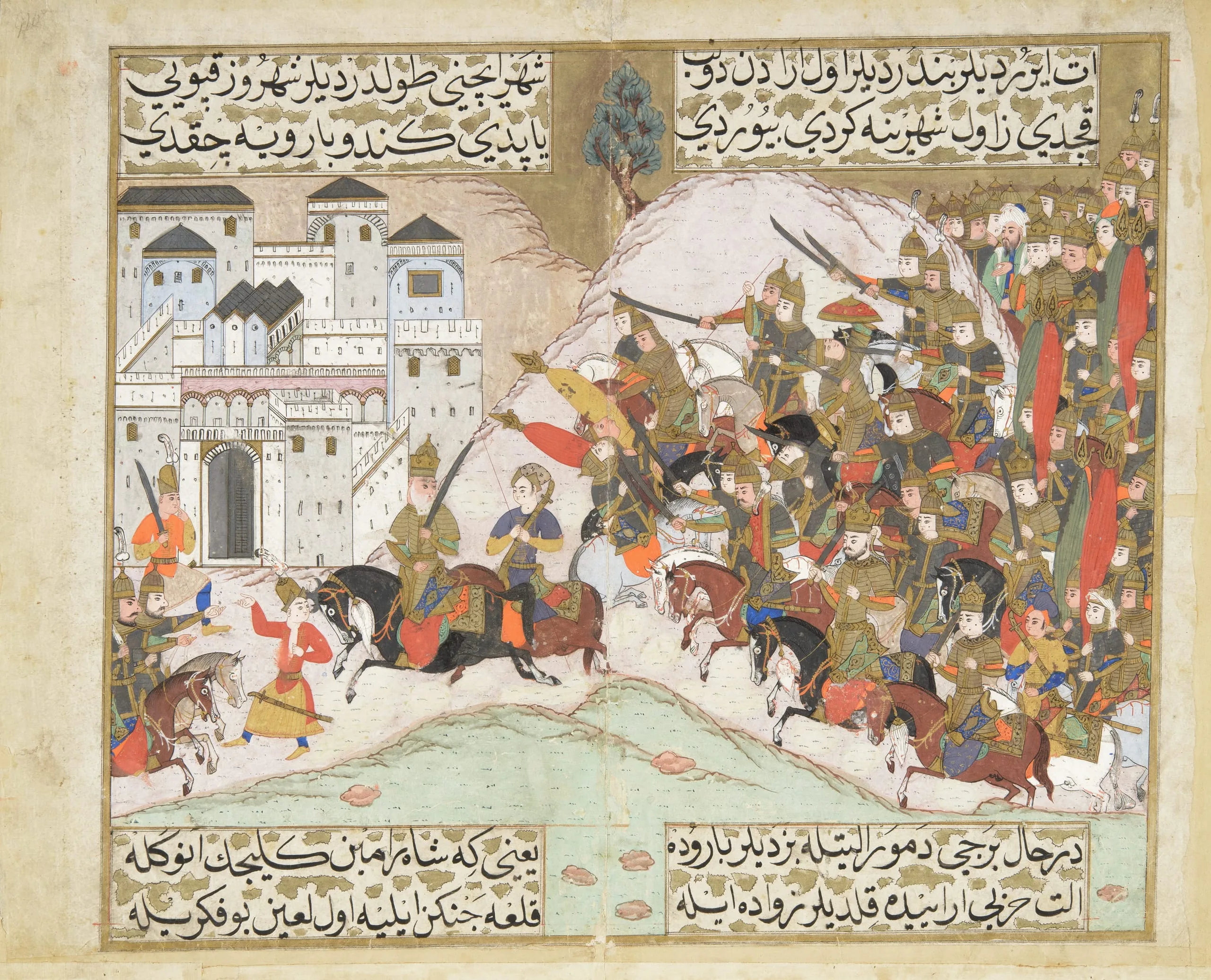
- The Army of Shah Ramin Attacking the Iron Fortress, Page from a Manuscript of Tuhfat al-Lata'if (The Best of Subtleties)
- Date Made
- 1593-1594/1002 A.H.
- Medium
- Ink, opaque watercolor, and gold on paper
- Dimensions
- 12 5/8 × 14 11/16 in. (32.07 × 37.31 cm)
Frame: 23 × 19 × 1 1/2 in. (58.42 × 48.26 × 3.81 cm)
- Accession Number
- M.85.237.41
- Curatorial Notes
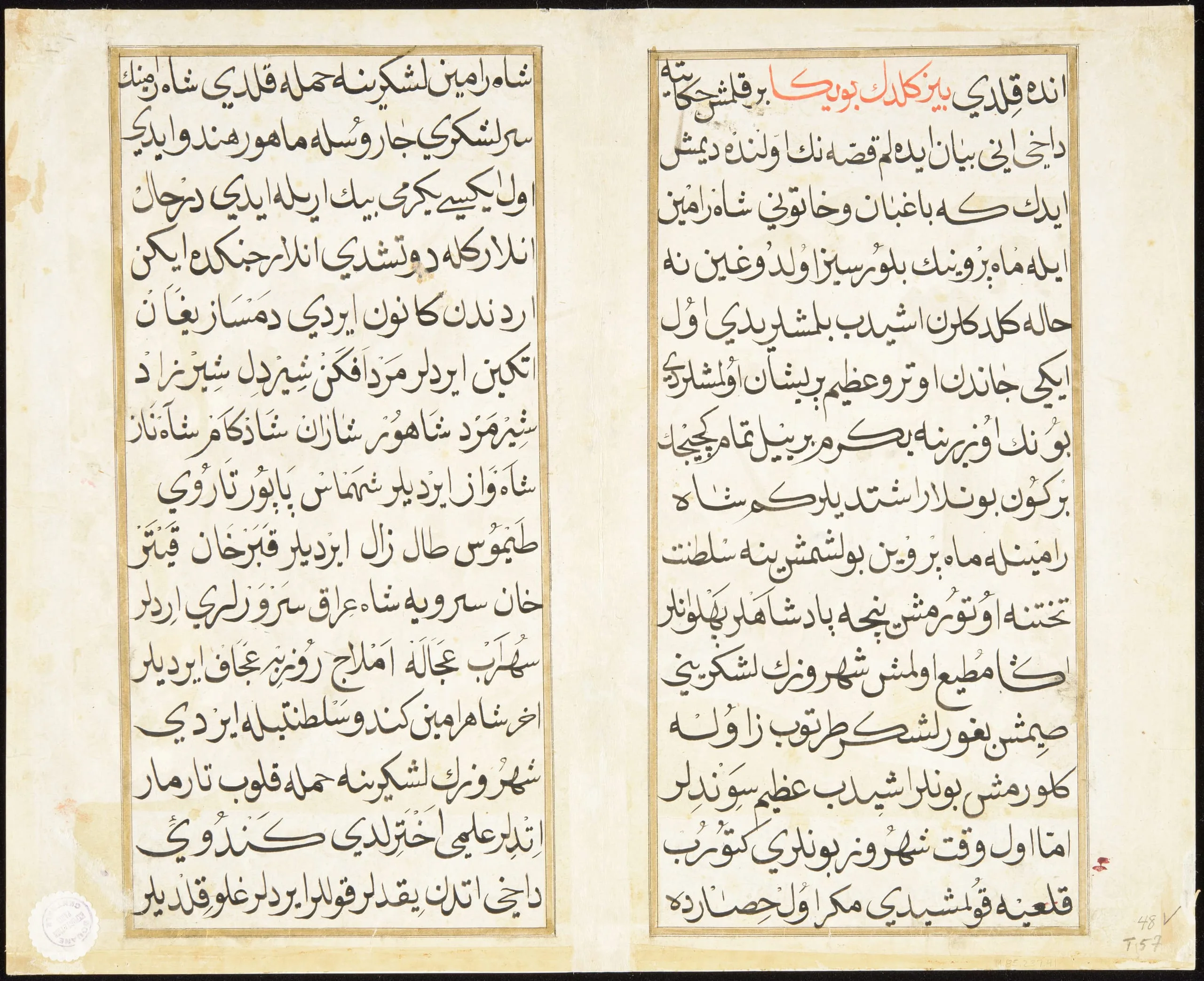
While sixteenth- and seventeenth-century Ottoman court artists were principally engaged in creating documentary-style illustrations for dynastic histories and chronicles of recent battles (see M.85.237.42), they were occasionally commissioned to produce paintings for works of literature. This illustration comes from one such manuscript made for the Ottoman Sultan Murad III (r. 1574–95); the focal point of the text is the romance between Shah Ramin, son of the King of Ghazni, and Mah-Parvin, the daughter of the king’s evil vizier, Shahruz. The double-page composition, depicting Shah Ramin’s army pursuing Shahruz, draws on the illustrative tradition of Ottoman chronicles, complete with detailed portrayals of the soldiers, their weapons, and the architecture of the cityscape.
- Selected Bibliography
- Denny, Walter B. Turkish Treasures from the Collection of Edward Binney, 3rd. Portland, OR: Portland Art Museum, 1979.
Lo Terrenal y lo Divino: Arte Islámico siglos VII al XIX Colección del Museo de Arte del Condado de Los Ángeles. Santiago: Centro Cultural La Moneda, 2015.
Pal, Pratapaditya, Thomas W. Lentz, Sheila R. Canby, Edwin Binney, 3rd, Walter B. Denny, and Stephen Markel. "Arts from Islamic Cultures: Los Angeles County Museum of Art." Arts of Asia 17, no. 6 (November/December 1987): 73-130.
- Komaroff, Linda. Beauty and Identity: Islamic Art from the Los Angeles County Museum of Art. Los Angeles: Los Angeles County Museum of Art, 2016.
- Binney, Edwin, 3rd. "Turkish Arts of the Book in the Binney Collection." Arts of Asia 17, no.6 (Nov/Dec 1987): 97-104.