LACMA

ShopMembershipMyLACMATickets
LACMA
Los Angeles County Museum of Art
5905 Wilshire Blvd.
Los Angeles, CA 90036
info@lacma.org
(323) 857-6000
Sign up to receive emails
Subscribe
© Museum Associates 2026
  • About LACMA
  • Jobs
  • Building LACMA
  • Host An Event
  • Unframed
  • Press
  • FAQs
  • Log in to MyLACMA
  • Privacy Policy
© Museum Associates 2026
Collections

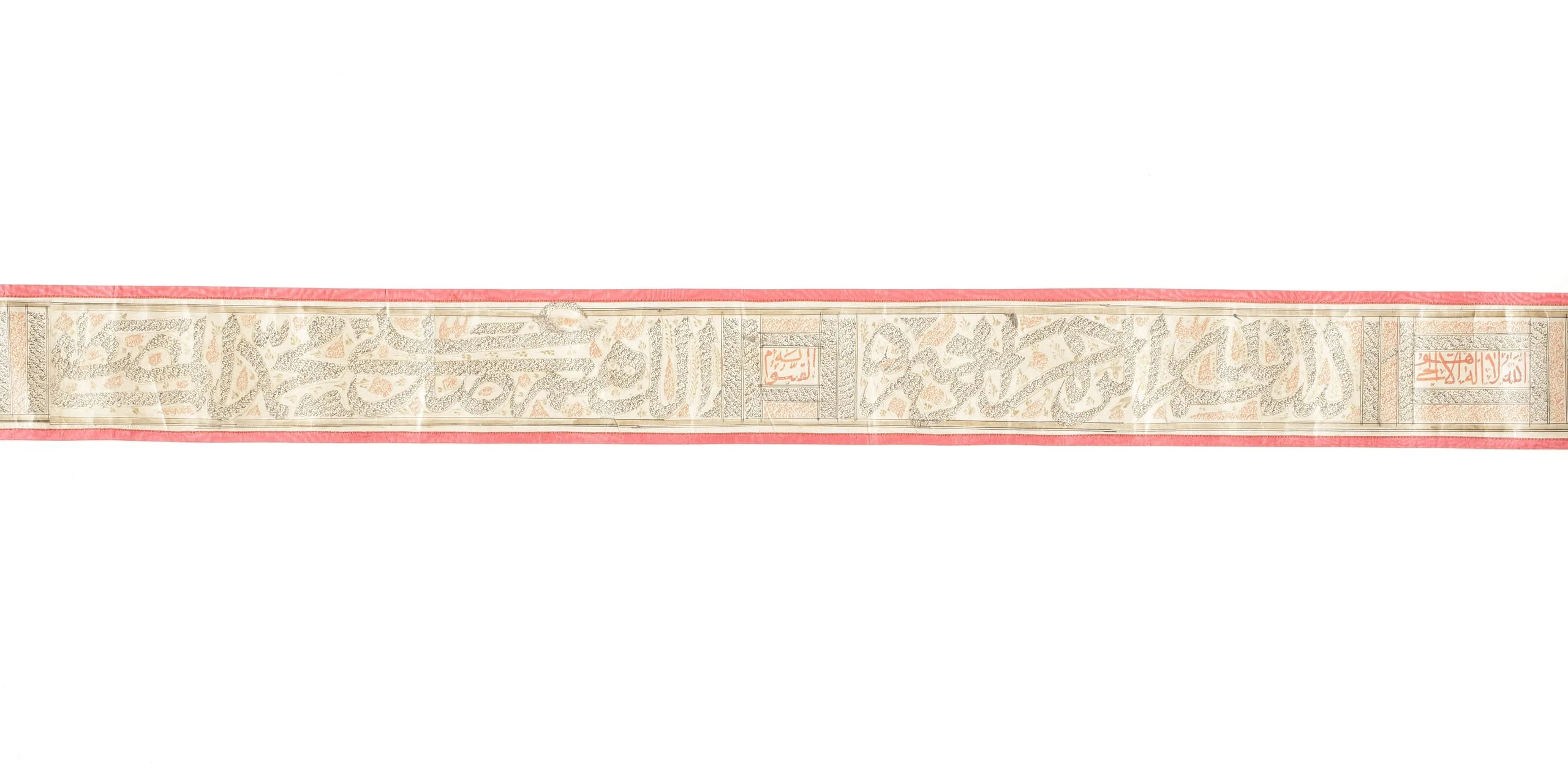
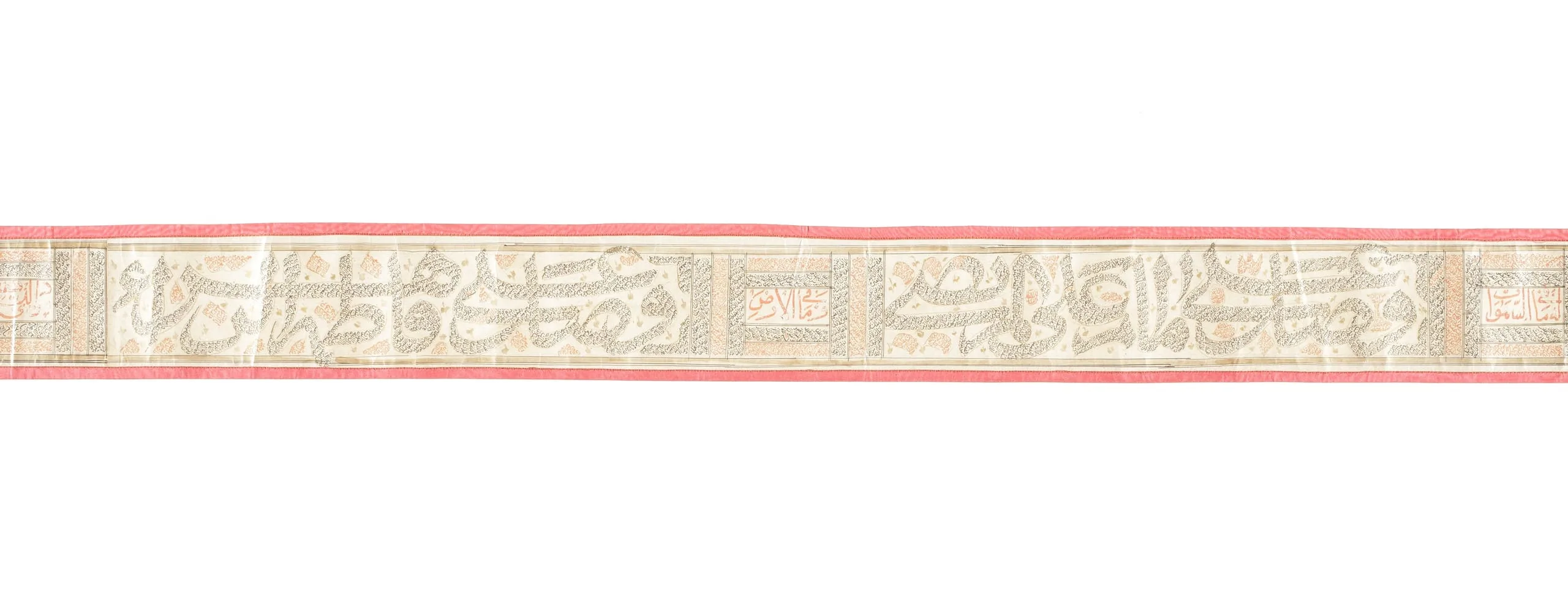
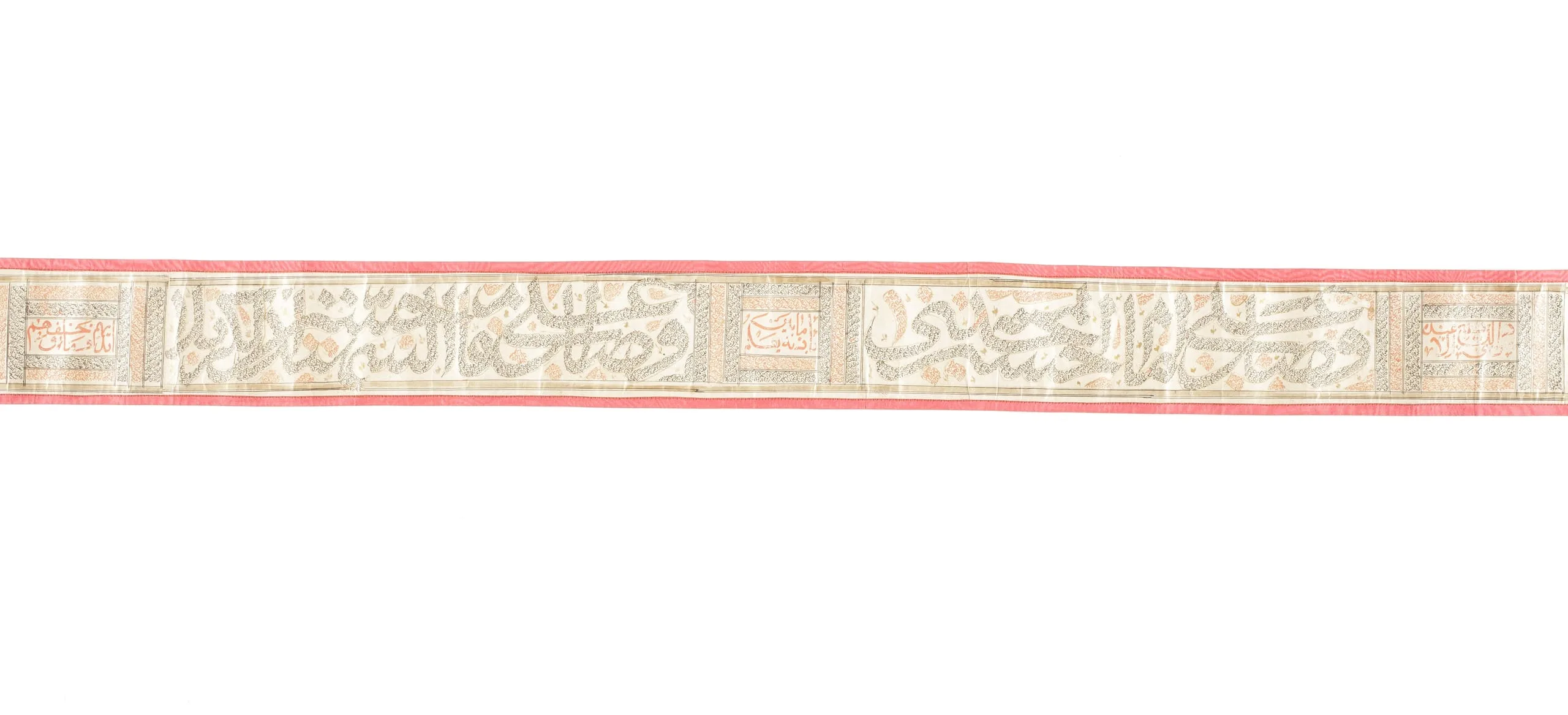
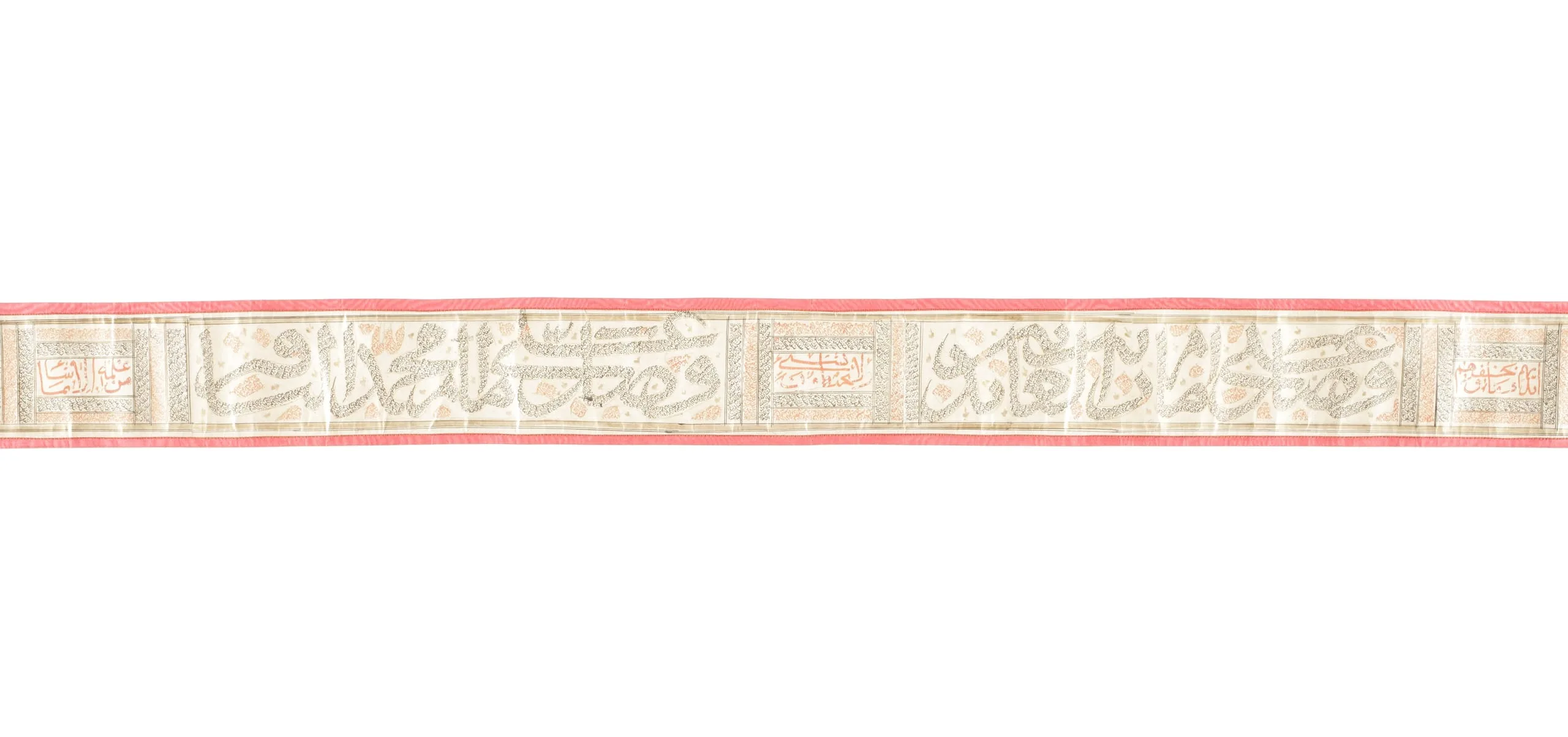
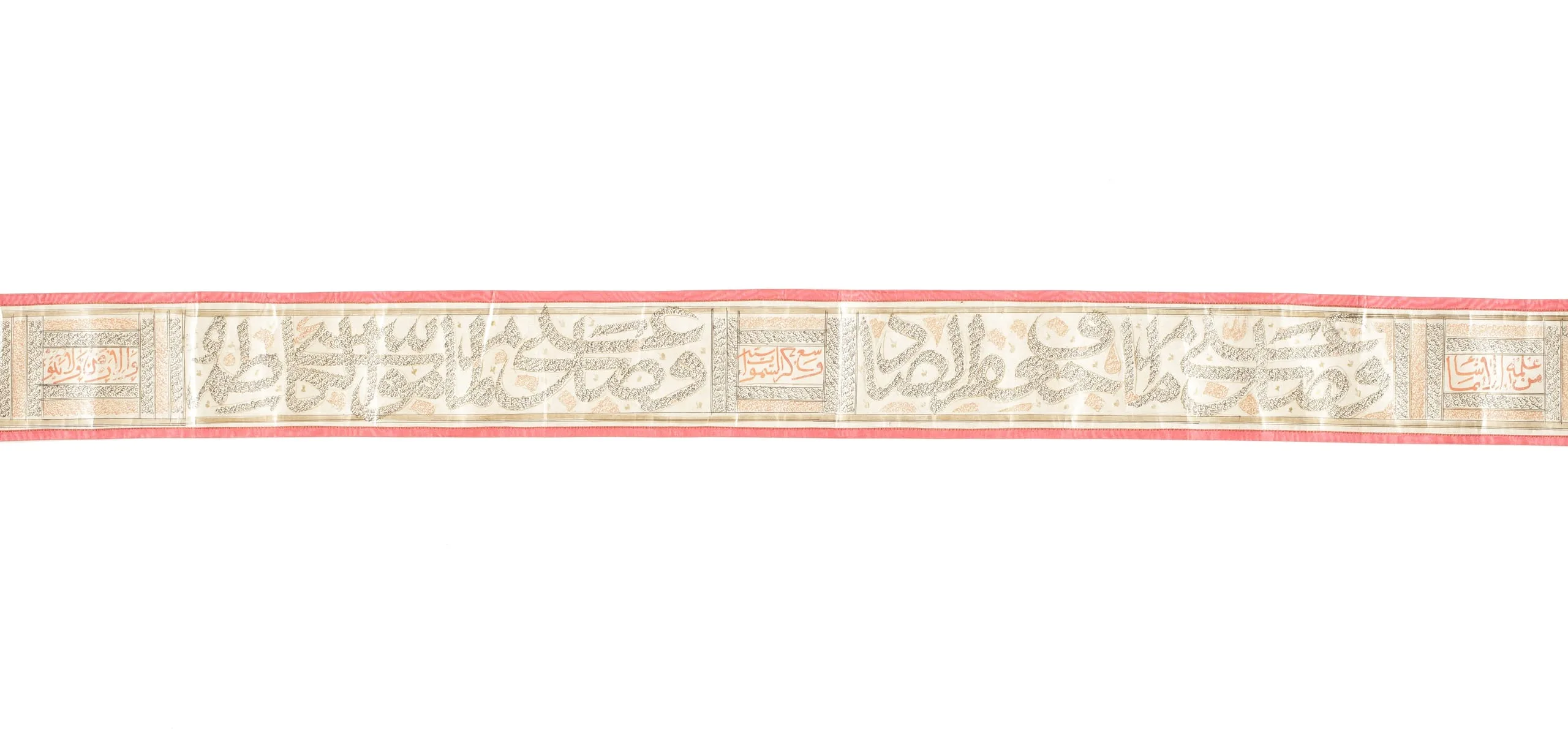
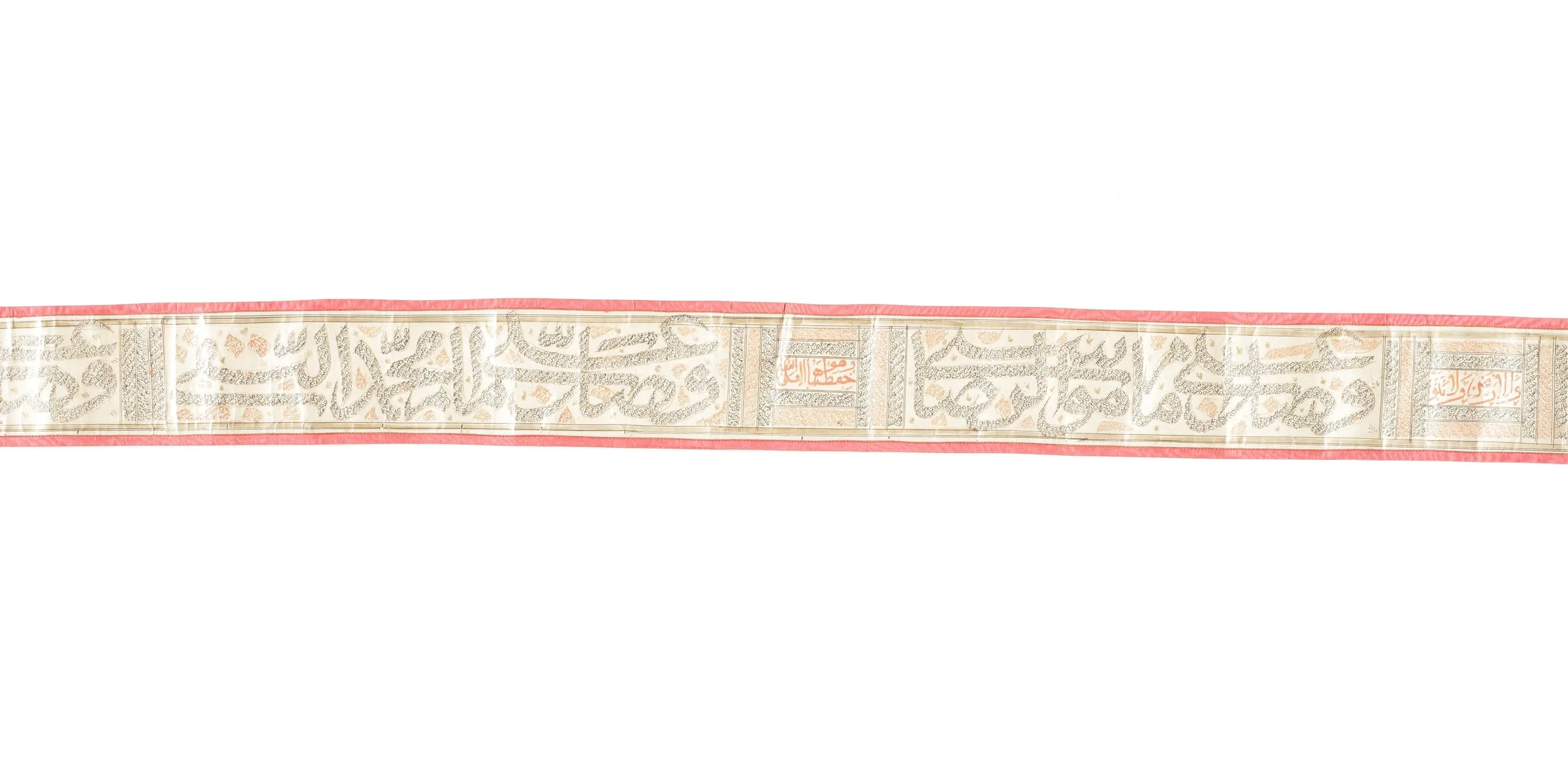
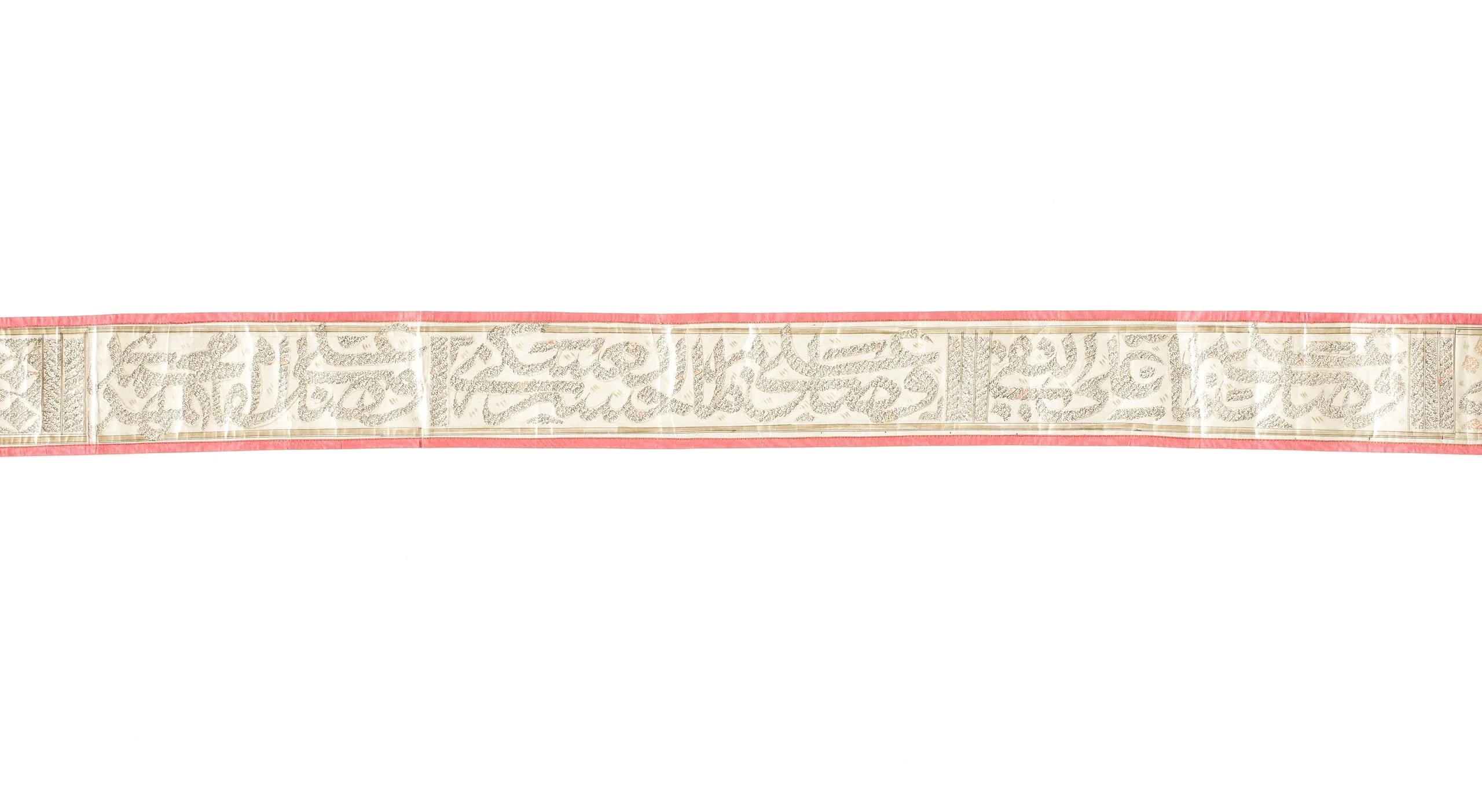
Scroll of the Qur'anearly 19th century

Not on view
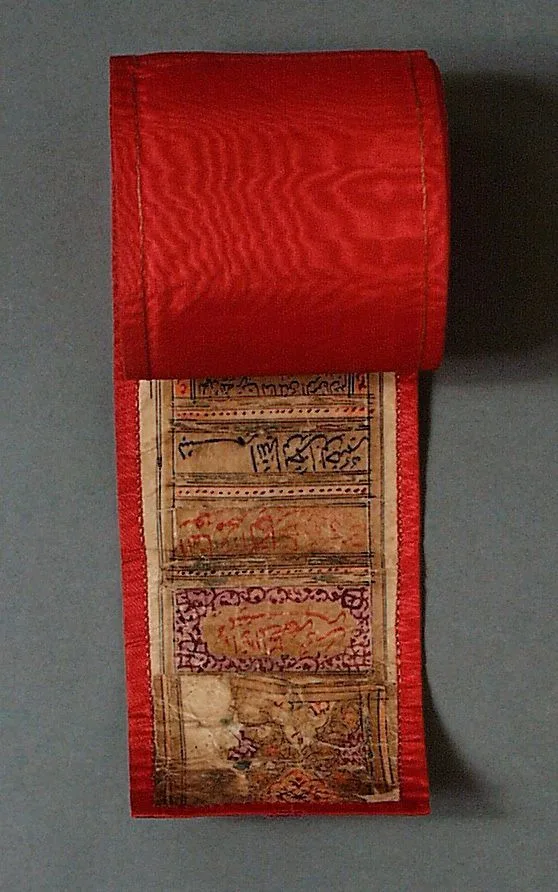
Partially unrolled manuscript scroll with crimson red moiré textile casing, revealing cream-colored paper with registers of Arabic or Persian script in black and red ink
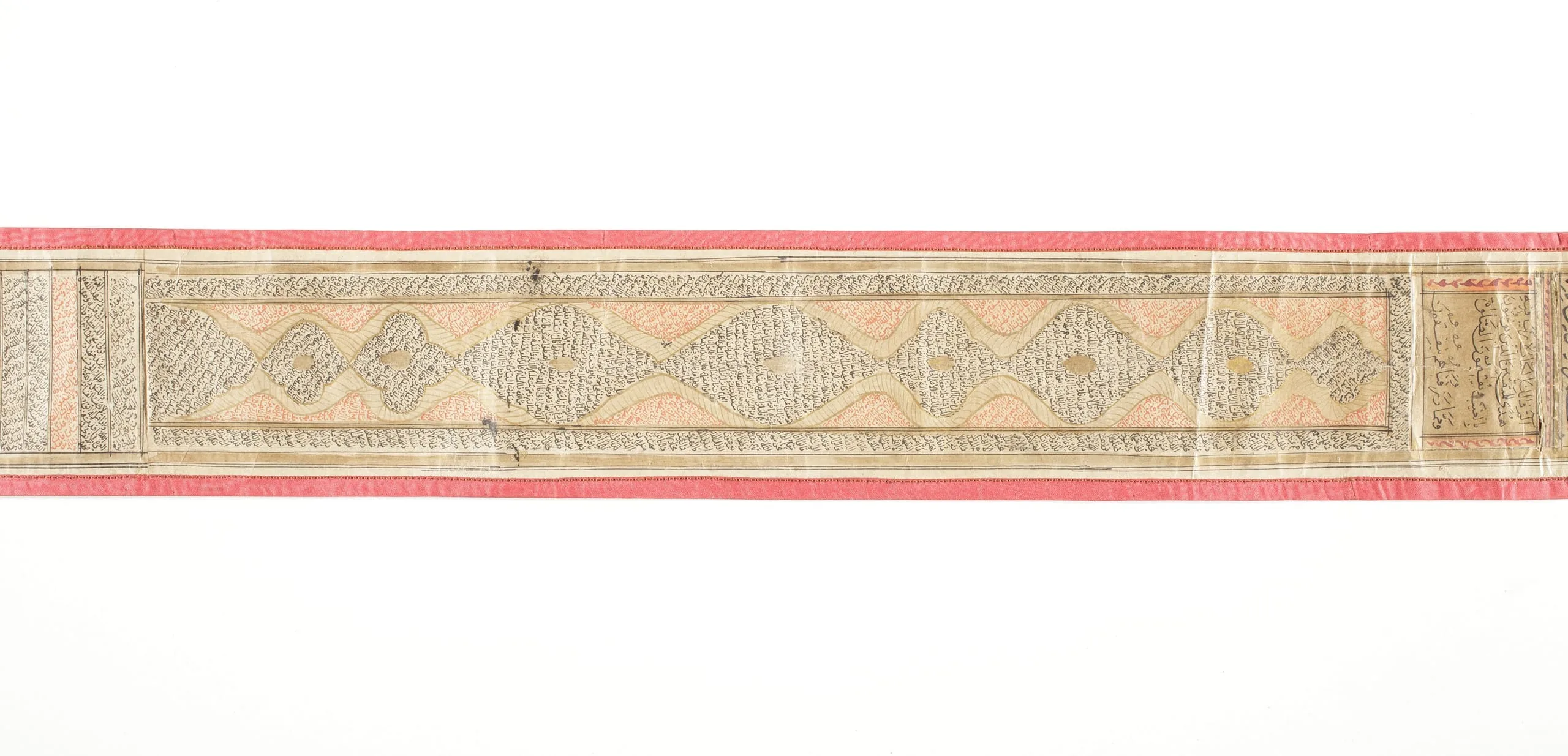
Horizontal manuscript strip with red fabric borders, featuring dense Arabic-script calligraphy arranged within interlocking diamond and lozenge-shaped medallions on a pale pink ground with gold accents; a column of Arabic script visible at right edge.
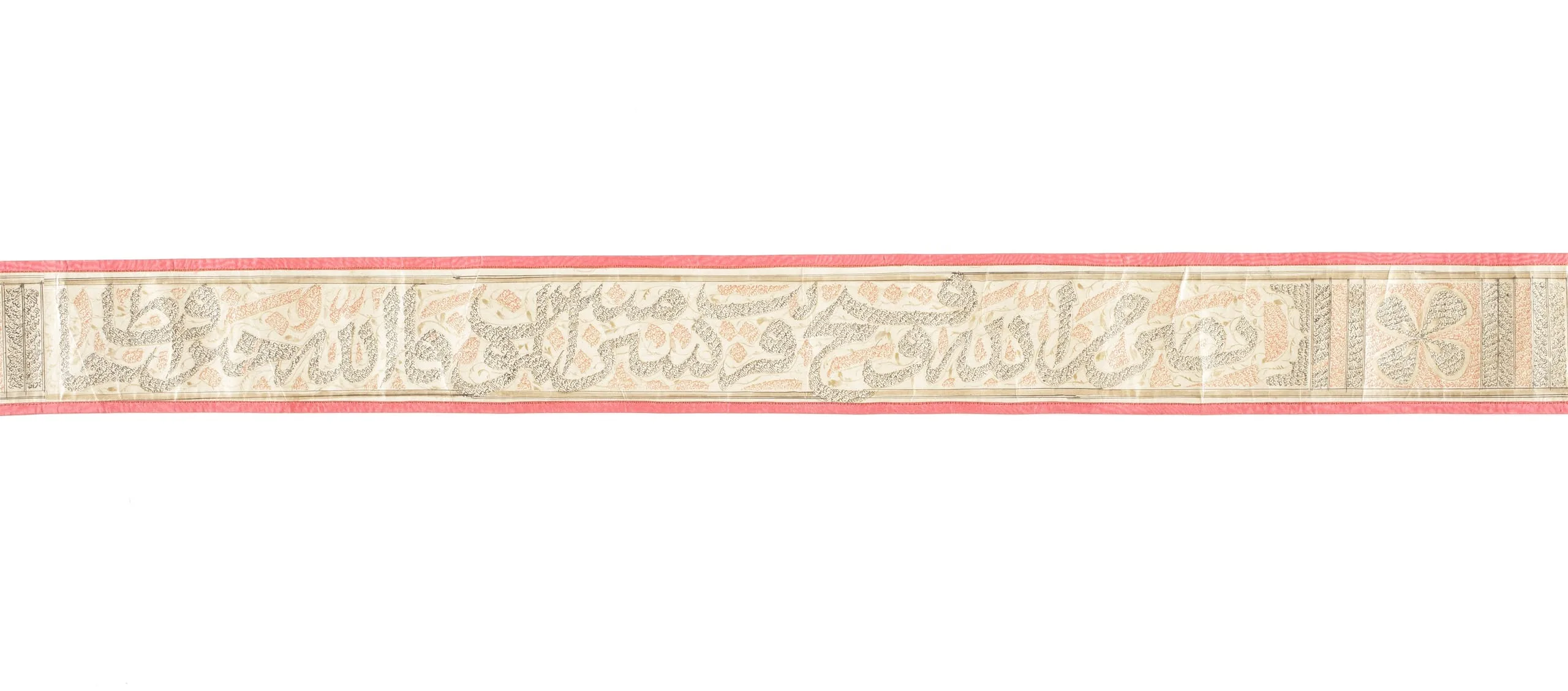
Narrow horizontal textile band with red borders enclosing a cream ground decorated with a continuous Arabic inscription in silver and gold thread, with small floral motifs at intervals.
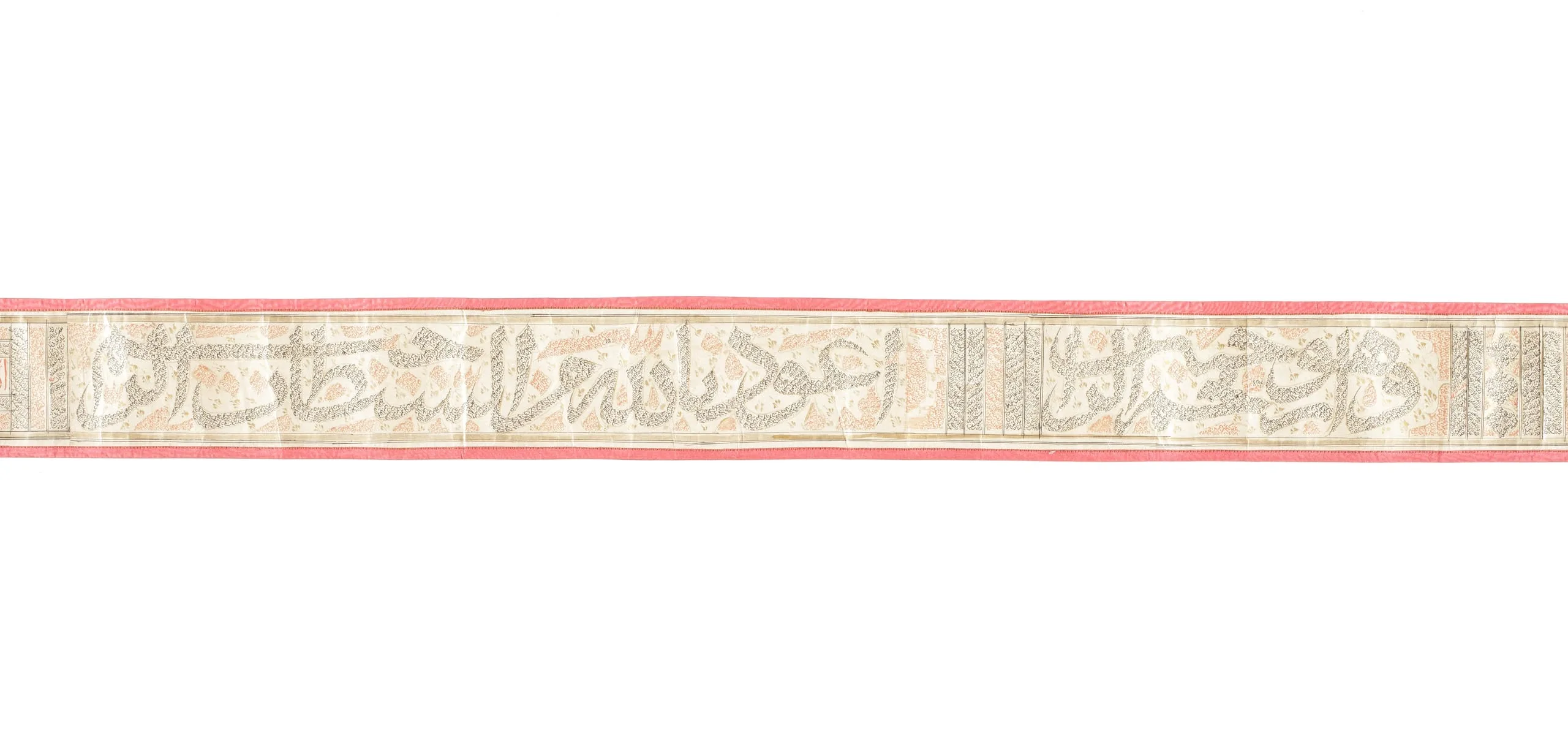
Narrow horizontal textile band with Arabic calligraphy in grey-green thread on a cream ground, bordered by red stripes along the upper and lower edges.
Narrow horizontal textile band with red borders, featuring Arabic calligraphic inscriptions in silver-grey thread on a pale ground, with small framed cartouches containing red Arabic script at intervals.
Horizontal textile or paper band with Arabic calligraphy in flowing naskh script, framed by a red border, with rectangular cartouches interspersed among the text on a cream ground.
Narrow woven textile band with cream ground and red border edges, densely inscribed with Arabic calligraphy in silver and gold threads, interspersed with small rectangular cartouches containing red script.
Narrow horizontal textile band with red borders enclosing panels of Arabic calligraphy in silver and red thread on a pale ground.
Horizontal textile band with red border stripes enclosing large Arabic calligraphy in silver and orange thread on a pale ground, with small rectangular cartouches interspersed throughout.
Narrow horizontal textile band with red border edges, densely inscribed with Arabic calligraphy in dark ink on cream ground, with small red accent text within rectangular cartouches.
Narrow textile band with metallic gold-embroidered Arabic script on cream ground, divided into rectangular panels by thin borders, with red selvedge edges along top and bottom.

Unknown, Scroll of the Qur'an, early 19th century (alternate view), Los Angeles County Museum of Art, The Edwin Binney, 3rd, Collection of Turkish Art at the Los Angeles County Museum of Art, photo © Museum Associates/LACMA

Title
Scroll of the Qur'an
Place Made
Turkey
Date Made
early 19th century
Medium
Ink, opaque watercolor and gold on paper
Dimensions
2 x 234 in. (5.1 x 594.6 cm)
Credit Line
The Edwin Binney, 3rd, Collection of Turkish Art at the Los Angeles County Museum of Art
Accession Number
M.85.237.63
Classification
Manuscripts
Collecting Area
Art of the Middle East: Islamic
Curatorial Notes

In Islam, the Qur’an is the revealed word of God shared with the Prophet Muhammad in the early seventh century. As the religion’s foundational scripture, it is not only an important spiritual resource for Muslims but often also a key component in their artistic expression. Artists and architects use Qur’anic texts as inscriptions on objects and buildings, while manuscript calligraphers and illuminators beautify complete written copies of the Qur’an, known as masahif (sing. mushaf), with fine writings and rich decoration often in precious metals such as gold and silver.

Throughout the centuries, Muslims have used masahif in different ways—as aide-mémoires for recitation, codices to be read, and as talismans. The form of this manuscript as a scroll with minuscule script arranged in patterns makes it unlikely that it was meant to be read or recited. Rather, it was more likely used as a talisman to protect against evil and harm, and would have been worn close to the body in a case of leather, fabric, or metal. The LACMA collection includes another Qur’an similarly worn for protection in the form of a miniature octagonal codex and stored in a metal case (M.91.364.43).

2024

Selected Bibliography
  • Denny, Walter B. Turkish Treasures from the Collection of Edward Binney, 3rd. Portland, OR: Portland Art Museum, 1979.
  • Overton, Keelan. "A History of Ottoman Art History Through the Private Database of Edward Binney, 3rd." Journal of Art Historiography 6 (2012): 1-19.