LACMA

ShopMembershipMyLACMATickets
LACMA
Los Angeles County Museum of Art
5905 Wilshire Blvd.
Los Angeles, CA 90036
info@lacma.org
(323) 857-6000
Sign up to receive emails
Subscribe
© Museum Associates 2025

Museum Hours

Monday

11 am–6 pm

Tuesday

11 am–6 pm

Wednesday

Closed

Thursday

11 am–6 pm

Friday

11 am–8 pm

Saturday

10 am–7 pm

Sunday

10 am–7 pm


  • About LACMA
  • Jobs
  • Building LACMA
  • Host An Event
  • Unframed
  • Press
  • FAQs
  • Log in to MyLACMA
  • Privacy Policy
© Museum Associates 2025
Collections

Hafiz Faydullah/Hakkakzade
Manuscript comprising a compendium of devotional works, including the Dala'il al-Khayrat (Guides to Good Things) by al-Jazuli1787/A.H. 1201

Not on view
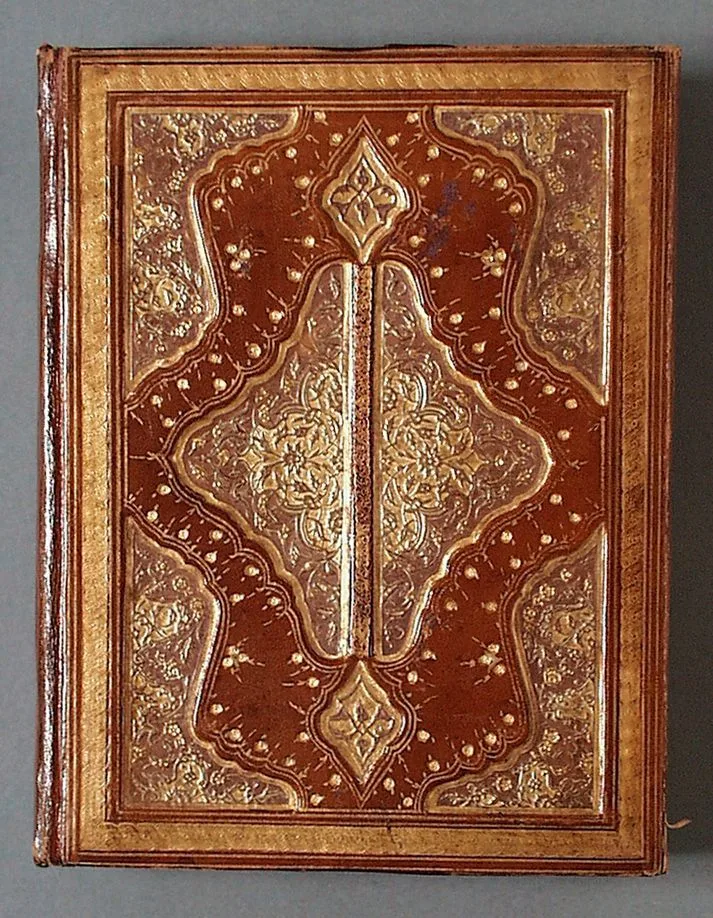
Leather book cover with gold-tooled arabesque decoration on a deep auburn ground, featuring a large central ogee medallion with a floral rosette and scattered dot motifs
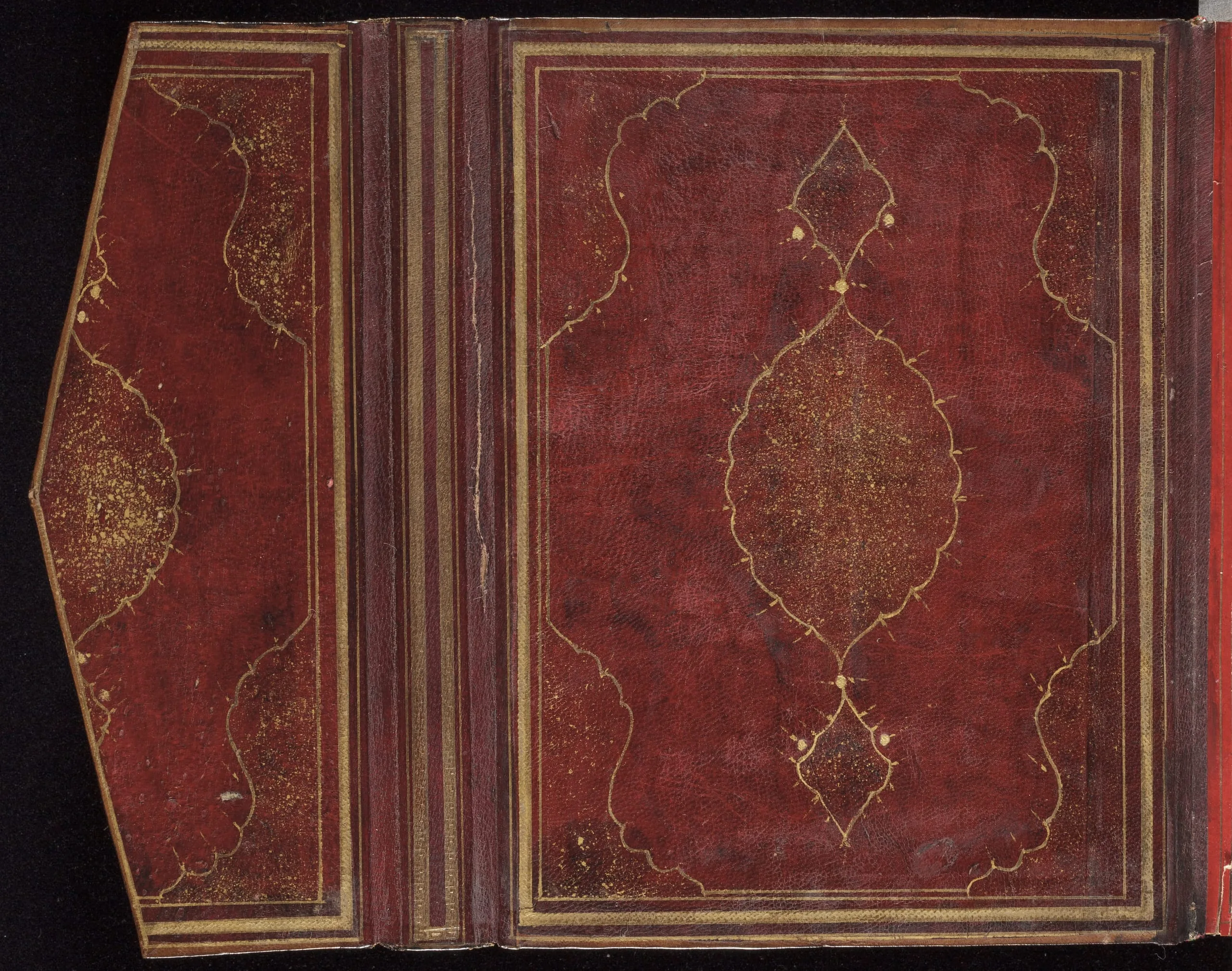
Leather book binding in deep red with gilt-stamped decoration: a central lobed medallion on the front cover, surrounded by delicate gold vine scrollwork within a double-ruled border; a flap with a half-medallion extends to the left.
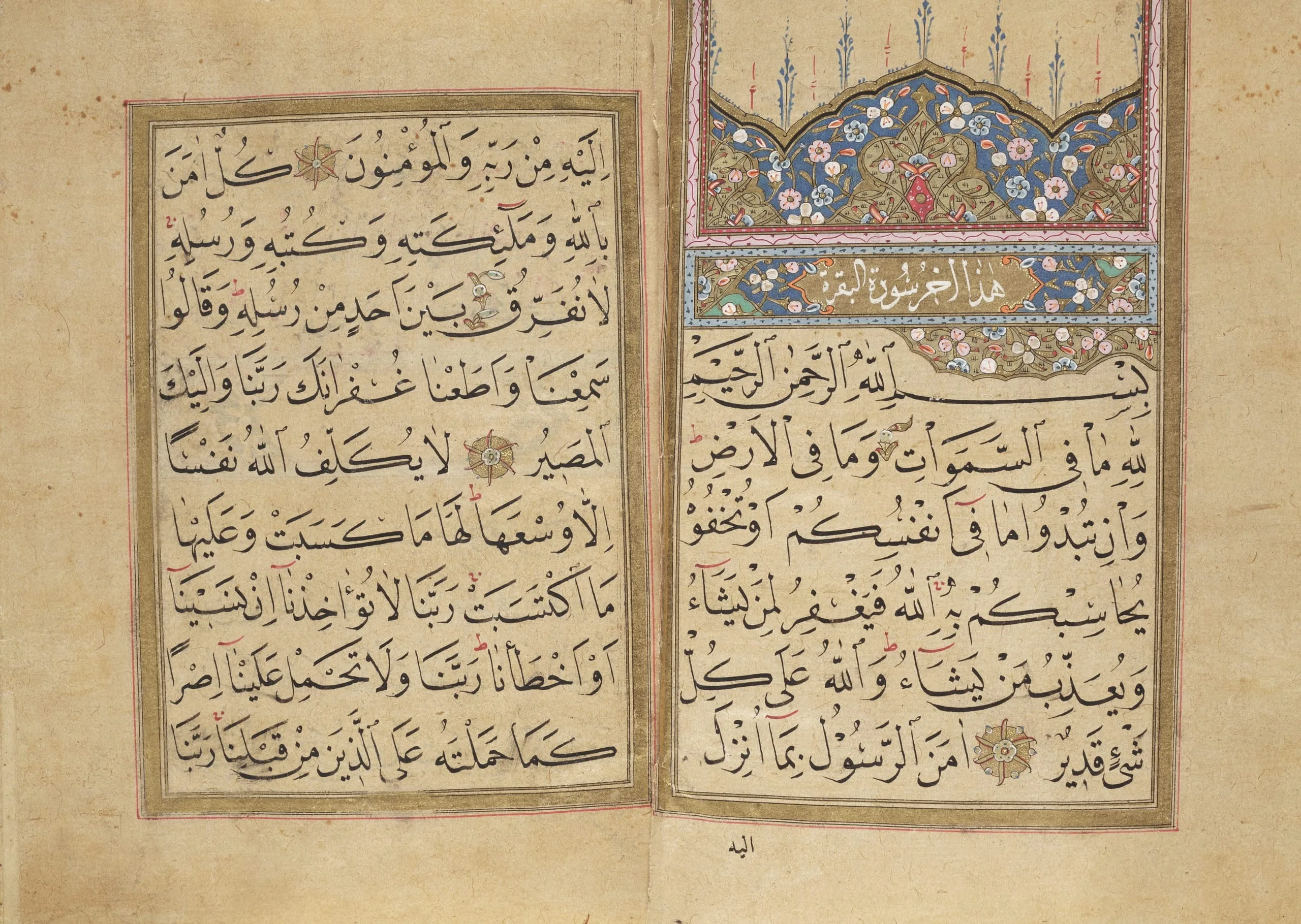
Illuminated manuscript spread with Arabic calligraphy in black naskh script on aged cream paper; right page features a polychrome floral headpiece in blue, red, and gold with an arched medallion design above the text columns; red ruled borders frame both pages.
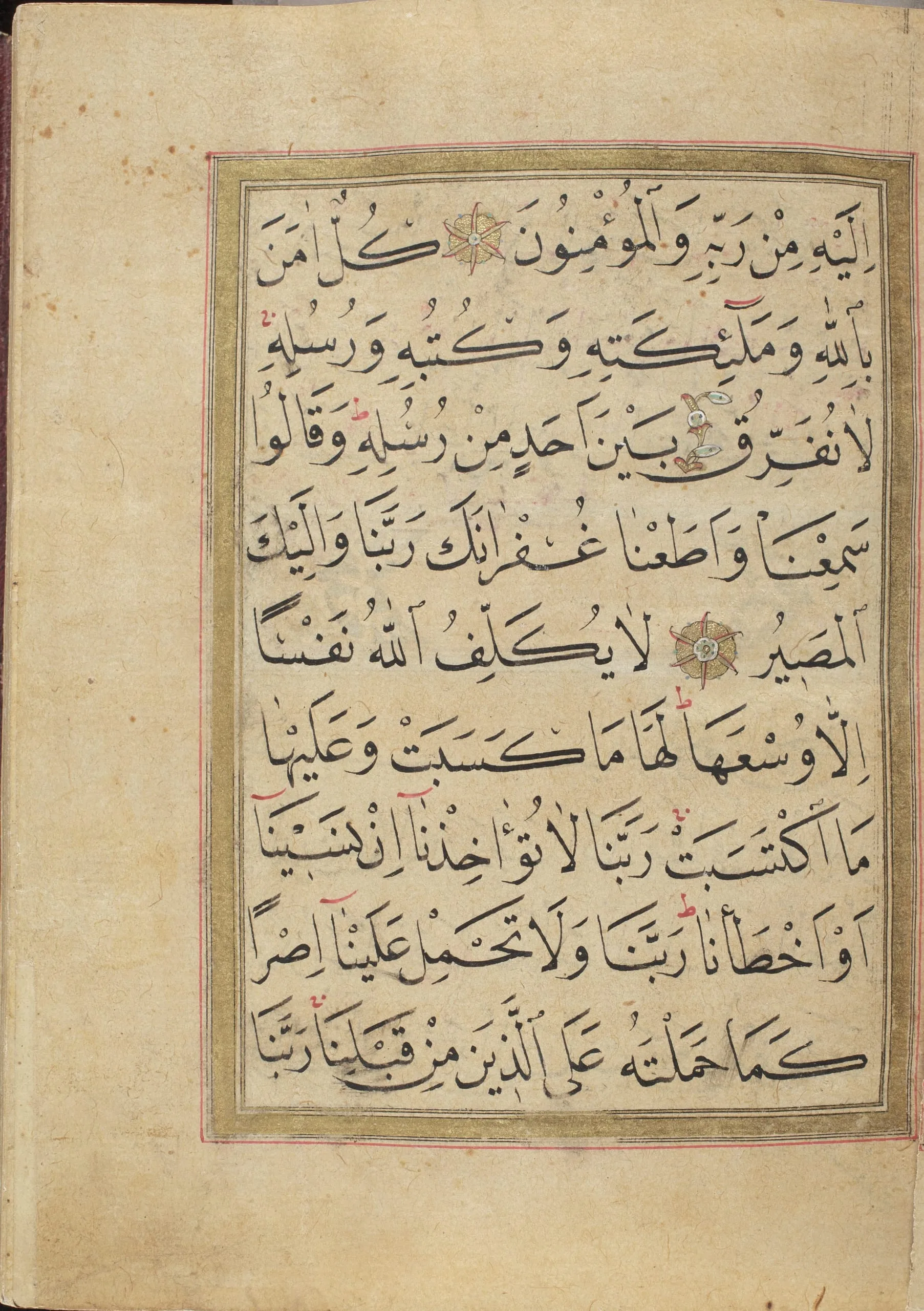
Manuscript page with Arabic calligraphy in naskh script, black ink on cream-colored paper, framed by thin red and gold ruled borders, with small gold rosette verse markers.
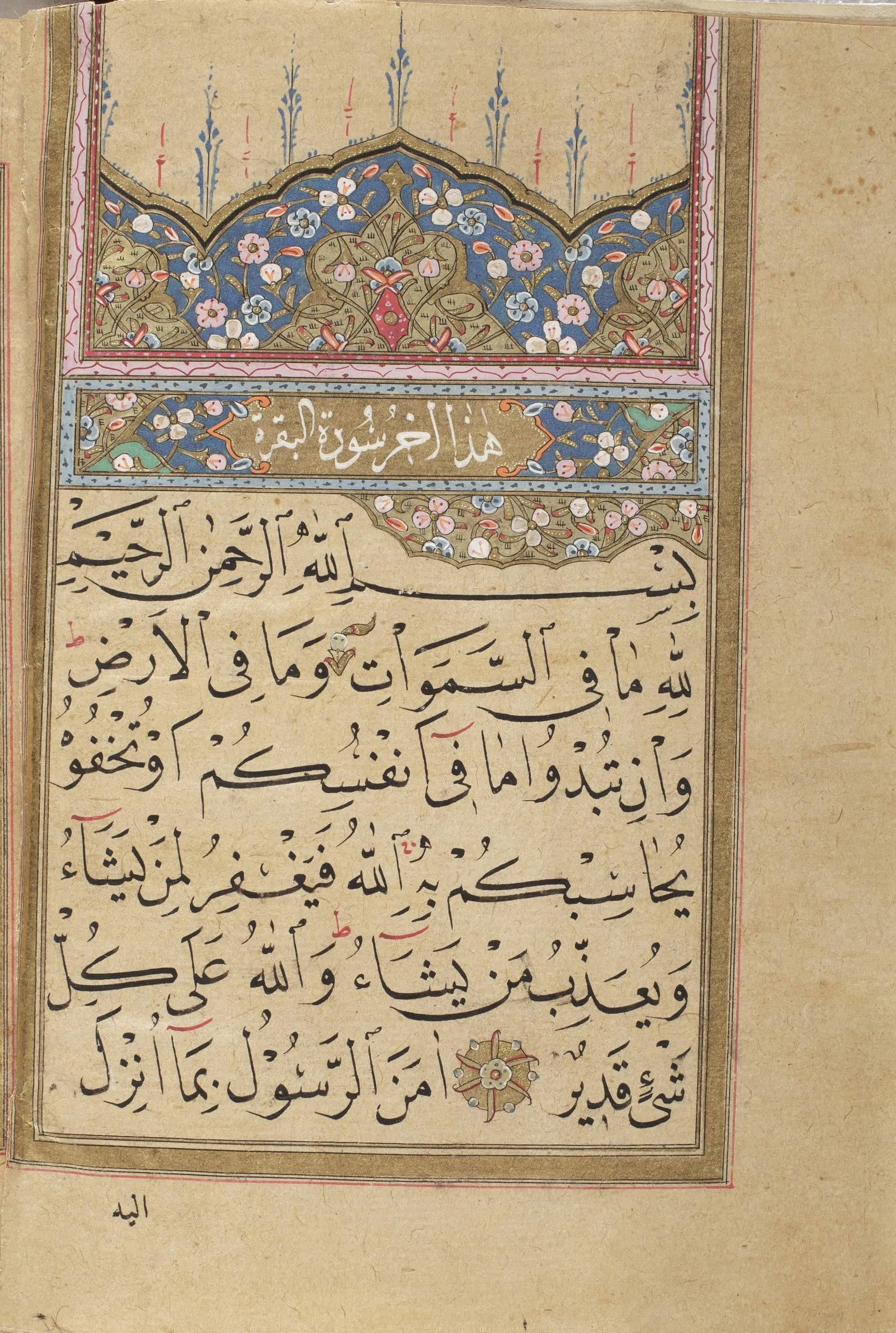
Illuminated manuscript page with Arabic calligraphy in large naskh script on cream-colored paper, topped by a decorated headpiece featuring a pointed arch with blue floral arabesque panels, pink and white blossoms, and gold leaf detailing. A framed cartouche with white Arabic script on blue ground sits below the headpiece.
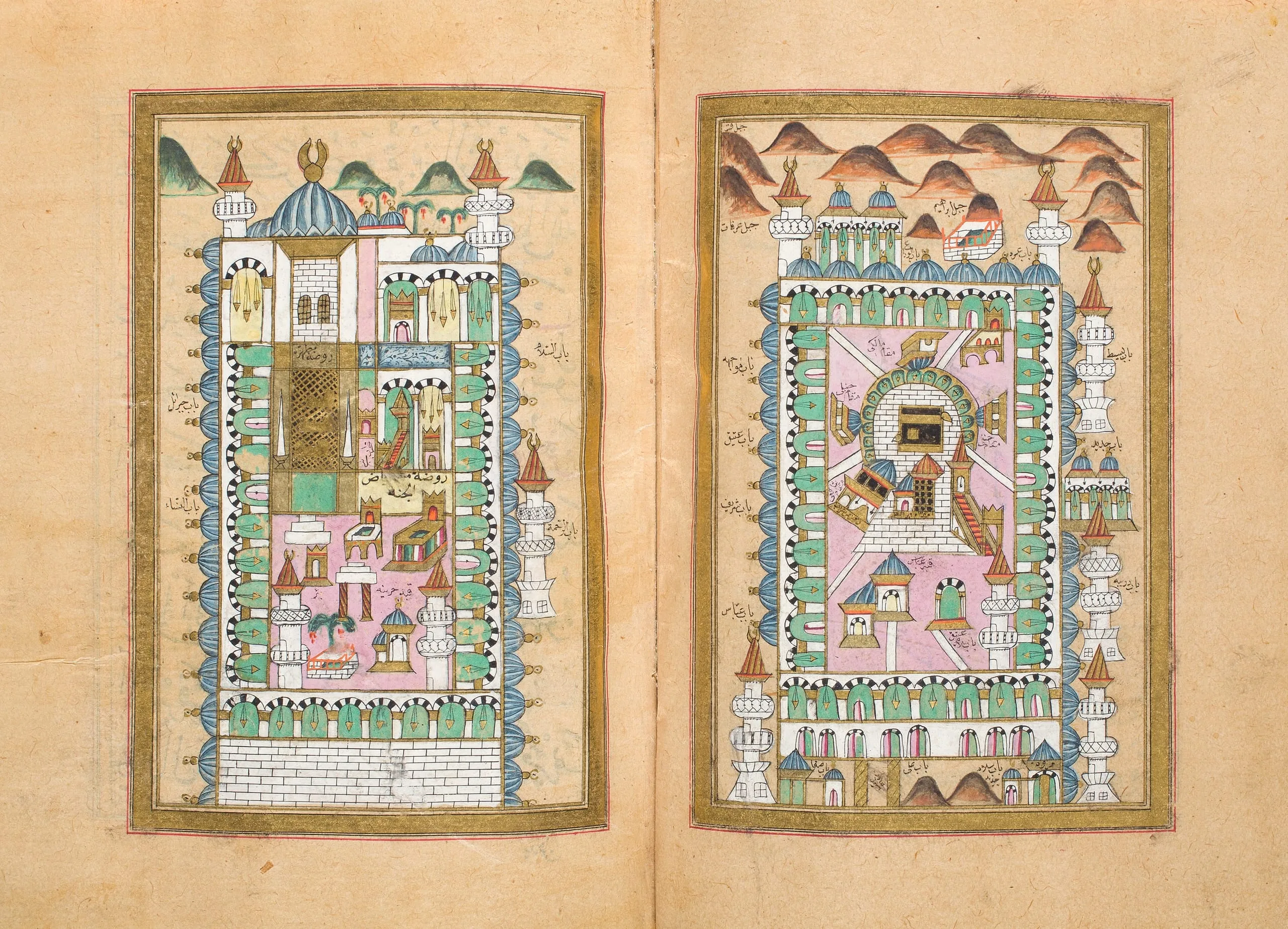
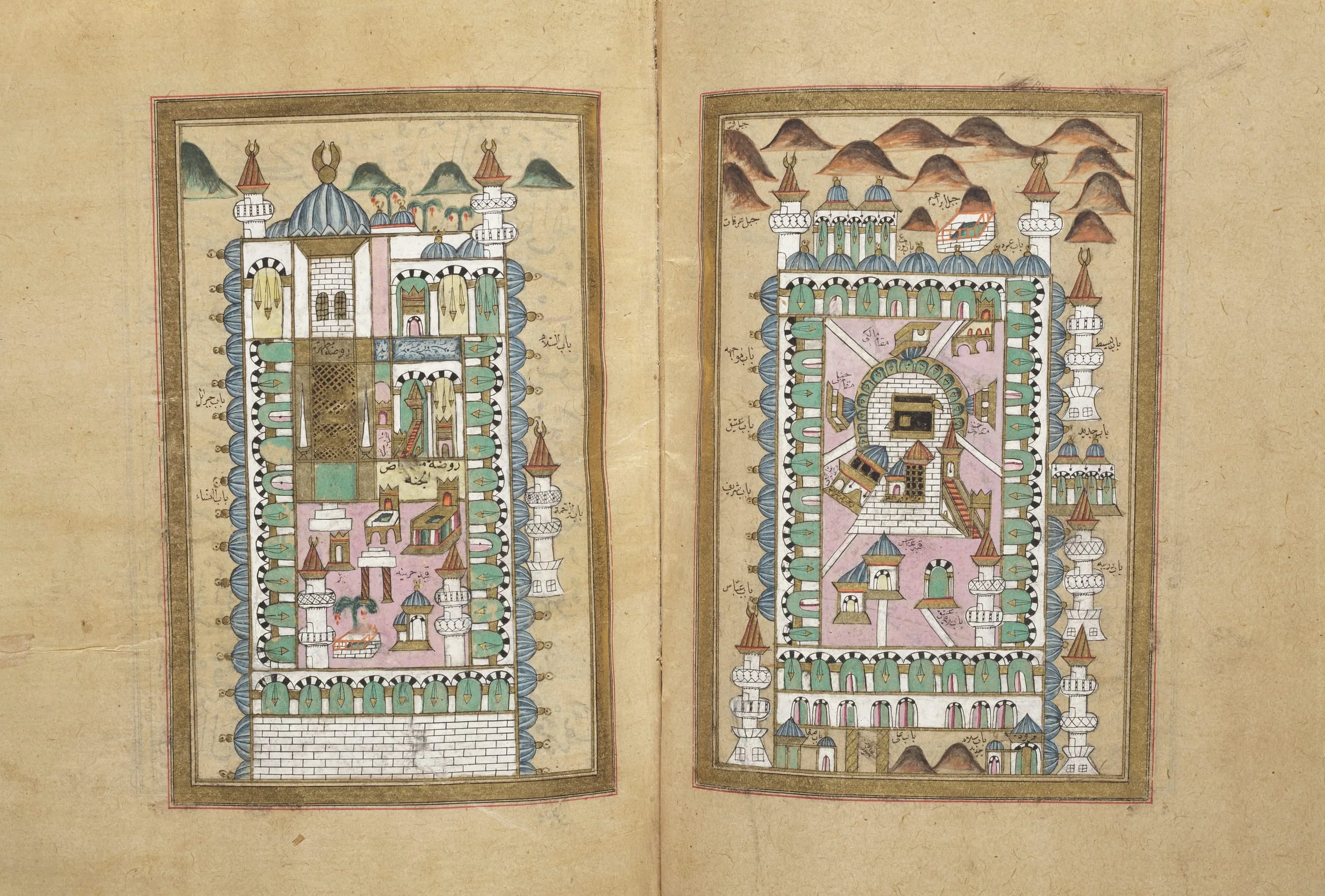
Illustrated manuscript double-page spread with opaque watercolor and gold on paper, depicting two sacred sanctuary plans in pink, green, and white with Arabic script annotations; left page shows a frontal mosque elevation with blue dome, minarets, and arched colonnades; right page shows an aerial view of a cubic structure centered in a courtyard surrounded by colonnaded arcades, minarets, and brown hills along the upper border, both framed by scalloped decorative borders.
Manuscript double-page spread with two architectural diagrams rendered in gouache and ink on cream paper, each framed by gold-ruled borders and decorative green and checkerboard bands. Left page depicts a walled sanctuary complex with domed structures, minarets, and arched colonnades in pink, green, and blue. Right page shows a cubic stone structure at center within a courtyard surrounded by minarets and arcades. Both compositions topped by brown hills and scattered Arabic script annotations throughout.
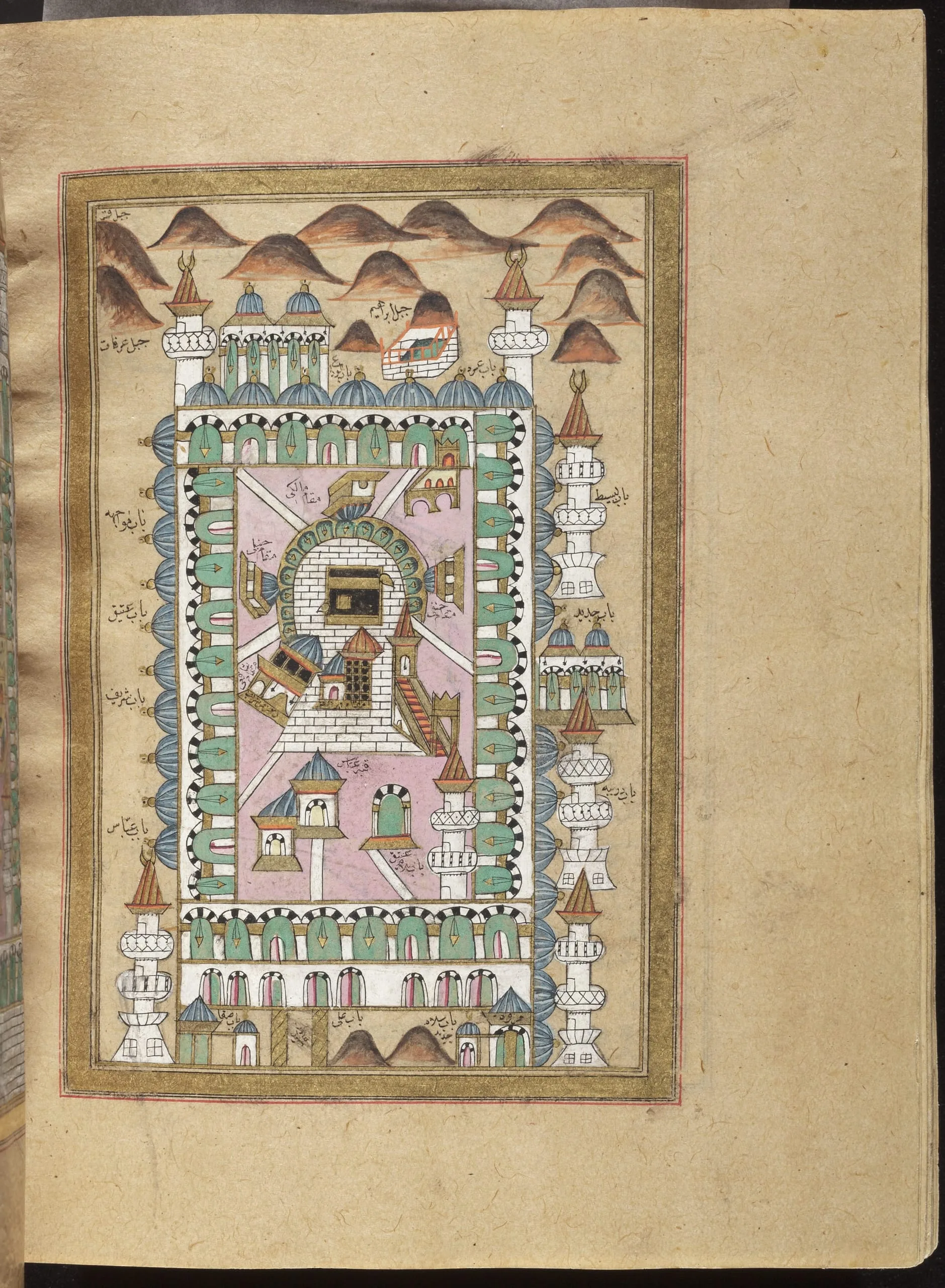
Manuscript illumination depicting a bird's-eye schematic view of a sacred enclosure, with a cubic structure at center surrounded by arcaded colonnades, minarets, and domed structures in green, white, and pink; rolling brown hills in the background; Arabic inscriptions throughout; gold-ruled border on aged parchment.
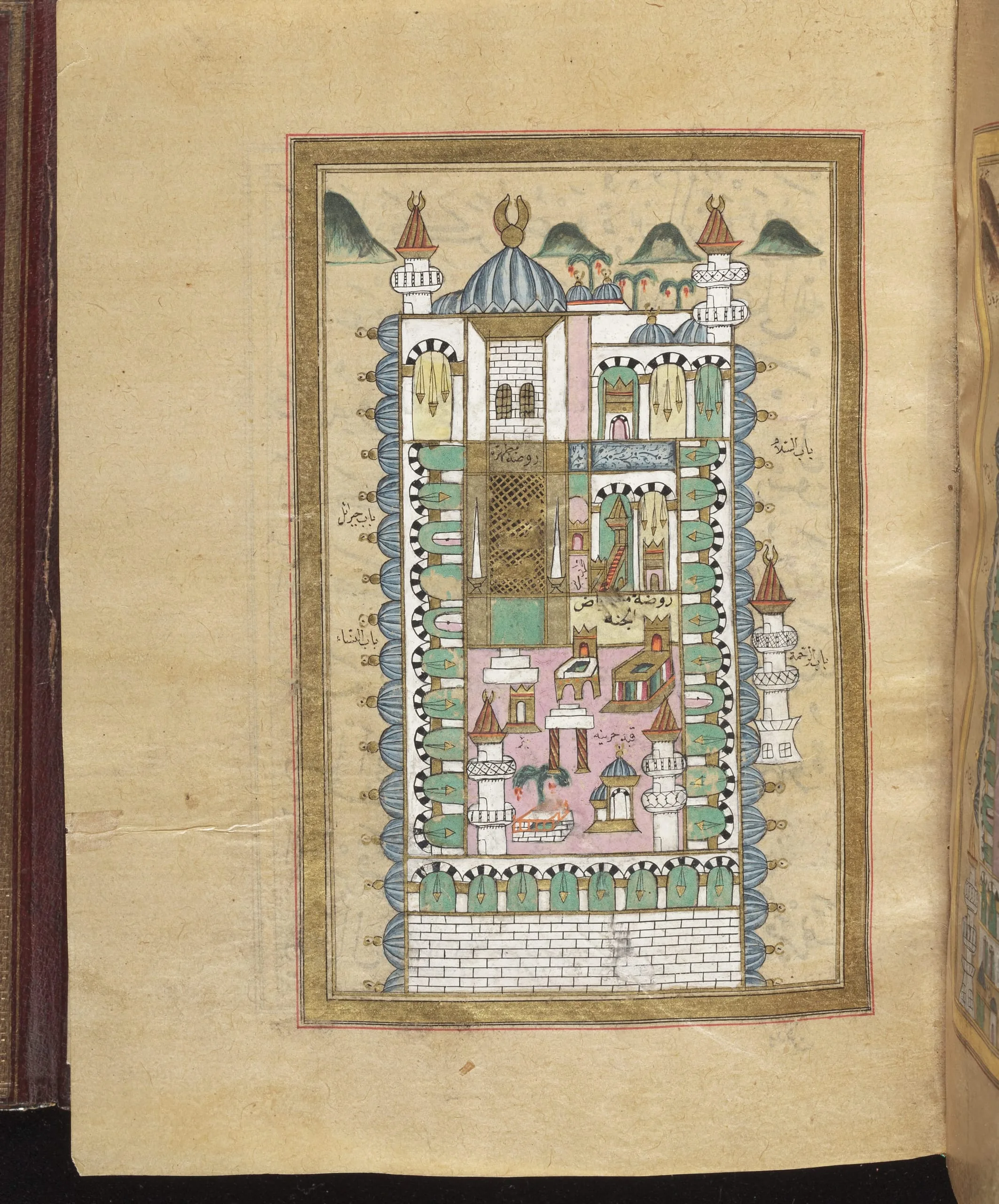
Illustrated manuscript page with a bird's-eye architectural diagram of a walled sacred complex, rendered in green, pink, blue, and gold. A central domed structure with a crescent finial is surrounded by colonnaded arcades, minarets, and smaller buildings. Arabic inscriptions label gates and structures along the margins. Blue and gray mountains appear above the enclosure walls.
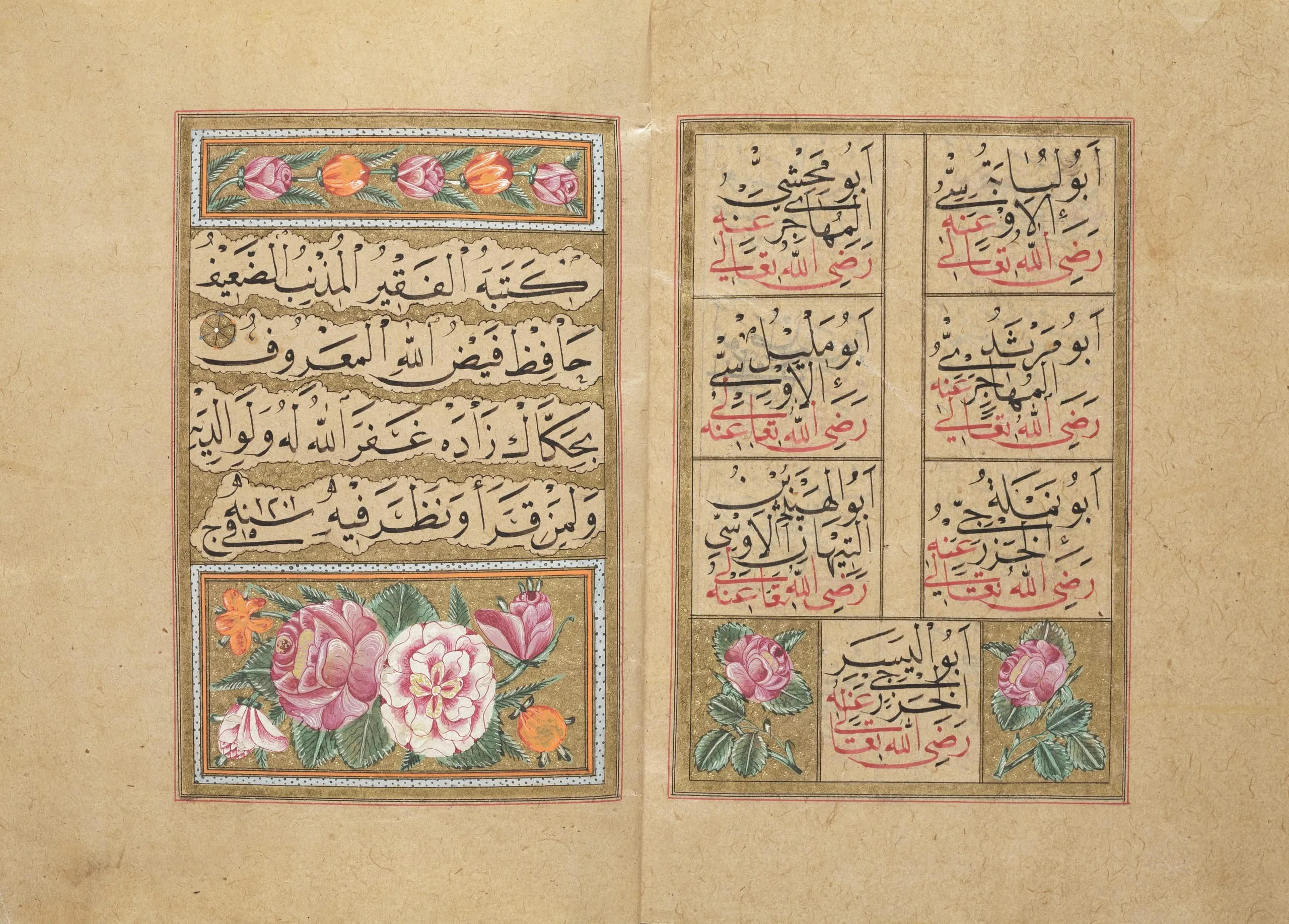
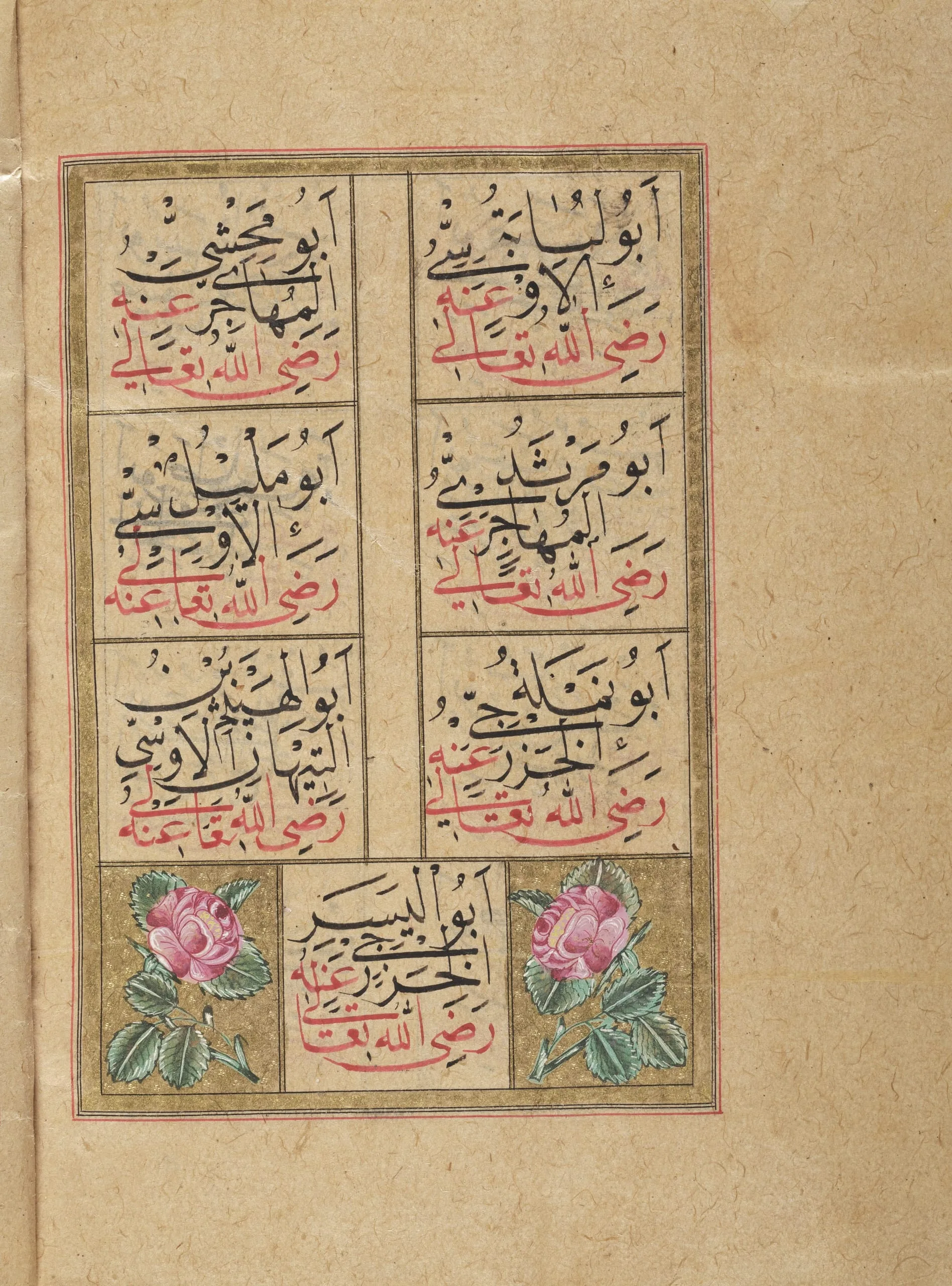
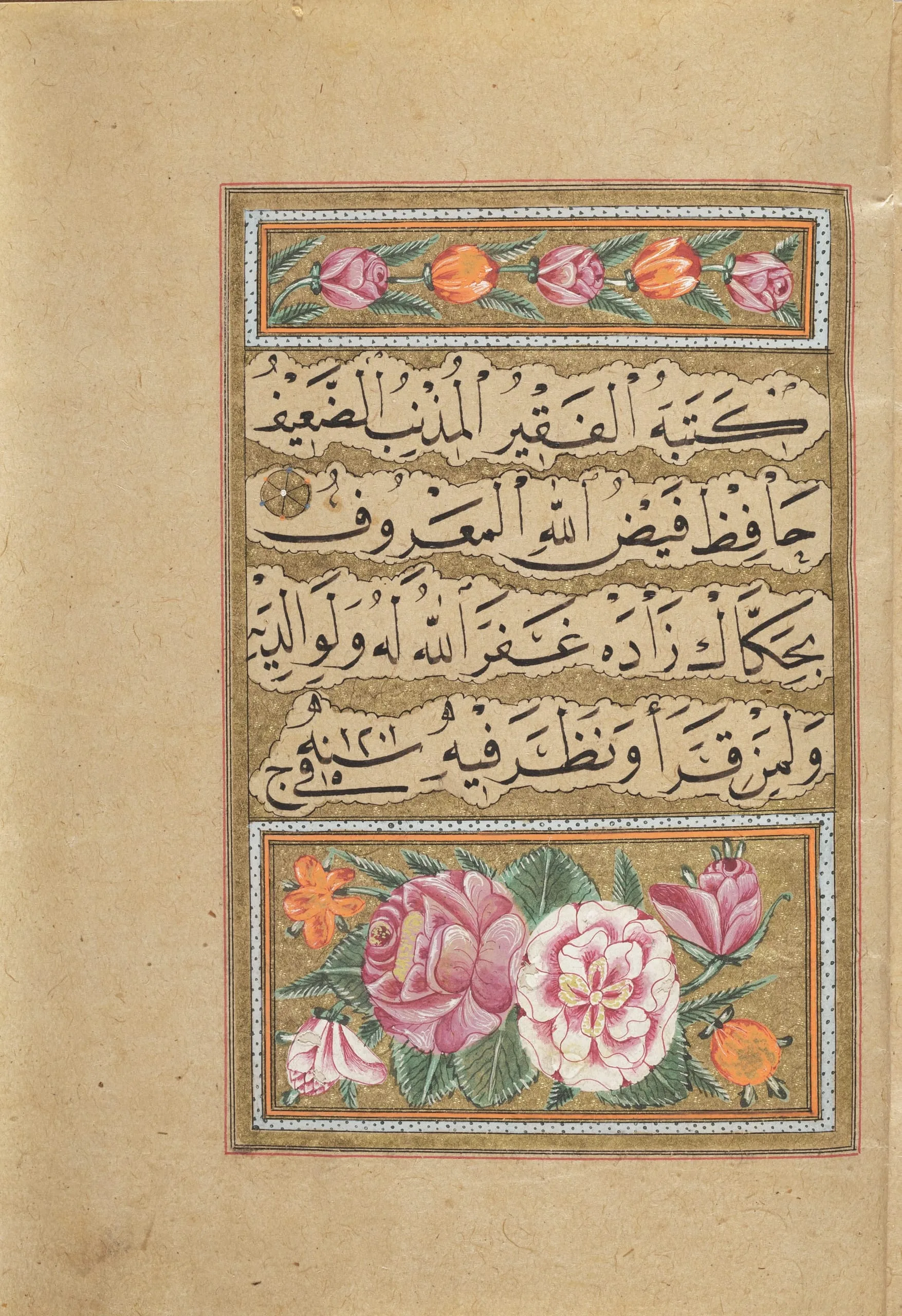
Illuminated manuscript bifolio with Arabic calligraphy in black and red naskh script on gold-flecked ground, bordered in blue geometric patterns. Left page features a floral header with tulips and roses and a large painted bouquet of pink peonies below. Right page divided into grid of text panels, each with small painted rose sprays.
Manuscript page with Arabic calligraphy arranged in a grid of seven panels, text in black and red ink on aged cream paper, bordered in gold and green; bottom panel flanked by painted pink roses with green leaves.
Illuminated manuscript page with four lines of large Arabic calligraphy in naskh script on a gold ground, framed by two rectangular floral panels featuring pink roses, tulips, and orange blossoms with green leaves against a gilded background, bordered with blue dotted and red ruled lines.
Artist or Maker
Hafiz Faydullah/Hakkakzade
Title
Manuscript comprising a compendium of devotional works, including the Dala'il al-Khayrat (Guides to Good Things) by al-Jazuli
Place Made
Turkey
Date Made
1787/A.H. 1201
Medium
Ink, opaque watercolor and gold on paper
Dimensions
7 5/8 x 5 7/8 in. (19.4 x 14.9 x 2.7 cm)
Credit Line
The Edwin Binney, 3rd, Collection of Turkish Art at the Los Angeles County Museum of Art
Accession Number
M.85.237.54
Classification
Manuscripts
Collecting Area
Art of the Middle East: Islamic
Curatorial Notes


Muhammad ibn Sulayman, called al-Jazuli (d. 1465), was the author of a guide for Turkish pilgrims making the hajj to the holy shrines of Mecca and Medina, a journey required of each Muslim if at all possible. Numerous examples of such guides are known, dating mainly from the eighteenth and nineteenth centuries in Sunni communities. Usual features of such manuscripts, as here, are depictions of the Kaʼba in Mecca and the mosque and tomb of the Prophet in Medina, among other shrines. Labels often accompany the images as a way of orienting the pilgrim during their travels or prayers.


While this guide could prepare an individual for pilgrimage, the manuscript remained important to many readers long after their journeys. Some served as mementos of the pilgrimage experience, and others allowed armchair travelers to visualize the holy sites from afar in a more intimate form of worship. Additionally, this collection of prayer-blessings lends itself to devotional recitation in groupings of 8, 4, and 2 prayers each. Worshippers sometimes also used their paintings in more tactile acts of devotion that activated the holy properties of these images. Many manuscripts of the Dala'il al-Khayrat bear traces of owners kissing, touching, and rubbing their faces or fingers on the images of these holy sites. In fact, some manuscripts experienced such frequent use that they suffered significant losses in their pigments as a result. A close look at the painting of Mecca in this manuscript reveals a prominent smudge in the shape of a fingerprint on the upper left entrance to the courtyard of the Masjid al-Haram, with another fingerprint smudge on the bottom wall to the holy sanctuaries in Madina on the left. While the exact reasons could vary, it is posited that some believers used these works as talismanic objects in order to obtain forgiveness for minor sins, protection, blessings, cures, or other forms of intercession that would spiritually connect the viewer to the holy sites, the Prophet Muhammad, and, of course, God.


By this period, the paintings of Mecca and Medina in al-Jazuli’s text could encompass naturalistic single-perspectival views that followed the latest Europeanizing trends, to multi-perspectival ones that had a much longer history in Ottoman painting. This bi-folio opening of the two cities follows the latter approach, which raises the hinter portion of courtyards and accompanying buildings so that the viewer could easily behold all of the key pilgrimage stations at once. In contrast, the illuminated program incorporates hyper-naturalistic depictions of roses on golden grounds as the headers and footers to each section. This manuscript thus combines old and new modes of painting within the same visual program.
Selected Bibliography
  • Lo Terrenal y lo Divino: Arte Islámico siglos VII al XIX Colección del Museo de Arte del Condado de Los Ángeles. Santiago: Centro Cultural La Moneda, 2015.