LACMA

ShopMembershipMyLACMATickets
LACMA
Los Angeles County Museum of Art
5905 Wilshire Blvd.
Los Angeles, CA 90036
info@lacma.org
(323) 857-6000
Sign up to receive emails
Subscribe
© Museum Associates 2025

Museum Hours

Monday

11 am–6 pm

Tuesday

11 am–6 pm

Wednesday

Closed

Thursday

11 am–6 pm

Friday

11 am–8 pm

Saturday

10 am–7 pm

Sunday

10 am–7 pm


  • About LACMA
  • Jobs
  • Building LACMA
  • Host An Event
  • Unframed
  • Press
  • FAQs
  • Log in to MyLACMA
  • Privacy Policy
© Museum Associates 2025
Collections

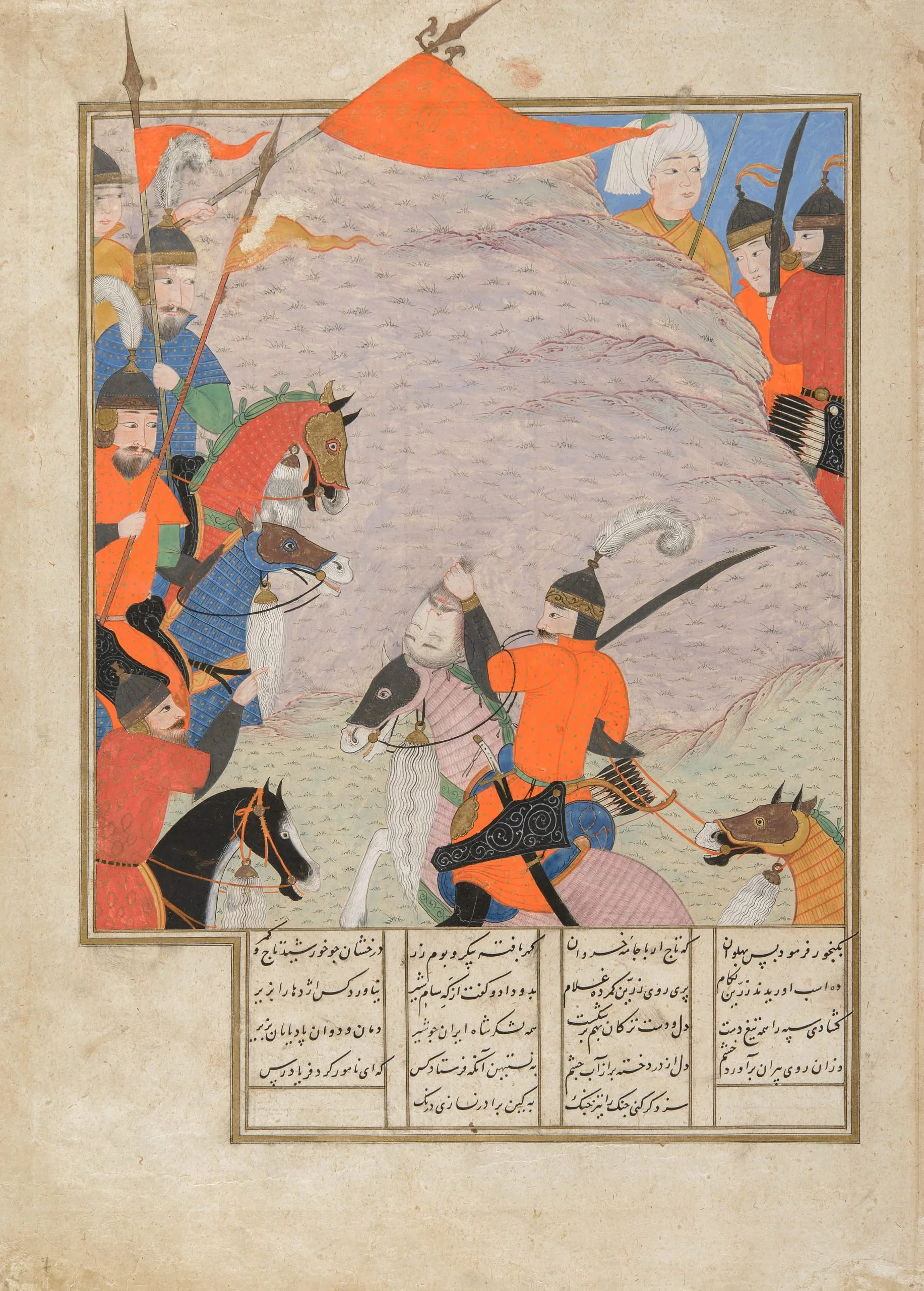
Bizhan Brings Back the Head of Human, Page from a Manuscript of the Shahnama (Book of Kings) of Firdawsi1494/A.H. 899

Not on view
Persian manuscript painting, mounted battle scene with multiple horsemen in orange robes and dark helmets, large pale gray billowing form at center, Persian script below
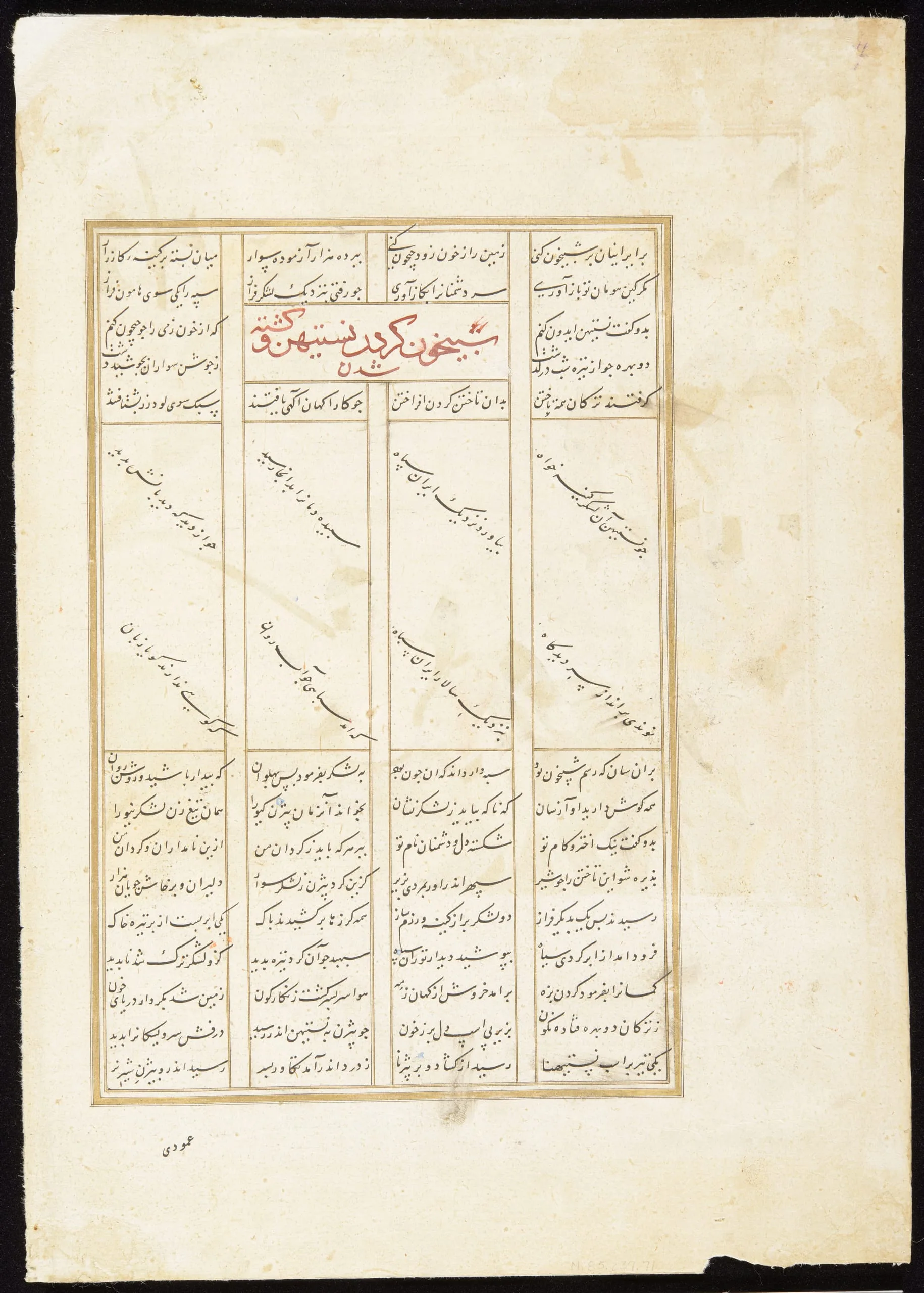
Manuscript page with four columns of Persian Nastaliq script in black ink, a central heading in red ink, and diagonal lines of verse in the middle registers, framed by a thin gold border on aged cream paper.
Title
Bizhan Brings Back the Head of Human, Page from a Manuscript of the Shahnama (Book of Kings) of Firdawsi
Place Made
Iran, Gilan
Date Made
1494/A.H. 899
Medium
Ink, opaque watercolor, and gold on paper
Dimensions
13 5/8 × 9 5/8 in. (34.61 × 24.45 cm) Frame: 15 × 20 × 1 1/2 in. (38.1 × 50.8 × 3.81 cm)
Credit Line
The Edwin Binney, 3rd, Collection of Turkish Art at the Los Angeles County Museum of Art
Accession Number
M.85.237.71
Classification
Manuscripts
Collecting Area
Art of the Middle East: Islamic
Curatorial Notes

Battle is a major theme of the Shahnama (Book of Kings), the Iranian national epic, which tells of the pre-Islamic kings, whose reigns are often punctuated by warfare, and the heroes who fight on their behalf. As this painting from a late fifteenth-century Shahnama manuscript demonstrates (also see M.75.24), illustrators rarely shied away from depicting the battlefield violence described throughout the poem. Here, the Iranian hero Bizhan triumphantly brandishes the head of his foe, a warrior named Human from the rival kingdom of Turan (Central Asia). Notably, the figures sport armor and weapons not of the epic’s ancient setting but of the period in which they were painted.
Selected Bibliography
  • Lo Terrenal y lo Divino: Arte Islámico siglos VII al XIX Colección del Museo de Arte del Condado de Los Ángeles. Santiago: Centro Cultural La Moneda, 2015.