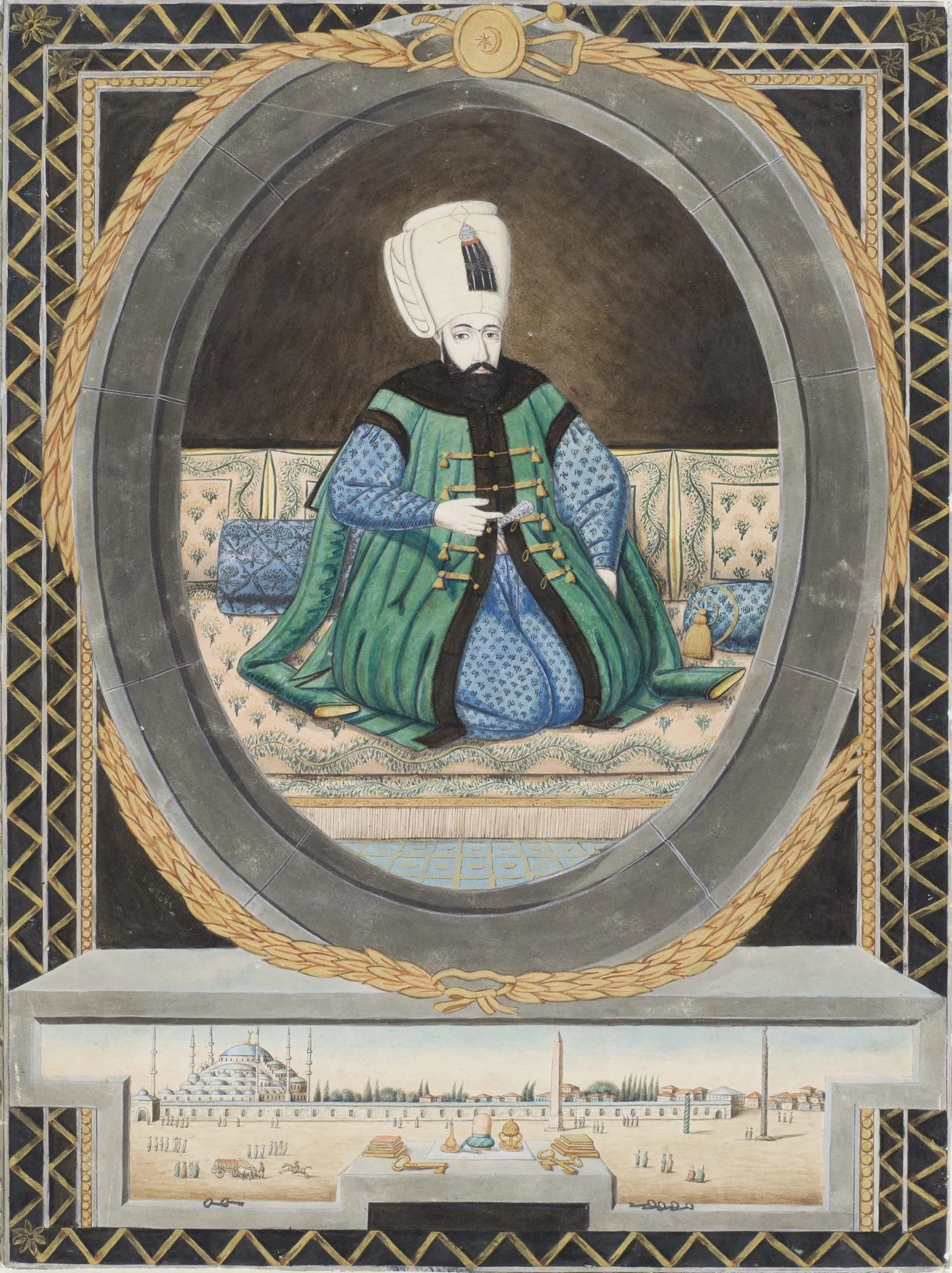
Series portraits of the sultans were a common feature of imperial Ottoman art even into the nineteenth century, when, as seen in this example, European influence is so strong that the only Turkish conventions are the pose of the sitter, his clothes, and the heraldic emblem of star and crescent above him. This painting relates to a series of royal Ottoman portraits that were subsequently engraved and printed in England in 1807. The scene below the seated figure of Sultan Ahmet is an allegorical reference to his reign, presenting symbols such as the keys to the Ka’ba; a turban from the favored order of dervishes; the so-called Blue Mosque, which he built; and the nearby Hippodrome.
During the mid to late eighteenth century, trends in sultanic portraiture transformed to encompass a wider range of media including oil on canvas and printed works. The current portrait is based on a series that Selim III (r. 1789-1807) commissioned from Konstantin Kapıdağlı, an Ottoman artist of Greek origin, who was expertly trained in European modes of painting, possibly thanks to training at a European institution. Kapıdağlı’s portrait series went on to receive Selim III’s approval before it was sent off to London in 1806, where engraved versions were produced and printed under John Young, the mezzotint engraver to the Prince of Wales. In the preface to this series, Young relates that Selim III originally requested the portraits and engraved plates to be sent back to Istanbul upon completion, so that no prints would be produced without his permission. However, Selim never had the chance to view the print series since he was dethroned in 1807. Despite this hurdle, the portrait series enjoyed a long afterlife once the project was finally brought to fruition in 1815. Yet far beyond the original intention of their imperial patron, these iconic portraits served as the reference for countless Ottoman genealogical trees (for example, AC1995.124.9) and many subsequent series during the nineteenth century, which included replicas of the painting here.
Moreover, Kapıdağlı’s portraits marked one of the last major series commissioned by a sultan before the sartorial reforms of Mahmud II (r. 1808-1839) in 1828, which introduced European-style uniforms to state and military officials. To support these reforms, as early as 1829 the sultan enthusiastically modeled this initiative in his own portraits that eschewed the traditional kneeling pose seen here. No longer donning the ceremonial caftan and turban of his forefathers, Mahmud II opted for an ensemble consisting of a fitted jacket, trousers, cape, and fez, which he proudly shows off in full-length, standing compositions.