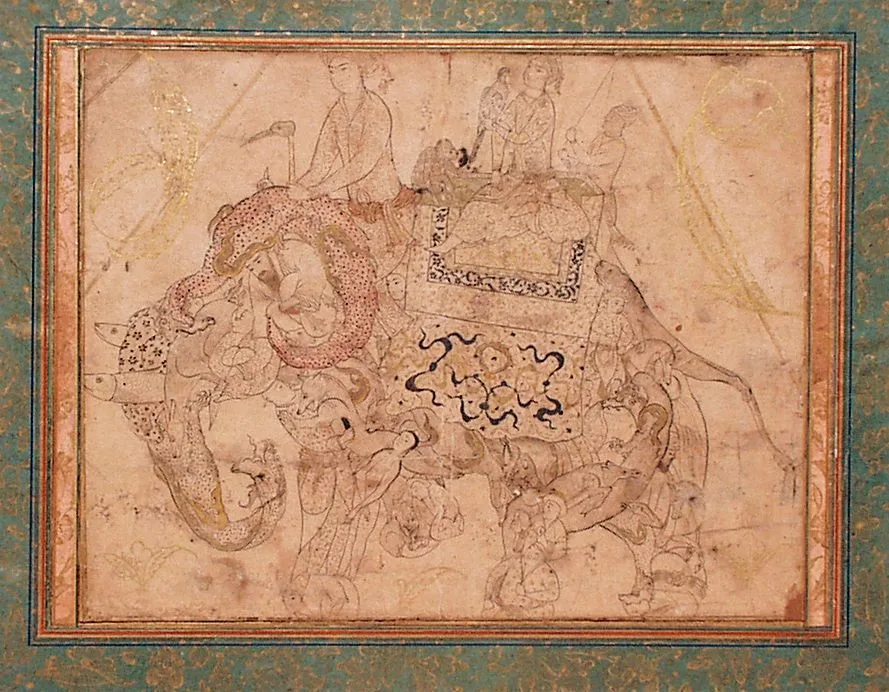
Although representations of fantastic or composite animals first appear in Indian art around the 2nd century BCE at the renowned Buddhist site of Sanchi, Madhya Pradish, they began to flourish in earnest in later Indian painting dating from the 16th–19th century. This later flowering was comprised of two distinct visual expressions known as the Mughal and Hindu traditions. The Mughal tradition, as exemplified by this LACMA drawing, features an intricate merging of disparate motifs including animal, human, and demonic source images. The Hindu tradition, in contrast, typically presents animals or other means of conveyance assembled from human figures, such as AC1993.123.2. Horses, elephants, and camels are the most common composite animals. See Robert J. Del Bontà, "Reinventing Nature: Mughal Composite Animal Painting," in Flora and Fauna in Mughal Art, ed. Som Prakash Verma (Mumbai: Marg Publications, 1999), pp. 69–82.
Here, a composite elephant is being ridden by a prince holding a falcon, a mahout, and an attendant. The elephant is formed by diverse creatures, predominantly real and fanciful animals, as well as several human figural stereotypes. Comparable Mughal composite elephants are in the San Diego Museum of Art (1990.292) and Cleveland Museum of Art (2013.282).