- Title
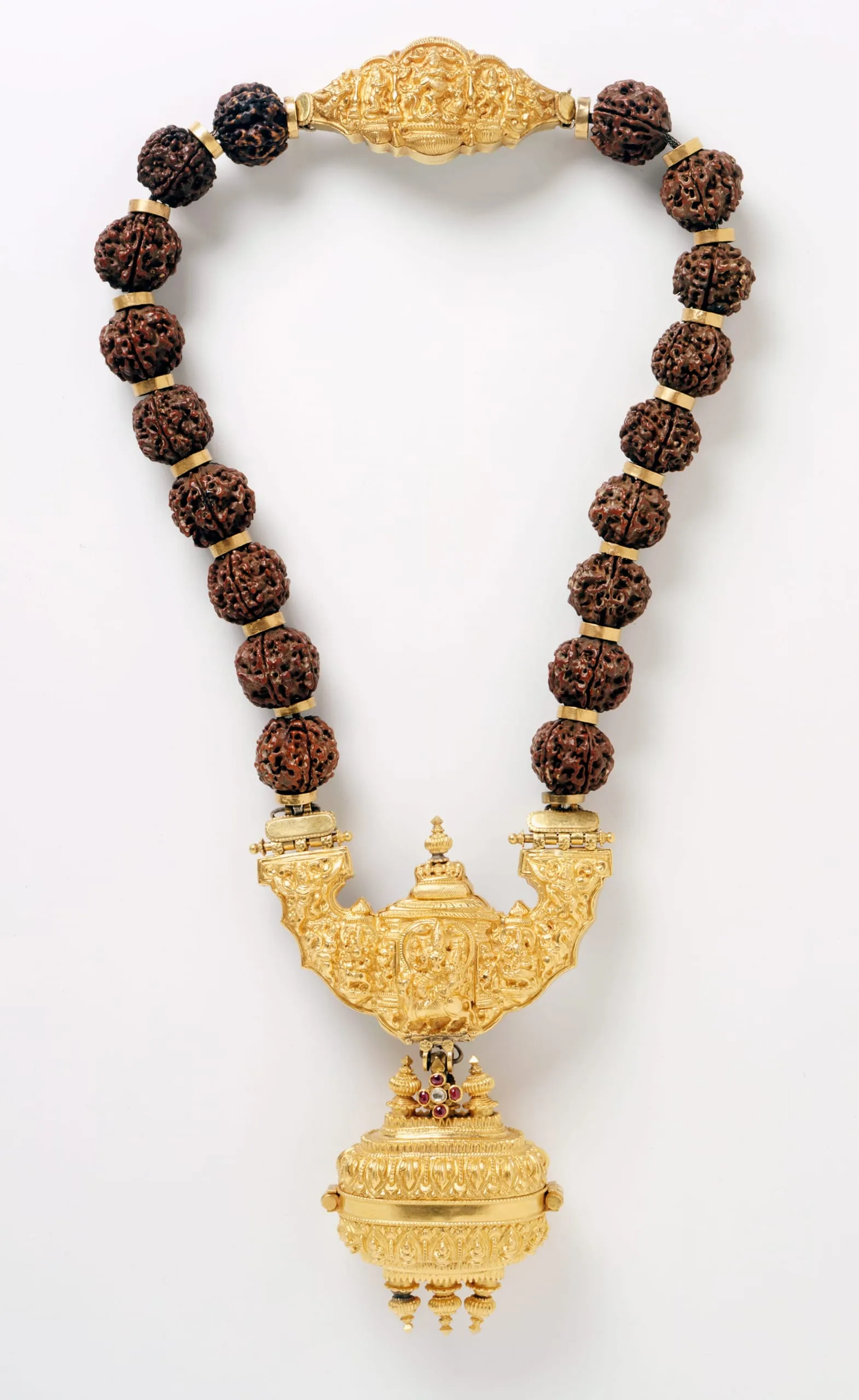
- Necklace with Shiva's Family
- Date Made
- late 19th century
- Medium
- Repoussé and cast gold, inlaid with rubies and a diamond; Rudraksha (eye of Rudra/Shiva) beads (elaeo carpus seeds); silver back plate on pendant
- Dimensions
- Overall: 9 × 5 × 1 in. (22.86 × 12.7 × 2.54 cm)
Clasp: 3 x 1 1/2 x 3/4 in. (7.62 x 3.81 x 1.905 cm)
Pendant: 2 3/4 x 4 1/4 x 1/2 in. (6.985 x 10.795 x 1.27 cm)
- Accession Number
- M.85.140
- Curatorial Notes
Known as a Rudraksha mala (eye of Rudra/Shiva garland), this opulent gold necklace has sacred elaeo carpus seeds strung as beads with gold spacers. It is secured with a lozenge-shaped gold clasp adorned with Shiva Nataraja (Lord of Dance) and his wife Shivakami in the center of a tripartite arched shrine. They are flanked by two ascetic worshipers and mythological creatures. The central element of the necklace is a U-shaped gold pendant in the form of an architectural pediment. In the center, Shiva and his wife Parvati are enthroned on Shiva’s bull mount. The holy family is completed by their children at their sides, the elephant-headed Ganesha on his rat mount and their son Karttikeya on his peacock.
Beneath the pendant is an oblong gold amulet case in the form of two joined halves of a rudraksha bead, which are believed to symbolize Parvati and Shiva. The amulet case typically holds a small linga or aniconic emblem of Shiva, and sacred ashes from a ritual fire or cremation to anoint deities and devotees. The upper half of the amulet case has two temple spires and a border of pendant leaves and streamers, while the bottom half is appropriately embellished with miniature Shiva-lingas.
This distinctive type of necklace was generally worn by Shaiva (Shiva-affiliated) temple priests and ascetics belonging to the Virashaiva (heroic worshipers of Shiva) sect, and during religious observances by adult males of the southern Indian Chettiyar mercantile and financial castes. According to the necklace’s commemorative inscription, engraved in Tamil on a silver plate on the pendant’s back, it was commissioned for a Chettiyar named Kuppathan. (Translation by Mehul Malik.) The Chettiyars were renowned in the 19th and 20th centuries for their palatial mansions and ardent patronage of Hindu temples and educational institutions.
- Selected Bibliography
- "Gold Treasures: Los Angeles County Museum of Art." The India Magazine of Her People and Culture 12, no.1 (1991): 78-79.
- Markel, Stephen. Mughal and Early Modern Metalware from South Asia at LACMA: An Online Scholarly Catalogue. Los Angeles: Los Angeles County Museum of Art, 2020. https://archive.org/details/mughal-metalware (accessed September 7, 2021).