- Title
- The Buddhist Deity Hevajra
- Date Made
- circa late 11th - early 12th century
- Medium
- Copper alloy with traces of gilding
- Dimensions
- 6 1/4 x 2 1/4 x 1 3/4 in. (15.87 x 5.71 x 4.44 cm)
- Accession Number
- M.85.115.3
- Curatorial Notes
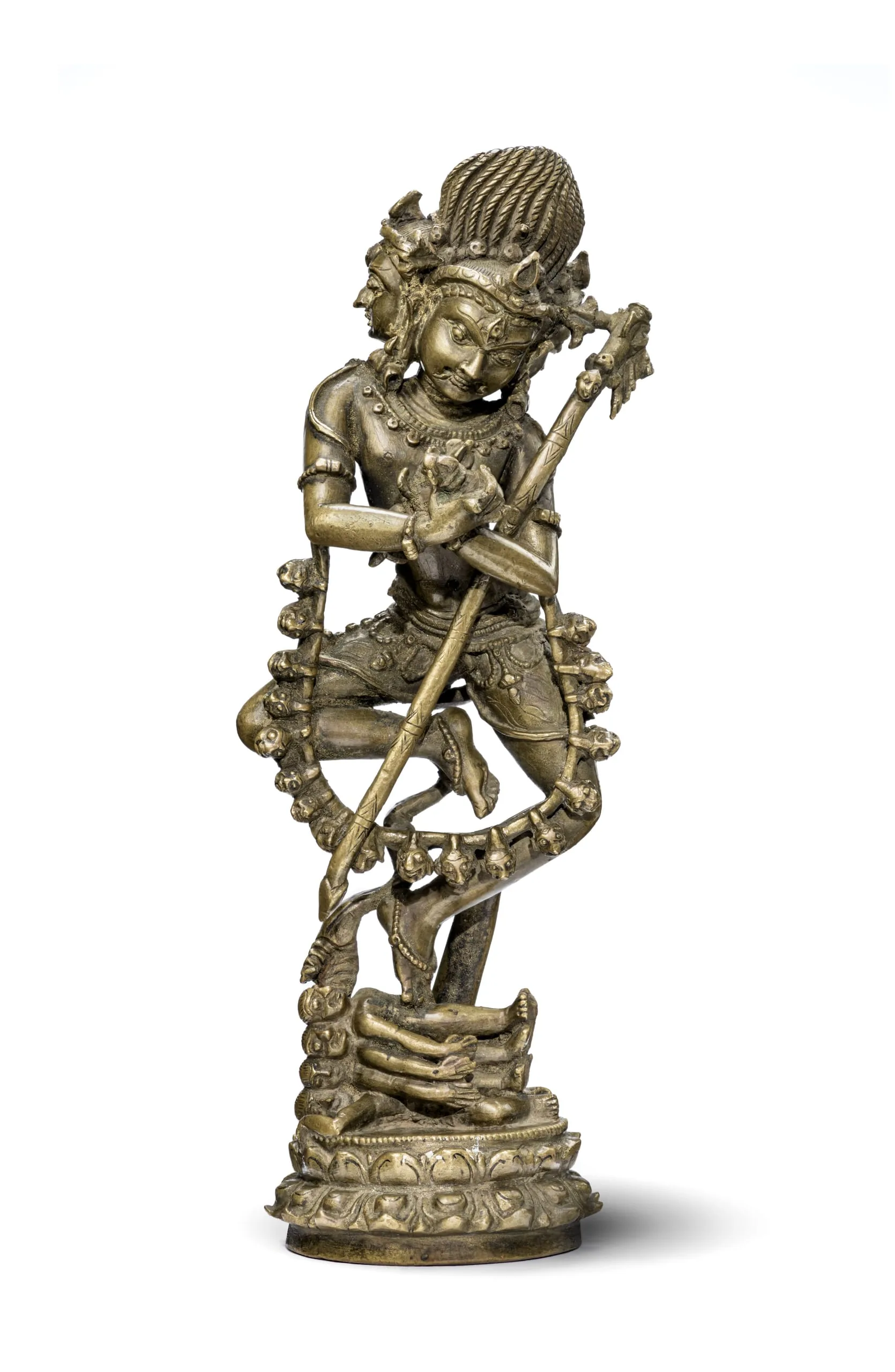
The Buddhist deity Hevajra (Adamantine HE [mantra]) is a meditational deity (yidam) in the Anuttara Yoga classification of Tantric Vajrayana Buddhism, which was practiced in the Gelug school of Tibetan Buddhism founded by Tsongkhapa (1357–1419). Hevajra is the central deity of the Hevajra Tantra (late 8th-early 10th century). His consort is Nairatmya (Selfless One; see M.70.1.4 and M.85.221).
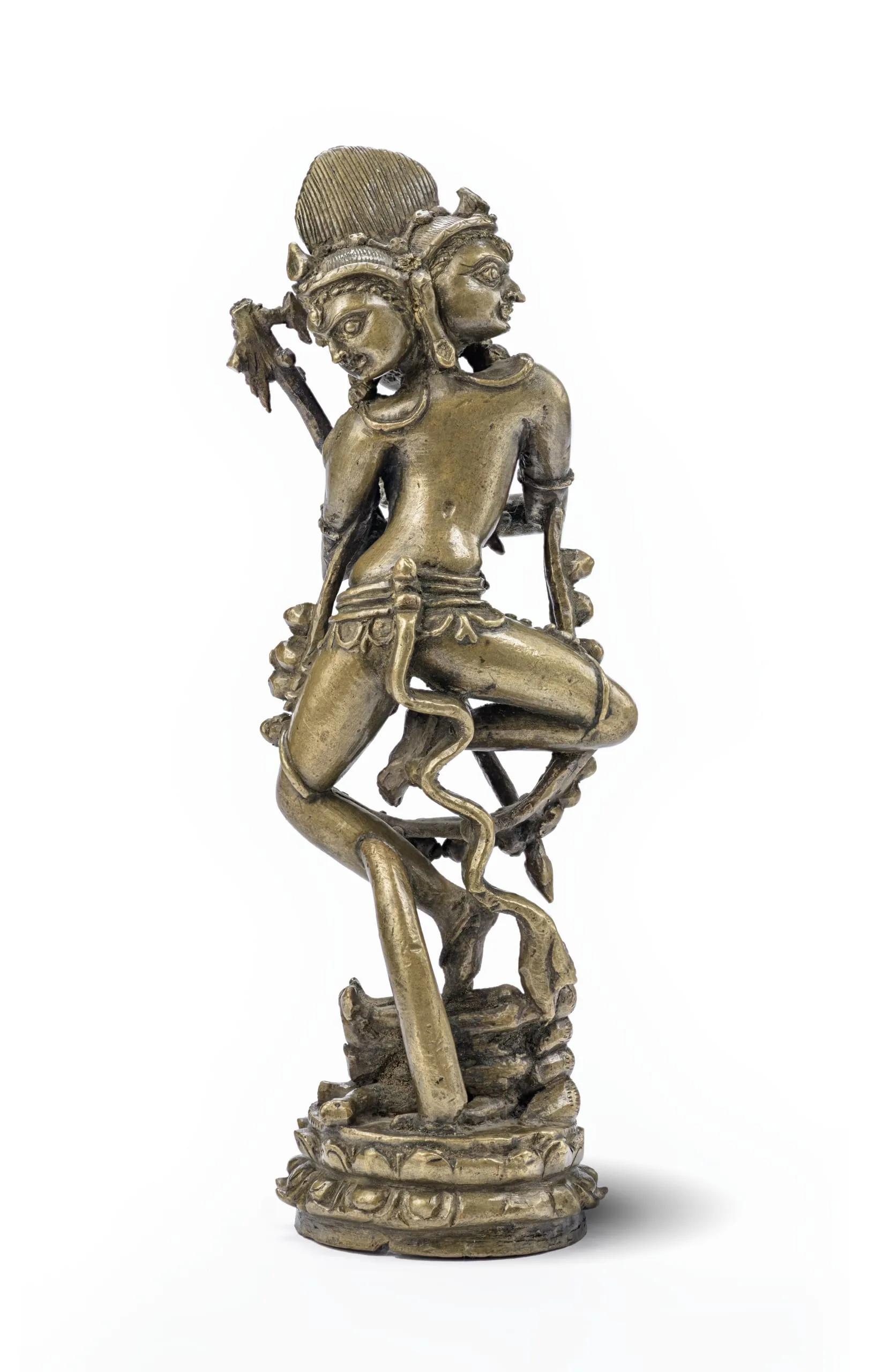
Hevajra has three heads, flaming hair, a prominent third eye, and two arms. He holds a thunderbolt (vajra) and vajra-topped bell (ghanta) in his hands, which are crossed in front of his chest in the thunderbolt-sound gesture (vajra humkara mudra) symbolic of his non-dual union with his female aspect, Nairatmya. A ritual staff (khatvanga) rests on his left shoulder. He wears plentiful jewelry, including a long garland of severed skulls. He is portrayed in the "half cross-legged" dance posture (ardhaparyanka-nritya), symbolic of a joyous and passionate Buddha nature. He is trampling on the four Maras, figures that represent various human failings, defilements, and death. See also M.81.6.
- Selected Bibliography
- Pal, Pratapaditya. Indian Sculpture, vol.2. Los Angeles: Los Angeles County Museum of Art; University of California Press, 1988.
- Huntington, John C. and Dina Bangdel. The Circle of Bliss: Buddhist Meditational Art. Columbus: The Columbus Museum of Art; Chicago: Serindia Publications, 2003.
- Xingyun, editor. Encyclopedia of Buddhist Arts. Los Angeles: Buddha's Light Publications USA, 2018.
- Little, Stephen, Tushara Bindu Gude, Karina Romero Blanco, Silvia Seligson, Marco Antonio Karam. Las Huellas de Buda. Ciudad de México : Instituto Nacional de Antropología e Historia, 2018.
- Little, Stephen, and Tushara Bindu Gude. Realms of the Dharma: Buddhist Art across Asia. Los Angeles: Los Angeles County Museum of Art, 2025.