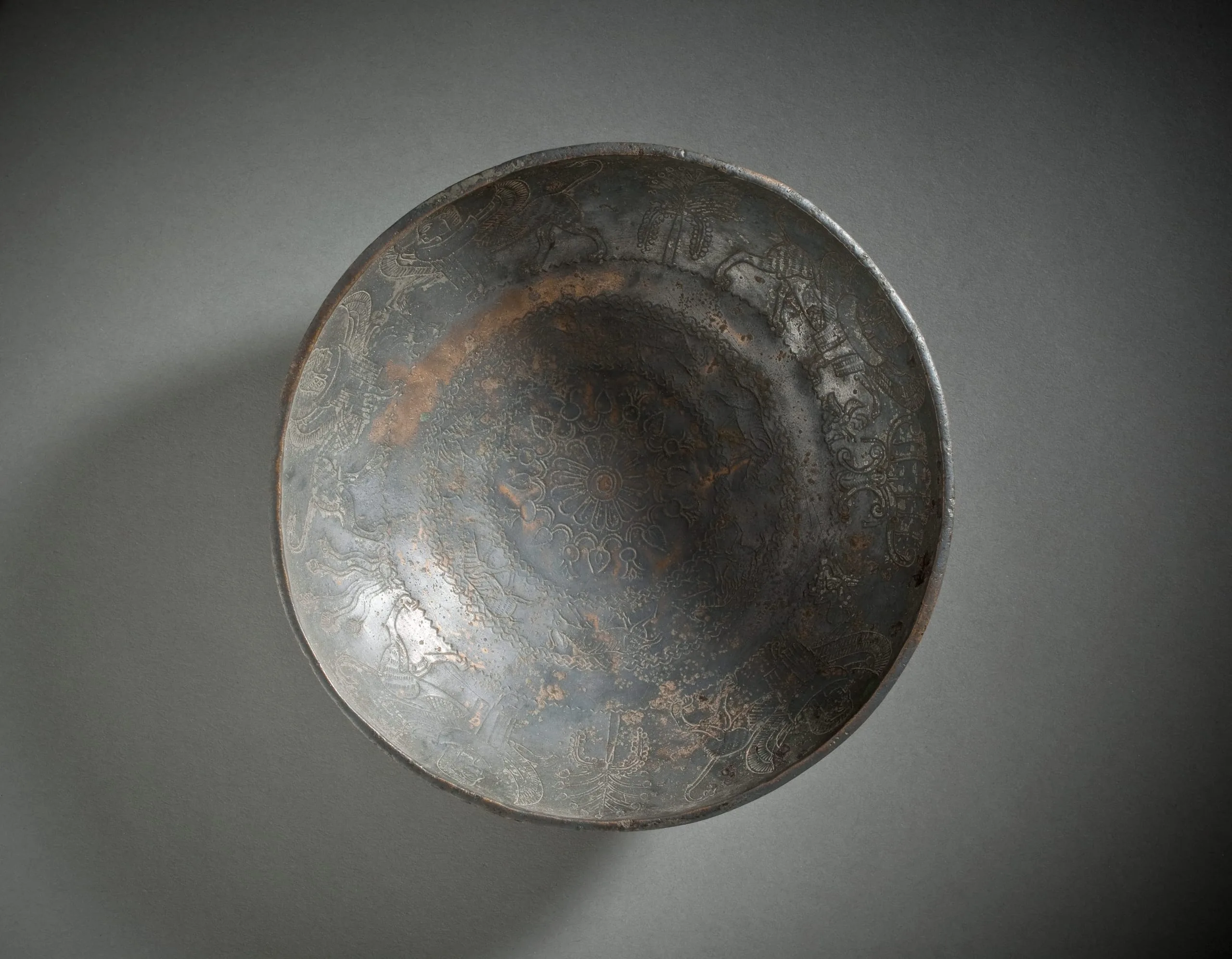
The exact origin of objects such as this, generically known as “Phoenician metal bowls,” is uncertain. They date to the eighth and seventh centuries BCE and have been discovered across a vast region stretching from modern-day Iraq to Greece, Cyprus, and Italy. Although Iron Age Phoenicia (or more broadly, the Levant) could have been the center of their production, due to their diverse imagery, which brings together several artistic traditions of the period (including Egyptian, Greek, Syrian, and Assyrian), it is also possible that they had been made in other locations in the Eastern Mediterranean and West Asia. Their expansive distribution and eclectic imagery speak to the interconnectedness of cultures in Iron Age Afro-Eurasia.
This remarkable bowl is decorated on the interior with a rosette medallion surrounded by four concentric registers. The first register features a stylized vegetal design, followed by another register consisting of a procession of grazing wild goats. The third register is undecorated, while the fourth features five Egyptian-style sphinxes separated by stylized plants, including two palm trees.