LACMA

ShopMembershipMyLACMATickets
LACMA
Los Angeles County Museum of Art
5905 Wilshire Blvd.
Los Angeles, CA 90036
info@lacma.org
(323) 857-6000
Sign up to receive emails
Subscribe
© Museum Associates 2026
  • About LACMA
  • Jobs
  • Host An Event
  • Unframed
  • Press
  • FAQs
  • Log in to MyLACMA
  • Privacy Policy
© Museum Associates 2026
Collections

Unknown
Dancing Celestial Nymph with an Attendant Holding a Mirror1st century BCE

Not on view
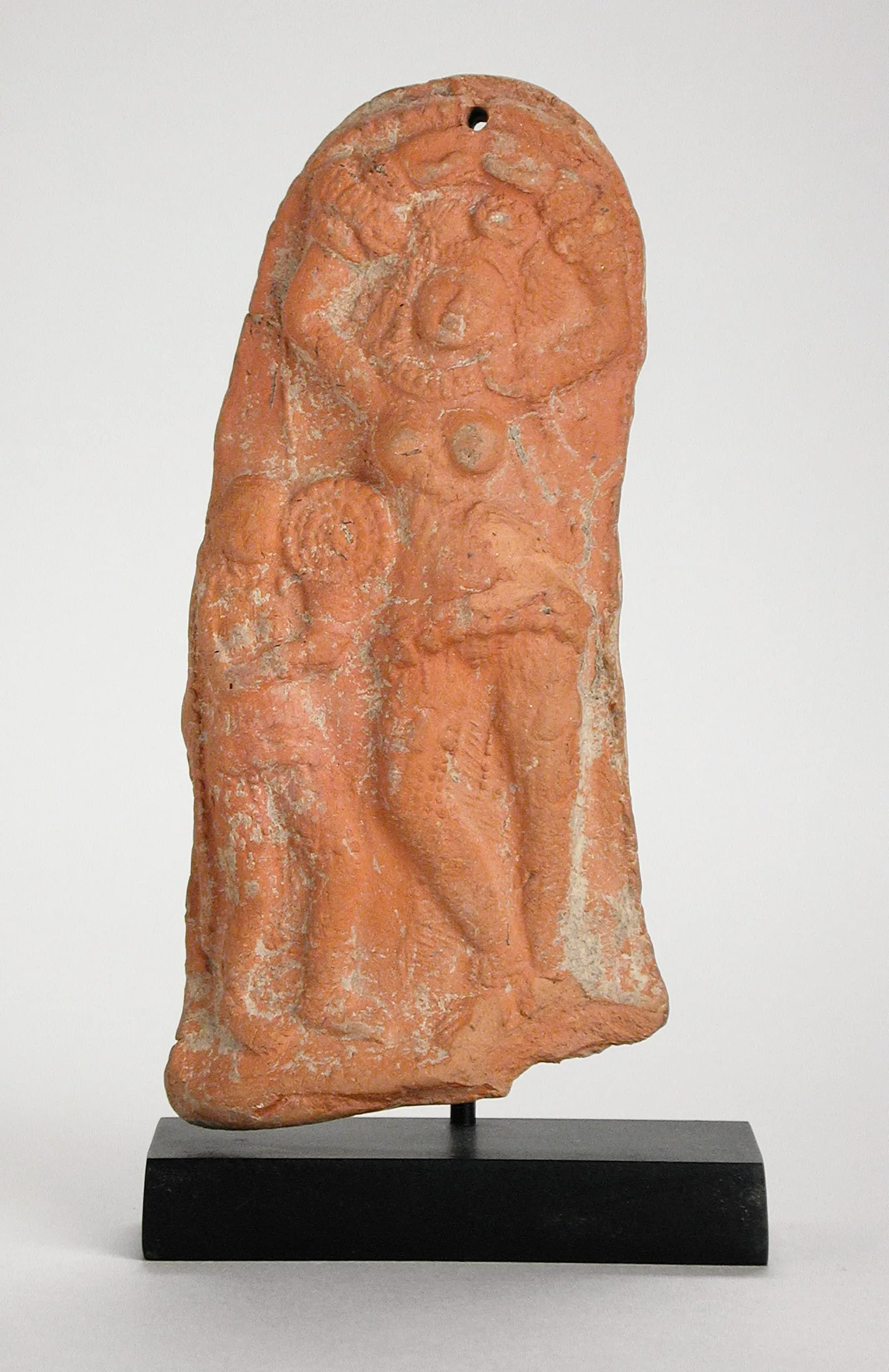
Terracotta relief plaque with a standing nude female figure, rounded headdress, and spiral motifs, on a black display stand

Unknown, Dancing Celestial Nymph with an Attendant Holding a Mirror, 1st century BCE, Los Angeles County Museum of Art, Indian Art Special Purpose Fund, photo © Museum Associates/LACMA

Artist or Maker
Unknown
Title
Dancing Celestial Nymph with an Attendant Holding a Mirror
Place Made
India, West Bengal, Haroa (?)
Date Made
1st century BCE
Medium
Molded earthenware
Dimensions
5 x 2 1/2 x 3/4 in. (12.7 x 6.35 x 1.91 cm)
Credit Line
Indian Art Special Purpose Fund
Accession Number
M.85.35.2
Classification
Sculpture
Collecting Area
South and Southeast Asian Art
Curatorial Notes

This molded earthenware relief plaque portrays a celestial nymph (apsaras) in a dancing pose with her hands joined above her head with the palms facing upwards in the gesture of Dawn (ushas mudra; see also AC1994.15.1). The nymph is richly adorned. She wears a headdress with floral medallions, ear ornaments, fringe necklace with "golden" vertical elements, ornate hip belt (katibandha) with pearl swags, and large floral bracelets and anklets. She stands frontally with her right knee bent and the foot splayed. Beside her a smaller female attendant offers her a metallic mirror with a polished reflective front and concentric bands of ornamentation on the mirror back (see also M.84.32.2, M.87.211, and AC1994.230.1). Earthenware plaques displaying the same ‘dancer with mirror’ iconography have been discovered at Kaushambi in Uttar Pradesh and Haroa near Chandraketugarh in West Bengal. See respectively S. C. Kala, Terracottas in the Allahabad Museum (New Delhi: Abhinav Publications, 1980), p. 45, fig. 115; and S. S. Biswas, Terracotta Art of Bengal (New Delhi: Agam Kala Prakasan, 1981), pl. XXXd.

The mounting hole drilled through the top of the plaque suggests that it was likely hung on the wall of a domestic shrine.

See also M.83.221.2 and M.90.196.1.
Selected Bibliography
  • Pal, Pratapaditya. Indian Sculpture, vol.1. Los Angeles: Los Angeles County Museum of Art; University of California Press, 1986.