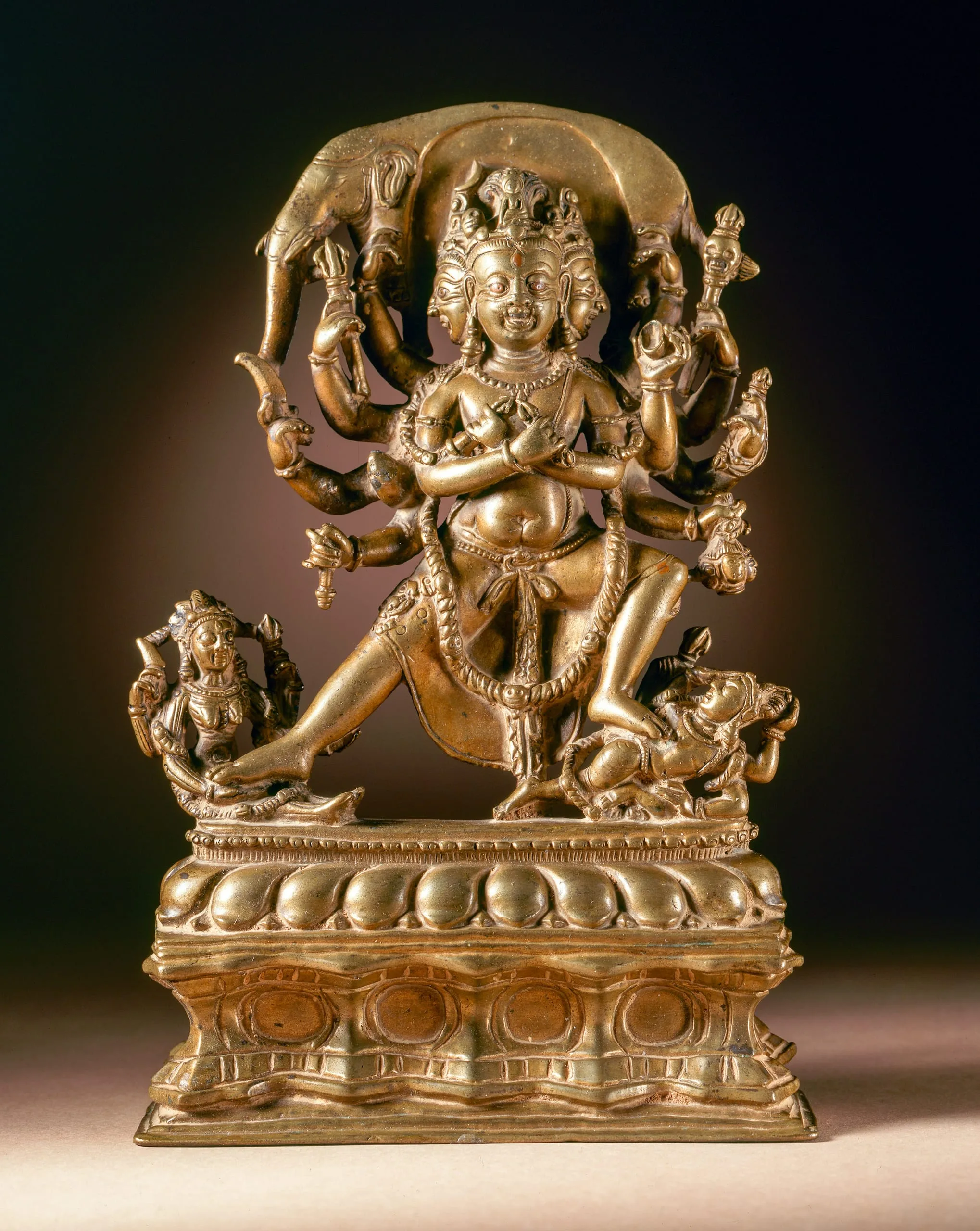
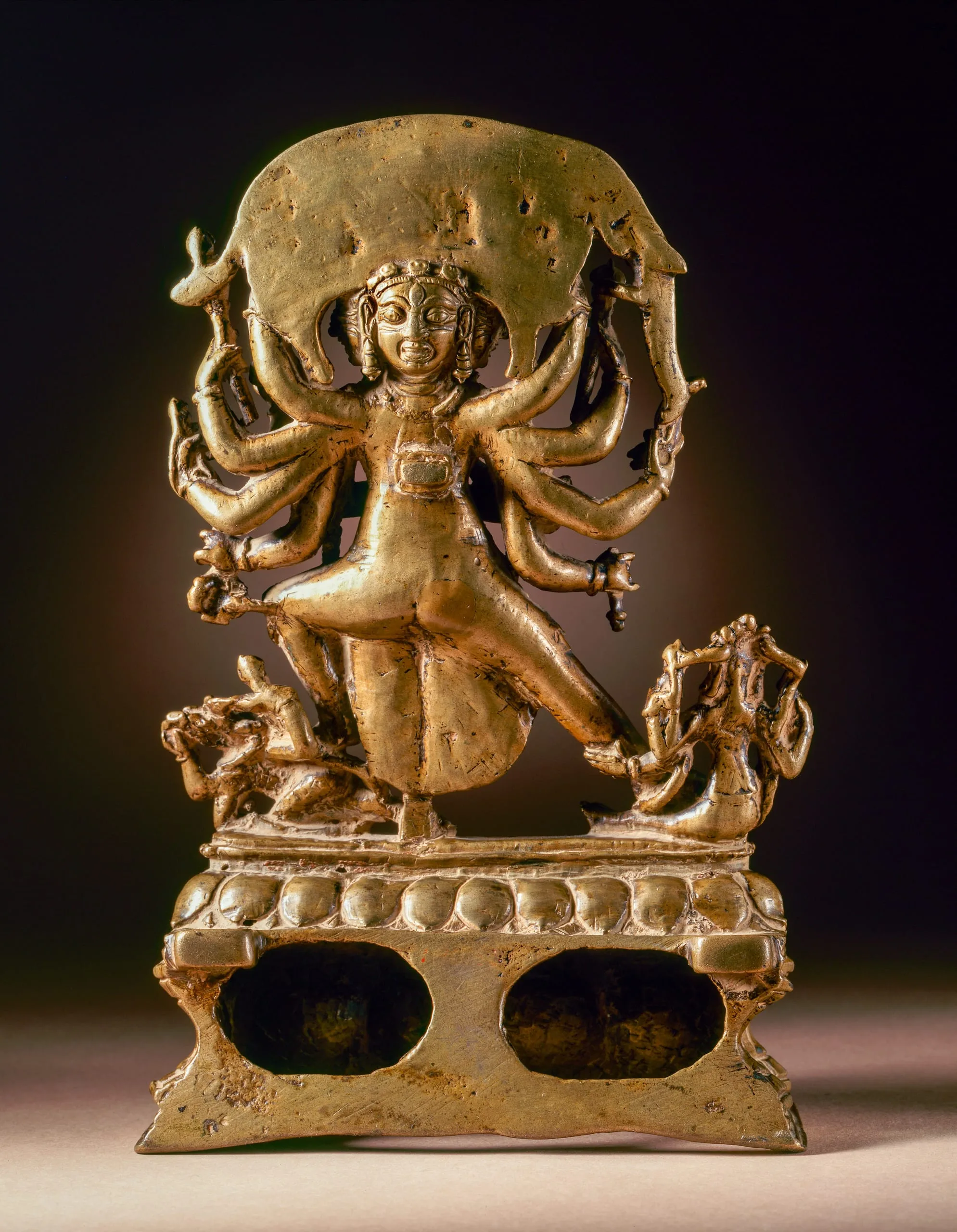
- Title
- The Buddhist Deity Chakrasamvara
- Date Made
- circa 9th-10th century
- Medium
- Leaded brass inlaid with copper and silver
- Dimensions
- 8 1/4 x 5 1/2 x 2 1/8 in. (20.95 x 13.97 x 5.39 cm)
- Accession Number
- M.85.2.4
- Curatorial Notes
Chakrasamvara (Circle of Supreme Bliss) is an archetypal deity of Vajrayana (esoteric) Buddhism. He represents transcendent compassion. This Kashmiri image is nimbate and has four wrathful heads, each featuring a third eye symbolic of wisdom. The heads shown on the front are graced with diminutive images of the transcendental Buddhas set in the deity’s crown: Akshobhya (the Imperturbable) in front, Amitabha (Infinite Light) on the left, and Ratnasambhava (Born of Jewel) on the right. He wears a lion skin, a long floral garland, and abundant jewelry. He has twelve arms. His two primary hands holding a thunderbolt (vajra) and bell (ghanta) are corssed in front of his chest in the gesture of thunderbolt sound (vajra humkara mudra). His two uppermost hand hold the flayed skin of an elephant over his head. His remaining right hands hold (from top to bottom) a vajra-tipped club, flaying knife (kartika), now-missing hand once likely holding a drum (damaru), and the handle of a now-damaged trident. His left hands hold a ‘cot’s leg’ ritual staff topped with a skull (khatvanga), skull cup (kapala), unknown implement with vajra terminals, and the severed heads of Brahma, the Hindu god of creation. Chakrasamvara stands in the militant posture (alidha asana). His right foot is atypically placed in the lap of the Hindu goddess Kalaratri (Night of Dread), who is caressing his foot. His left foot is crushing the four-armed Hindu god Bhairava, who holds a vajra-tipped club in his upper right hand and may be saluting his conqueror with his lower right hand. His left hands support his torso and head. The figures are set atop a lotus base surmounting stylized geometric mountains. Lugs for a separately cast and now-missing aureola are on the rear of the base.
- Selected Bibliography
- Pal, Pratapaditya. Indian Sculpture, vol.2. Los Angeles: Los Angeles County Museum of Art; University of California Press, 1988.
- Reedy, Chandra L. Himalayan Bronzes: Technology, Style and Choices. Newark: University of Delaware Press, 1997.
- Huntington, John C. and Dina Bangdel. The Circle of Bliss: Buddhist Meditational Art. Columbus: The Columbus Museum of Art; Chicago: Serindia Publications, 2003.
- Beguin, Gilles. Dieux et Demons de l'Himalaya: Art du Bouddhisme Lamaique. Paris: Grand Palais, 1977.
- Rosenfield, John. The Arts of India and Nepal: The Nasli and Alice Heeramaneck Collection. Boston: Museum of Fine Arts, Boston, 1966.
- Linrothe, Rob. Collecting Paradise: Buddhist Art of Kashmir and its Legacies. New York: Rubin Museum of Art, 2014.
- Little, Stephen, and Tushara Bindu Gude. Realms of the Dharma: Buddhist Art across Asia. Los Angeles: Los Angeles County Museum of Art, 2025.