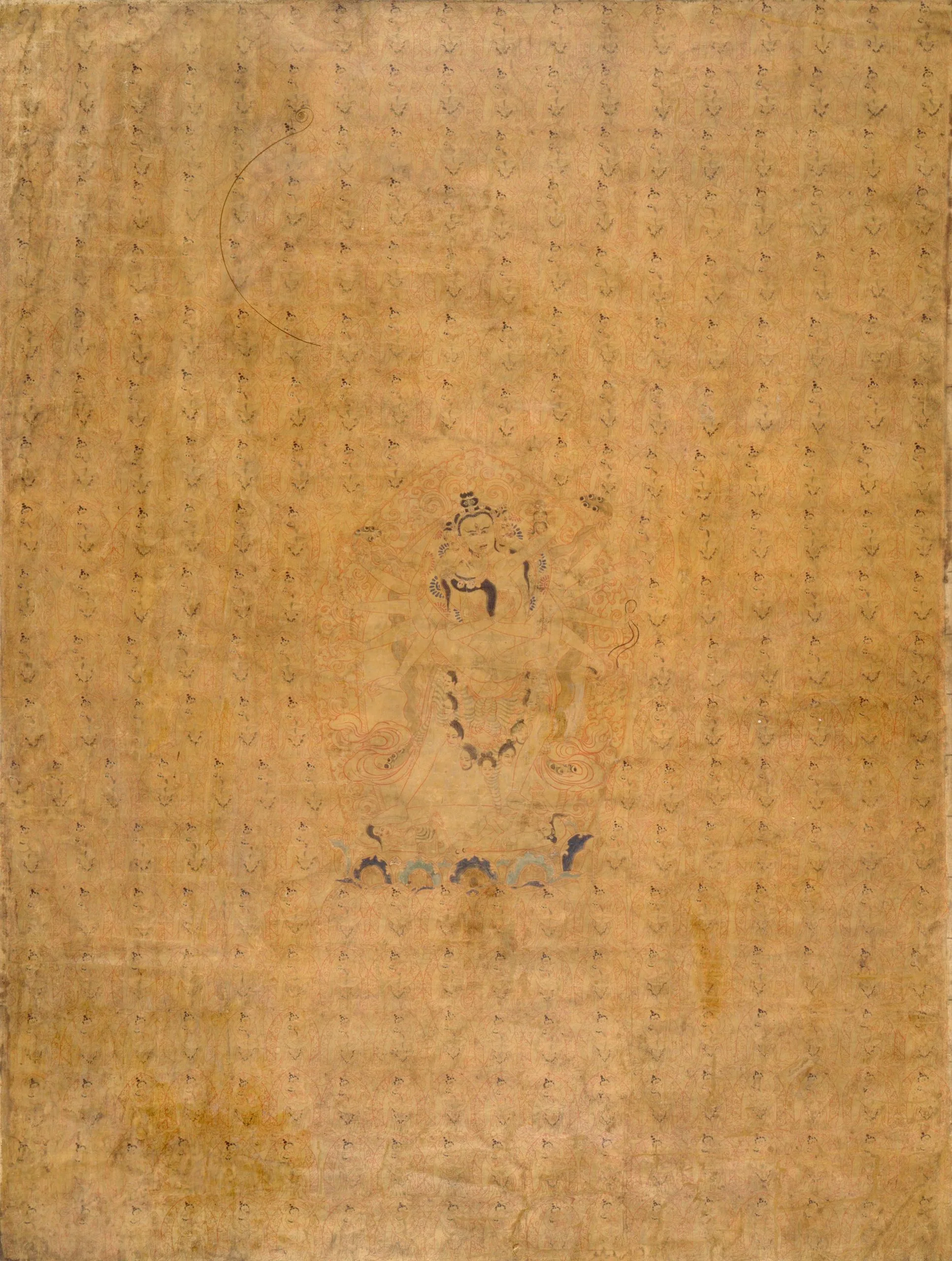
- Title
- Myriad Chakrasamvara and Vajravarahi
- Date Made
- circa 1800
- Medium
- Mineral pigments and gold on cotton cloth
- Dimensions
- 32 x 24 in. (81.28 x 60.96 cm)
- Accession Number
- M.84.224.1
- Curatorial Notes
The principal figures in this gold-field painting are the archetypal deities of Tibetan Vajrayana (esoteric) Buddhism: the twelve-armed Chakrasamvara (Circle of Supreme Bliss), who symbolizes the Buddha’s infinite compassion, embracing his female aspect Vajravarahi (Diamond Sow), who represents the transcendent wisdom of a Buddha. Their union embodies the all-pervading bliss of complete enlightenment. Chakrasamvara and Vajravarahi are surrounded by multiple smaller depictions of themselves, identical except that each diminutive Chakrasamvara has only two arms. Repetitive representations such as this were intended to multiply the efficacy of the deities portrayed or to increase the merit attained by the patron who commissioned the painting.
This type of Tibetan painting (thangka) in which the figures are rendered in a linear technique is known in Tibetan as gser thang (a thangka in which the color gold predominates). Here, the figures are drawn in red and gray against the gold background. See also M.83.253 and AC1993.190.1, and M.70.1.3.
- Selected Bibliography
- Pal, Pratapaditya. Art of Tibet. Expanded edition. Los Angeles: Los Angeles County Museum of Art, 1990.