- Title
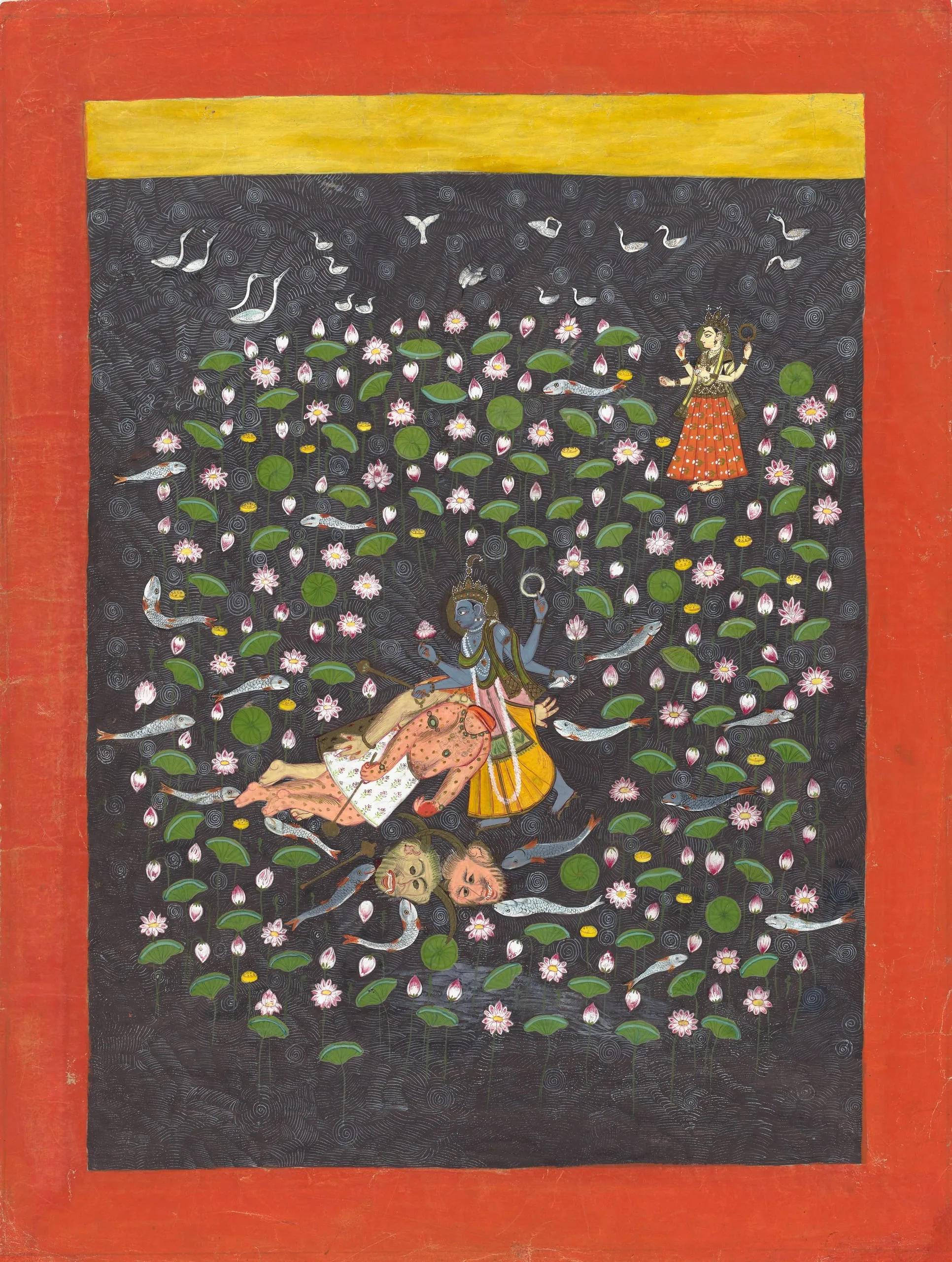
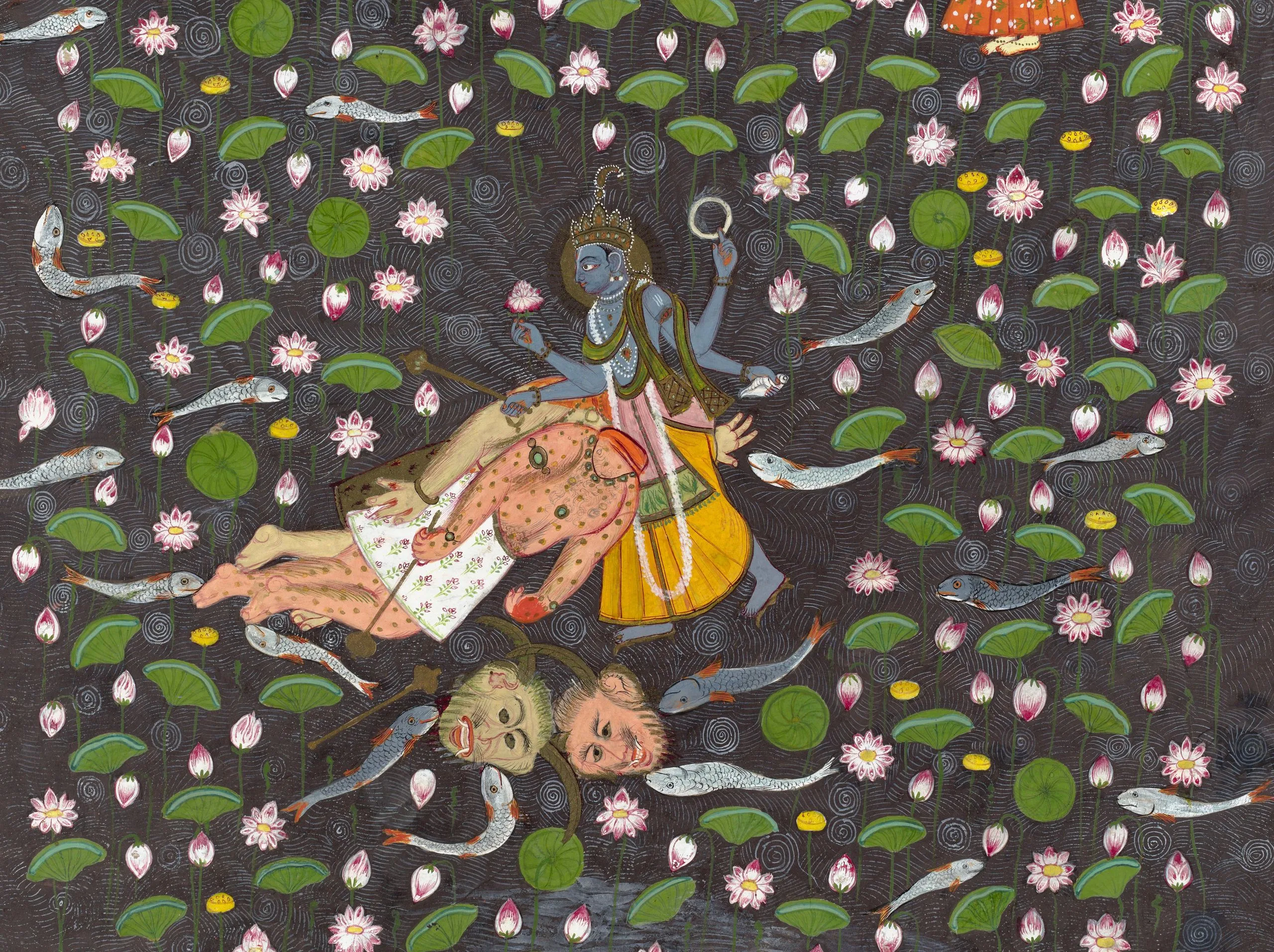
- Vishnu Vanquishing the Demons Madhu and Kaitabha (recto), Text (verso); Folio from a Devimahatmya (Glory of the Goddess)
- Date Made
- circa 1775
- Medium
- Opaque watercolor and gold on paper
- Dimensions
- Image (Image): 16 1/8 x 11 5/8 in. (40.9575 x 29.5275 cm)
Sheet (Sheet): 20 x 15 in. (50.8 x 38.1 cm)
Frame: 30 × 24 in. (76.2 × 60.96 cm)
- Accession Number
- M.84.229.5
- Curatorial Notes
Dating from circa 550 CE, the Devimahatmya (Glory of the Goddess) is a devotional text of 700 Sanskrit verses that extol the Goddess (Devi) as the supreme power and creator of the universe. This folio illustrates the climax of Chapter 1 in which the Goddess in her form as Mahamaya (Great Illusion) triumphs over the demons Madhu and Kaitabha. When Vishnu, the God of Preservation, was sleeping in the primordial ocean at the end of a kalpa (cosmic age), Madhu and Kaitabha sprang from Vishnu’s earwax and attempted to slay Brahma, the God of Creation, who sat on the lotus that emerges from Vishnu's navel and was contemplating the next cycle of the universe. Brahma appealed for help to Mahamaya, who generates and personifies Vishnu’s fecund sleep. She agreed to help and then manifested as the goddess Yoganidra, who personifies the waking interval between Vishnu’s cosmic slumber. Vishnu then awoke and fought the demons for 5000 years. Unable to defeat them, Vishnu offered them a boon. The arrogant demons said they would give Vishnu a boon instead. Vishnu asked the demons for the boon of slaying them. The demons granted the boon but asked to be killed anywhere the earth was not flooded by water. Vishnu then enlarged his thighs, so they were above the water, and beheaded the demons with his discus. Here, the bodies of the decapitated demons lay across Vishnu’s thighs while their severed heads float in the ocean. Yoganidra is in the upper right.
See also its series mate M.86.345.5.
- Selected Bibliography
- Pal, Pratapaditya. The Classical Tradition in Rajput Painting. New York: The Gallery Association of New York State, 1978.