- Title
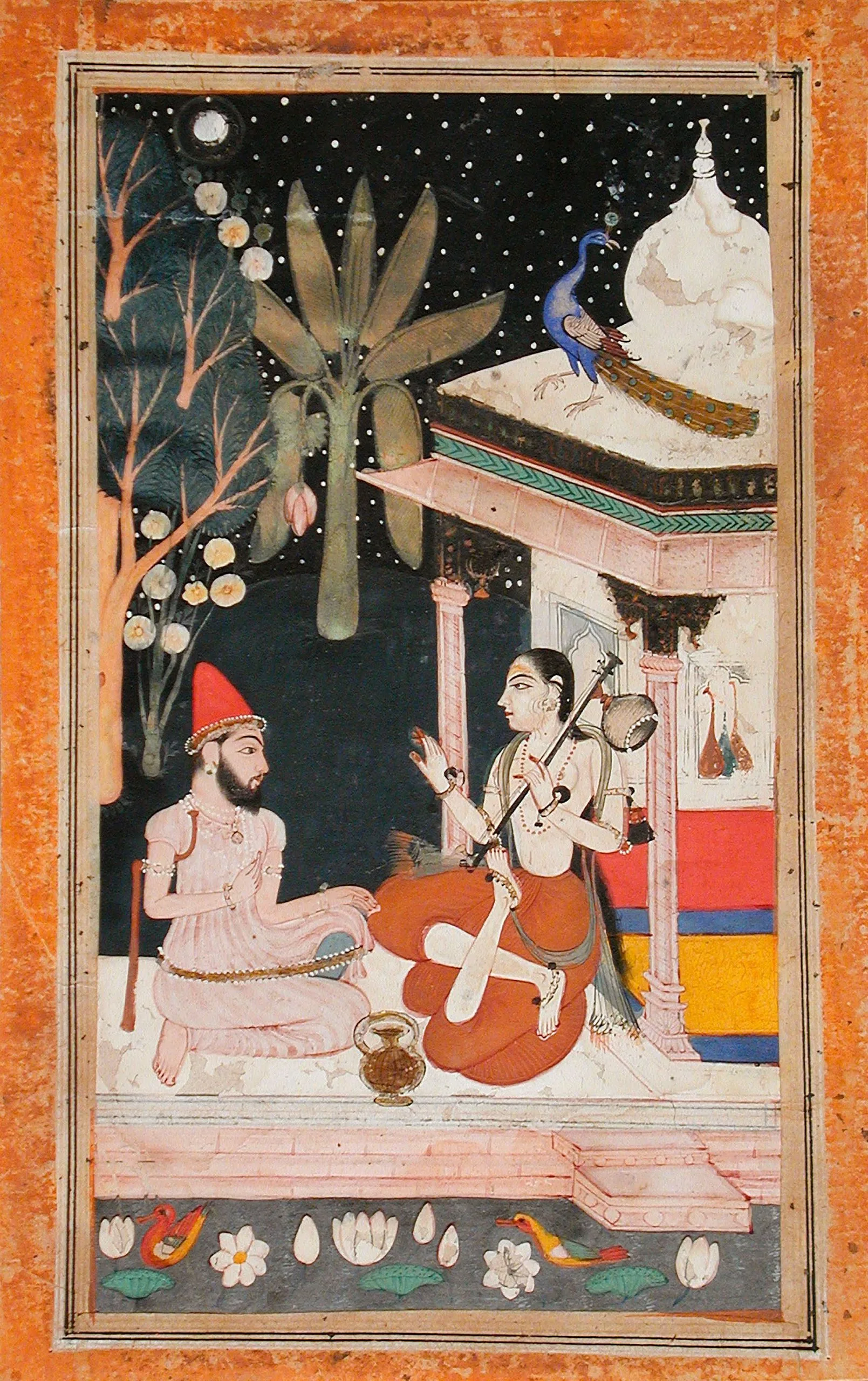
- Kedara Ragini, Fifth Wife of Shri Raga, Folio from a Ragamala (Garland of Melodies)
- Date Made
- circa 1675-1700
- Medium
- Opaque watercolor and gold on paper
- Dimensions
- Image: 8 1/8 x 4 5/8 in. (20.63 x 11.74 cm); Sheet: 9 5/16 x 5 7/8 in. (23.65 x 14.92 cm)
- Accession Number
- M.84.229.2
- Curatorial Notes
Kedara Ragini is the fifth wife of Shri Raga in the predominant ragamala (garland of melodies) classification system generally known as the Rajasthani system. It is named after the god Shiva as Kedareshvara, the lord of the Shaiva pilgrimage location in the Himalayas named Kedara. It is a tender melody associated with the early evening. In Bundi ragamalas, Kedara Ragini is envisioned as a female ascetic teaching the secrets of yoga.
Here, the personified melody sits in front of a pavilion’s verandah holding a vina against her shoulder while singing or expounding on yoga. Her rapt visitor, perhaps a Sufi, wears a red conical cap, a pink garment, and pearl jewelry. He has an ascetic’s crutch under his arm and wears a yoga support band around his knees. A golden “kettle” ewer for water is placed beside him. The star-filled night sky indicates the time of day the melody is to be played. A comparable Bundi Kedara Ragini is in the National Museum, New Delhi (51.68/1-22).
- Selected Bibliography
- Pal, Pratapaditya. The Classical Tradition in Rajput Painting. New York: The Gallery Association of New York State, 1978.