LACMA

ShopMembershipMyLACMATickets
LACMA
Los Angeles County Museum of Art
5905 Wilshire Blvd.
Los Angeles, CA 90036
info@lacma.org
(323) 857-6000
Sign up to receive emails
Subscribe
© Museum Associates 2025

Museum Hours

Monday

11 am–6 pm

Tuesday

11 am–6 pm

Wednesday

Closed

Thursday

11 am–6 pm

Friday

11 am–8 pm

Saturday

10 am–7 pm

Sunday

10 am–7 pm


  • About LACMA
  • Jobs
  • Building LACMA
  • Host An Event
  • Unframed
  • Press
  • FAQs
  • Log in to MyLACMA
  • Privacy Policy
© Museum Associates 2025
Collections

Unknown
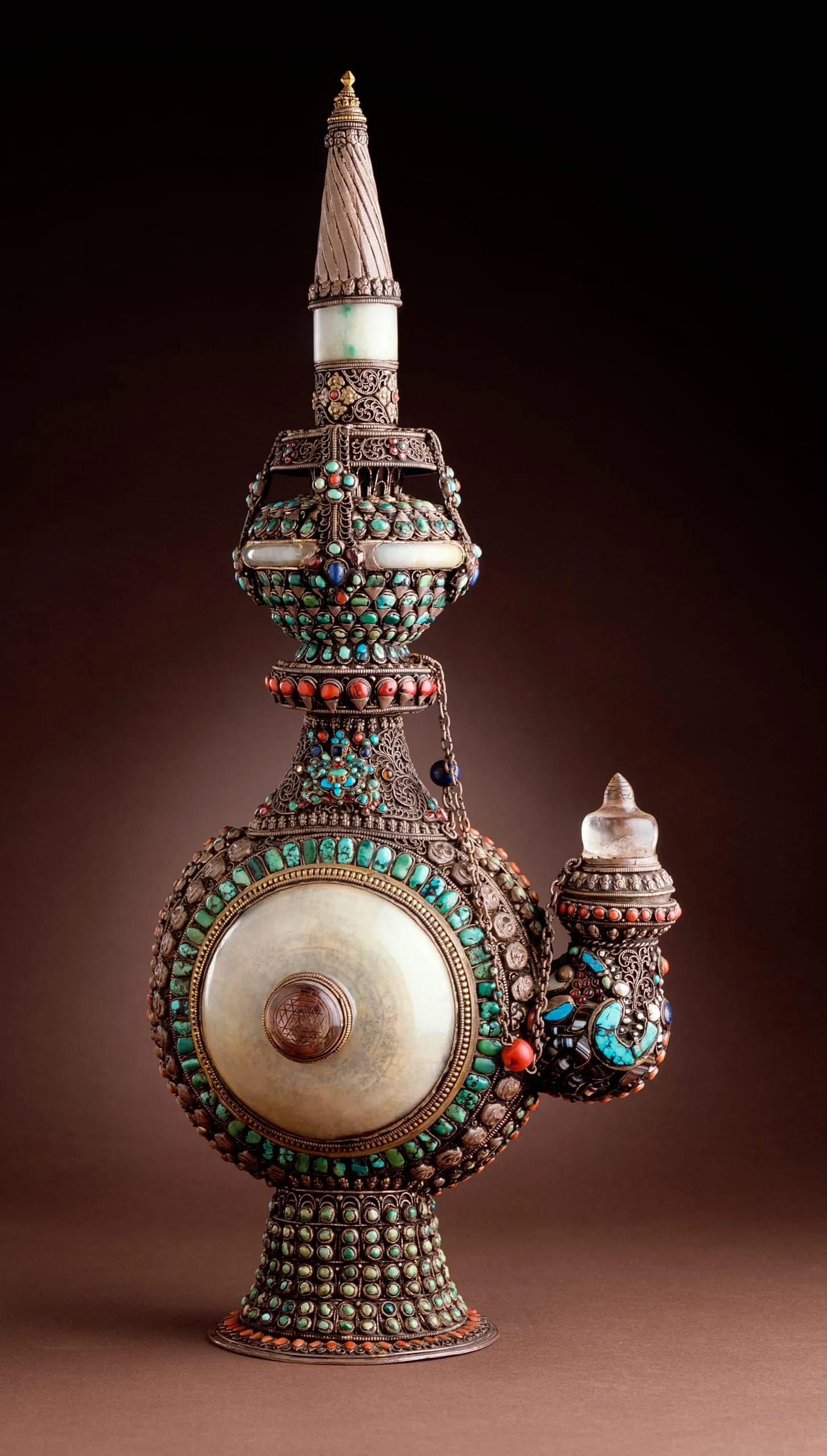
Ceremonial Ewer19th century

On view:
Resnick Pavilion, floor 1
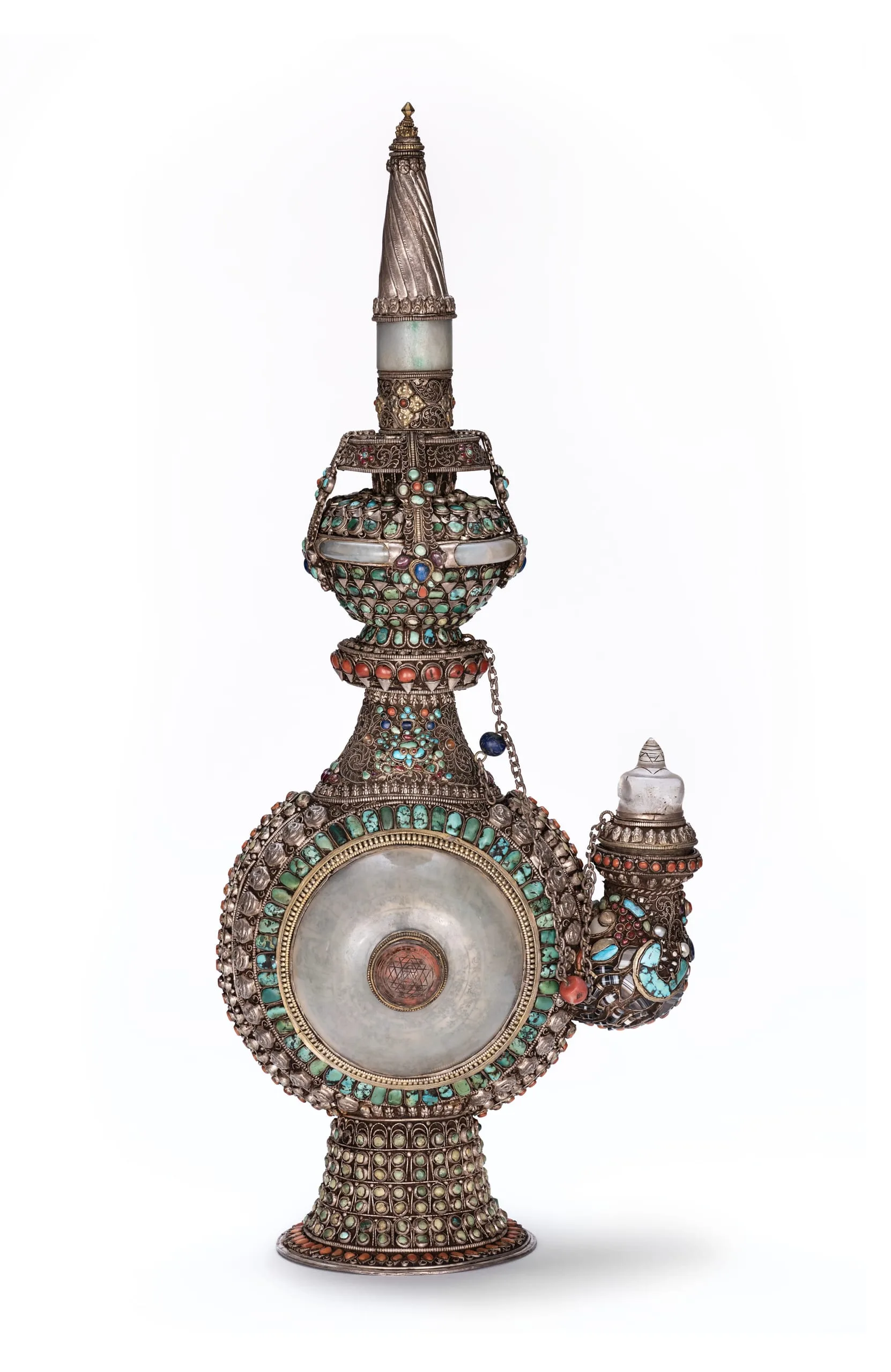
Ornate metal and stone vessel with flattened disk body, tall spiral finial, and dense encrustation of turquoise and coral cabochons in silver settings, with a small chained secondary bottle at the side
Tibetan ritual vessel with a globular jade body, tall spiraling spire finial, and side spout, densely inlaid with turquoise, coral, and lapis lazuli cabochons set in silver filigree mounts.
Artist or Maker
Unknown
Title
Ceremonial Ewer
Place Made
Central Tibet (by a Newar artist)
Date Made
19th century
Medium
Silver inlaid with jade, rock crystal, and gemstones
Dimensions
21 1/8 x 9 x 6 3/4 in. (53.65 x 22.86 x 17.14 cm)
Credit Line
Gift of Mr. and Mrs. Michael Phillips
Accession Number
M.84.227.2
Classification
Furnishings
Collecting Area
South and Southeast Asian Art
Curatorial Notes

The ceremonial water ewer (Sanskrit: kalasha; Tibetan: ril-ba) is used in Buddhist rituals of ablution and consecration, and is a symbol of purification. During ceremonies, when a Buddhist priest sprinkles disciples with the "Water of Life" or "Nectar of Immortality" from the vessel, he bestows blessings. The water ewer is the symbol of Maitreya, the Buddha of the Future. It is also an attribute of the 8000-armed form of Avalokiteshvara (the Bodhisattva of Compassion), who uses it to relieve the thirst of all beings and purify their despondency and negative karma with the gentle waters of its compassion.

This morphological form of this Tibetan ewer derives from that of a Central Asian, Islamic, or Indo-Islamic water vessel (aftaba), such as AC1995.52.1 and M.83.2.2. Its silver filigree and gem-encrusted inlay indicate it was made by a Newari artist in Tibet or working for the Tibetan trade. The bulbous middle component of the tall neck is an auspicious water pot. The rock crystal stopper above the mouth is a Tibetan choten or stupa (funerary monument). In the center of each side of the body, the rock crystal knobs are engraved with mystical diagrams (yantras). The circular white jade plaques forming the sides of the body are translucent to allow the numinous utterances written underneath to be visible.

Pratapaditya Pal has suggested that the "deft incorporation of the auspicious water pot and the choten into the design may indicate that the ewer was once used for rights connected with Amitayus" (Eternal Life), the transcendental Jina Buddha who presides over the Sukhavati Paradise. (Pal 1990, 297, no. R25)

See also M.75.10, M.85.295.2a-b, and M.2011.157.1.
Selected Bibliography
  • Little, Stephen, Tushara Bindu Gude, Karina Romero Blanco, Silvia Seligson, Marco Antonio Karam. Las Huellas de Buda. Ciudad de México : Instituto Nacional de Antropología e Historia, 2018.
  • Little, Stephen, and Tushara Bindu Gude. Realms of the Dharma: Buddhist Art across Asia. Los Angeles: Los Angeles County Museum of Art, 2025.