- Title
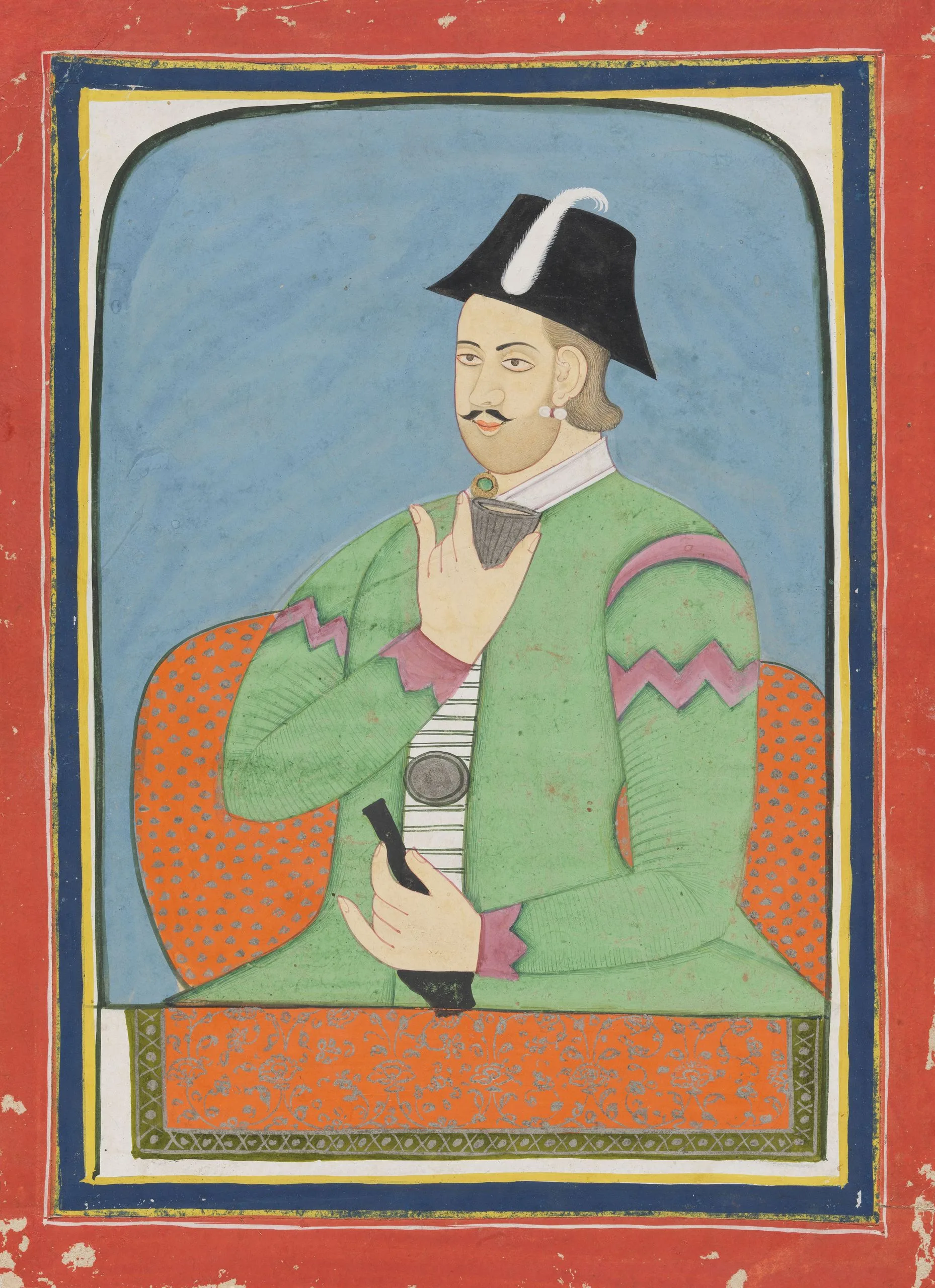
- European Man Drinking Wine
- Date Made
- 1800-1825
- Medium
- Opaque watercolor, silver, and gold on paper
- Dimensions
- Image: 11 7/8 x 8 in. (30.16 x 20.32 cm); Sheet: 14 1/2 x 10 5/8 in. (36.83 x 26.98 cm)
- Accession Number
- M.84.224.2
- Curatorial Notes
In addition to printed sources for European figural types, Indian artists presumably also drew upon their own personal observations of the numerous European administrative and military personnel active throughout India by the mid-18th century onward. This representation of a European Man Drinking Wine is likely based on an in-person encounter with an English or French military officer or footman in a livery uniform. He wears a bicorne or cocked hat embellished with a feather cockade. It is worn in the side-to-side fashion, best known by its association with Napoléon Bonaparte. His green jacket features a single epaulet on the left shoulder. He wears a shirt with a white stock collar and a striped waistcoat with a large central button or fastener. Although the clothing components are based on actual European garb, their somewhat misshapen representations and the figure’s awkward proportions and flattened perspective suggest that the artist’s conceptual model was misunderstood rather than being adapted from an anatomically correct representation in a European print.
The figure has been placed in the artificial context of an Indianized setting by being shown seated against a bolster behind a carpet-covered railing, similar to the jharoka portraits of Indian royalty presenting themselves in a balcony window.
On the back of the painting is an inscription in devanagari script erroneously identifying the subject as Tipu Sultan, the ruler of Mysore (r. 1782-1799).