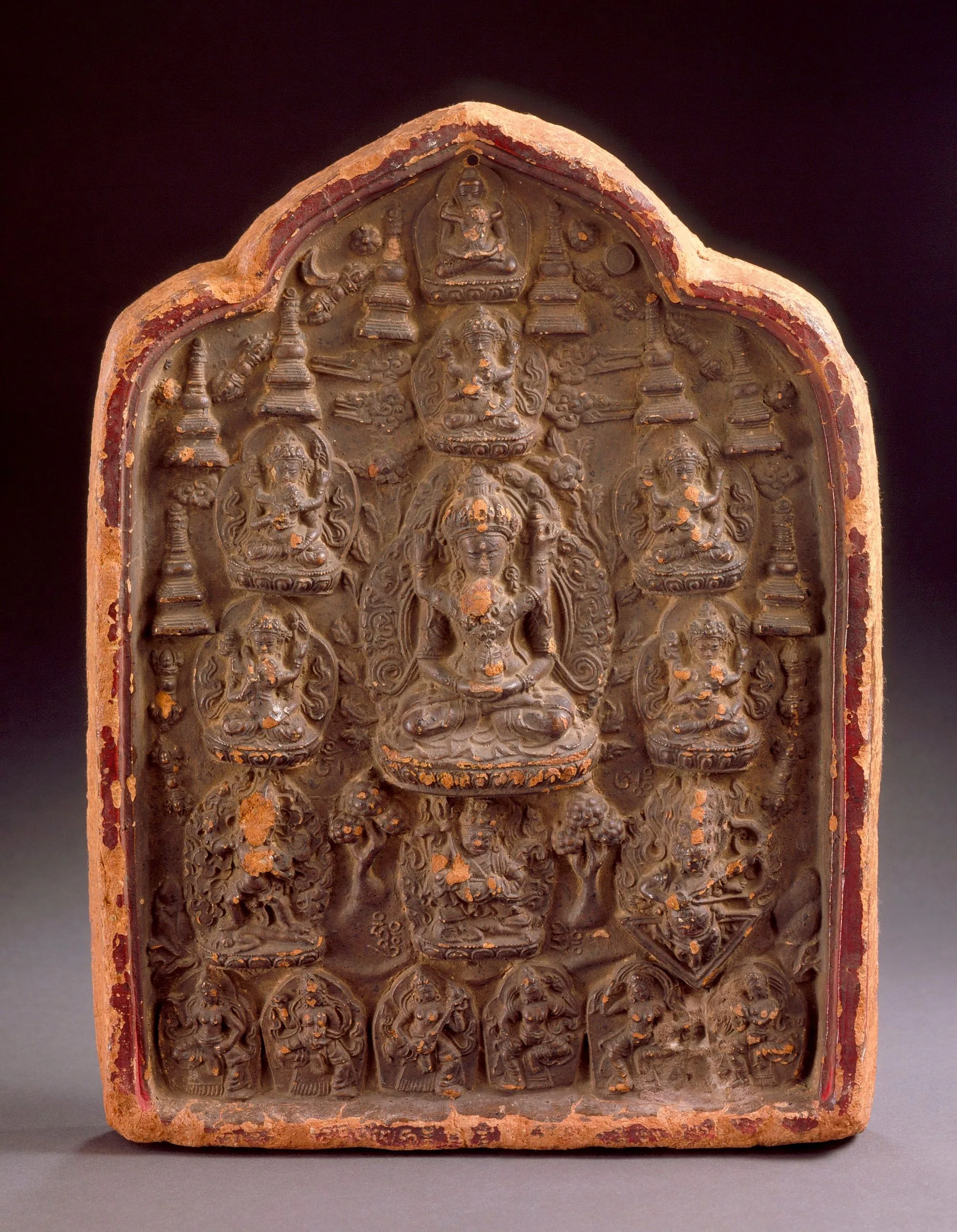
The central figure of mandala depicted in this earthenware molded votive tablet (tsatsa/tshatsha) is Amitayus, the Buddha of Eternal Life, whose symbolic color is red. Amitayus is seated embracing (yab-yum) his consort Tsendali (also known as Chandali). Amitayus is a form of Amitabha, the Buddha of Infinite Light, who is the transcendental Buddha of discriminating wisdom. Amitayus is also widely worshipped throughout Asia as the Buddha presiding over the Sukhavati (Pure Land of Bliss) Paradise in the West, where Buddhists can be reborn endlessly while they wait to attain enlightenment. Emblematic of his role in this regard, Amitayus is seated on a lotus throne with his hands in the gesture of meditation (dhyana mudra) and holding a golden vase (tshe-bum) containing the elixir of immortality (amrita).
At the zenith of the mandala, flanked by the Sun and Moon, the primordial Buddha (Adi Buddha) embraces his consort Prajnaparamita. Amitayus and Tsendali are surrounded by five transcendental Jina Buddhas embracing their consorts. Beneath them are three guardian deities. The guardian figure on emerges from a triangular dagger and holds an arrow, suggesting that the mandala was used by a member of the Nyingmapa sect. The central guardian figure is flanked by two trees with adjacent stylized Sanskrit characters representing mystical "seed syllables" (bija) that embody the spiritual essence of the particular mantra invoked. The nadir of the mandala has a row of six dancing goddesses. The perimeter of the mandala has eight stupas (chörten) and eight thunderbolts (vajras). An effaced inscription is on the bottom edge of the mandala frame that is painted red. See also M.77.19.15 and M.83.253.
For a comparable Tibetan tsatsa with a mandala of Avalokiteshvara, see Marylin M. Rhie and Robert A.F. Thurman, Wisdom and Compassion: The Sacred Art of Tibet, expanded edition (Tibet House New York in association with New York: Harry N. Abrams, Inc., 1996), p. 330, no. 130.