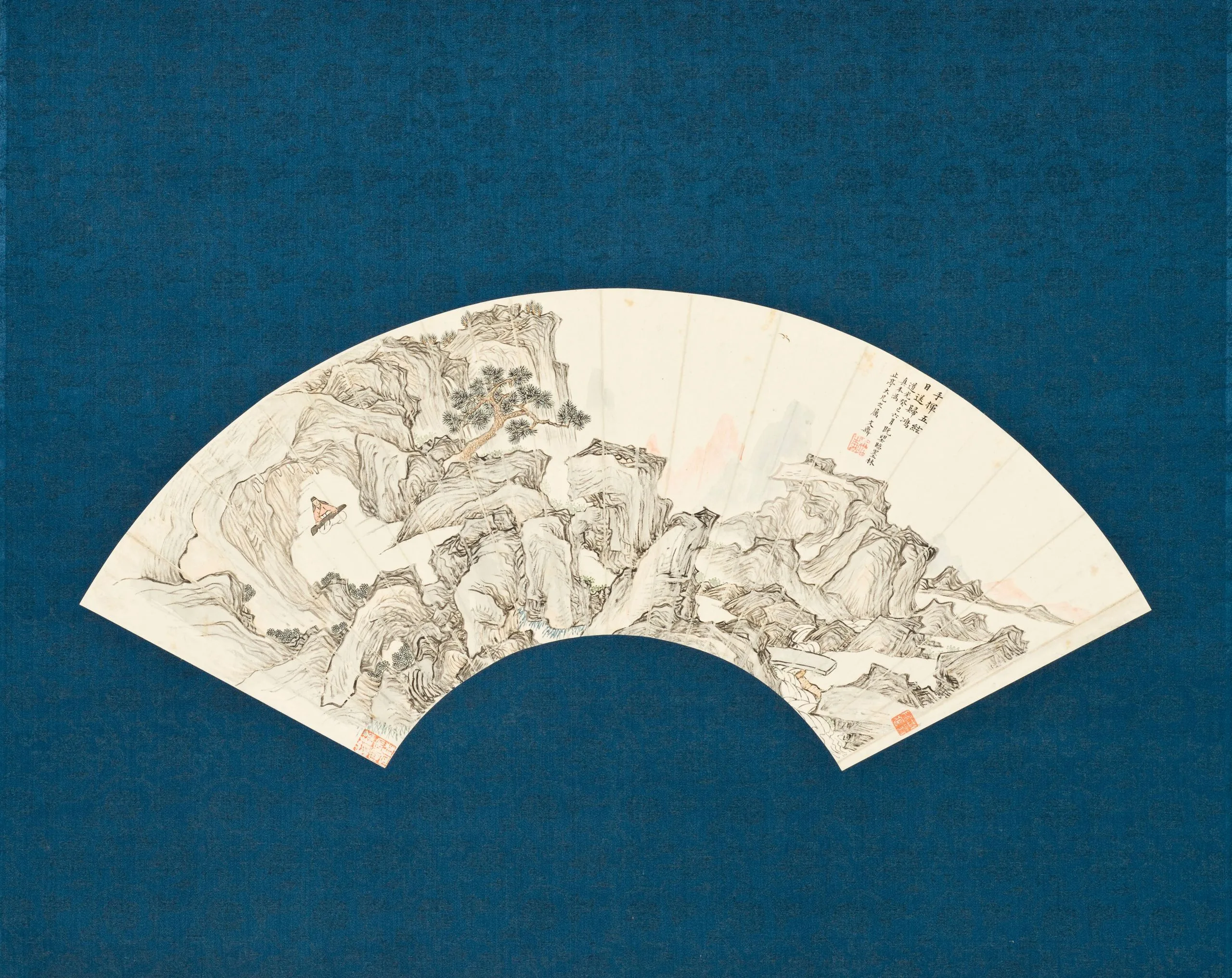
The Qing-dynasty artist and antiquarian Wen Ding mastered the arts of painting, calligraphy, and seal carving. This landscape in fan format, now remounted as a hanging scroll, is composed of variously shaped and textured rocks rendered in the loose, expressive, calligraphic brushwork typical of the literati style. The inscription reads: “Hand plucking zither strings, while eyes seeing off homeward swans. / In the sixth month of the year gengsi in the Daoguang reign [1833], [I] copied an authentic work by Molin for older brother Zhiting.—Wen Ding.” The figure on the left playing a zither (qin) is likely a depiction of Ji Kang (223−262), one of the Seven Sages of the Bamboo Grove of the Three Kingdoms period. Along with being an accomplished qin musician, Ji was a poet, Daoist philosopher, and alchemist who remained aloof from dangerous politics and dedicated himself to art and refinement. “Hand plucking zither strings, while eyes seeing off homeward swans” is quoted from one of Ji’s poems. The line is also used by Gu Kaizhi (c. 348−405) in his treatise On Painting to describe capturing the spirit of a person in figure painting.
The “Molin” referred to in Wen Ding’s inscription is the art name of Xiang Yuanbian (1525−1590), a connoisseur who amassed a large collection of ancient paintings and calligraphy. Famous artists such as Qiu Ying and Dong Qichang were in residence at Xiang’s home to study the collection and paint for him. Xiang, like Wen Ding, was a native of Jiaxing in Zhejiang Province, so it is not surprising that Wen had easy access to the Xiang family collection.
Wan Kong
2024