- Title
- The Distribution of the Buddha's Relics
- Date Made
- 2nd-3rd century
- Medium
- Schist
- Dimensions
- 4 3/8 x 6 1/2 x 1 1/2 in. (11.11 x 16.51 x 3.81 cm)
- Accession Number
- M.84.151
- Curatorial Notes
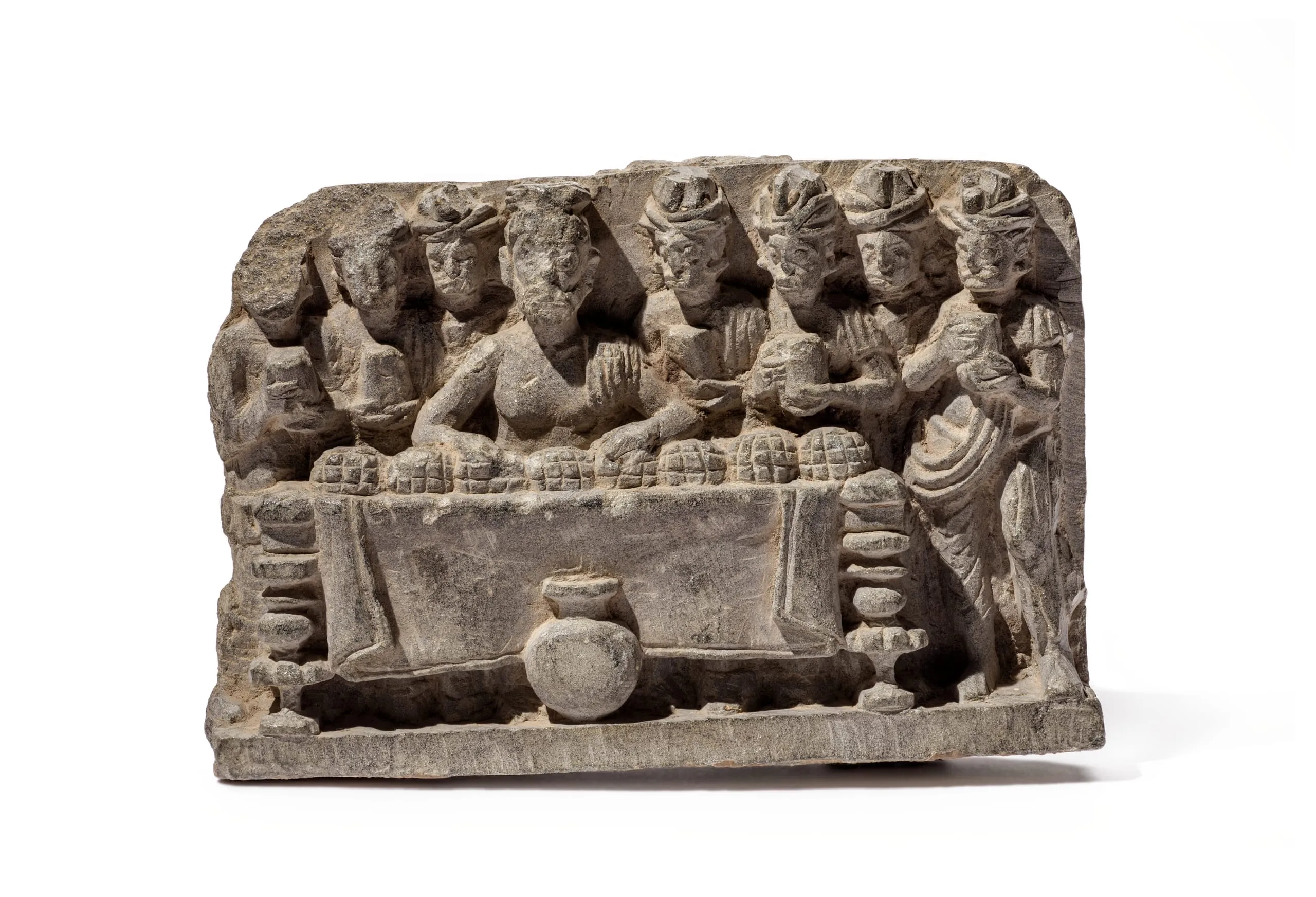
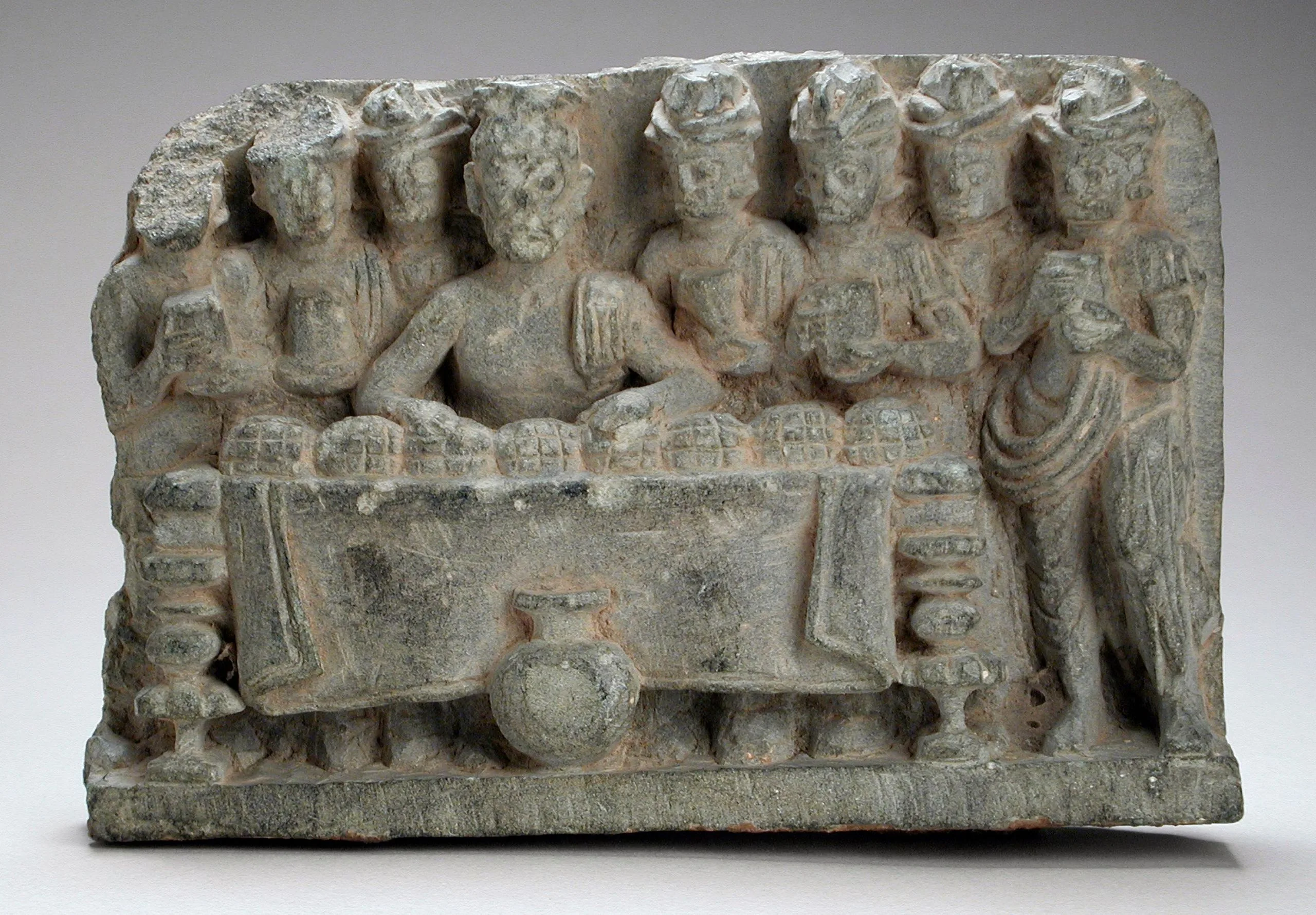
After the death of the Buddha and his final enlightenment (mahaparinirvana) in Kushinagara, Uttar Pradesh, traditionally dated to circa 483 BCE, his body was cremated. His ashes and bones were then distributed as relics to the heads of eight prominent clans by a Brahmin named Drona. Representations of the distribution of the Buddha's relics were frequent subjects of early Buddhist painting and narrative sculpture adorning Buddhist stupas (funerary monuments). Ornate reliquaries were fashioned to house the relics, many of which were dispersed throughout the Buddhist world.
Drona, distinguished here by his beard and central position in the stele, sits behind a cloth-covered table with eight mounds of relics. Behind him are seven turbaned figures representing the clan kings, all of whom hold vessels to receive the relics. The eighth king on the far left is now missing except for a remnant of his foot. In front of the table is a large urn that originally contained the Buddha’s remains to be divided.
- Selected Bibliography
- Pal, Pratapaditya. Indian Sculpture, vol.1. Los Angeles: Los Angeles County Museum of Art; University of California Press, 1986.
- Little, Stephen, Tushara Bindu Gude, Karina Romero Blanco, Silvia Seligson, Marco Antonio Karam. Las Huellas de Buda. Ciudad de México : Instituto Nacional de Antropología e Historia, 2018.
- Little, Stephen, and Tushara Bindu Gude. Realms of the Dharma: Buddhist Art across Asia. Los Angeles: Los Angeles County Museum of Art, 2025.