LACMA

ShopMembershipMyLACMATickets
LACMA
Los Angeles County Museum of Art
5905 Wilshire Blvd.
Los Angeles, CA 90036
info@lacma.org
(323) 857-6000
Sign up to receive emails
Subscribe
© Museum Associates 2025

Museum Hours

Monday

11 am–6 pm

Tuesday

11 am–6 pm

Wednesday

Closed

Thursday

11 am–6 pm

Friday

11 am–8 pm

Saturday

10 am–7 pm

Sunday

10 am–7 pm


  • About LACMA
  • Jobs
  • Building LACMA
  • Host An Event
  • Unframed
  • Press
  • FAQs
  • Log in to MyLACMA
  • Privacy Policy
© Museum Associates 2025
Collections

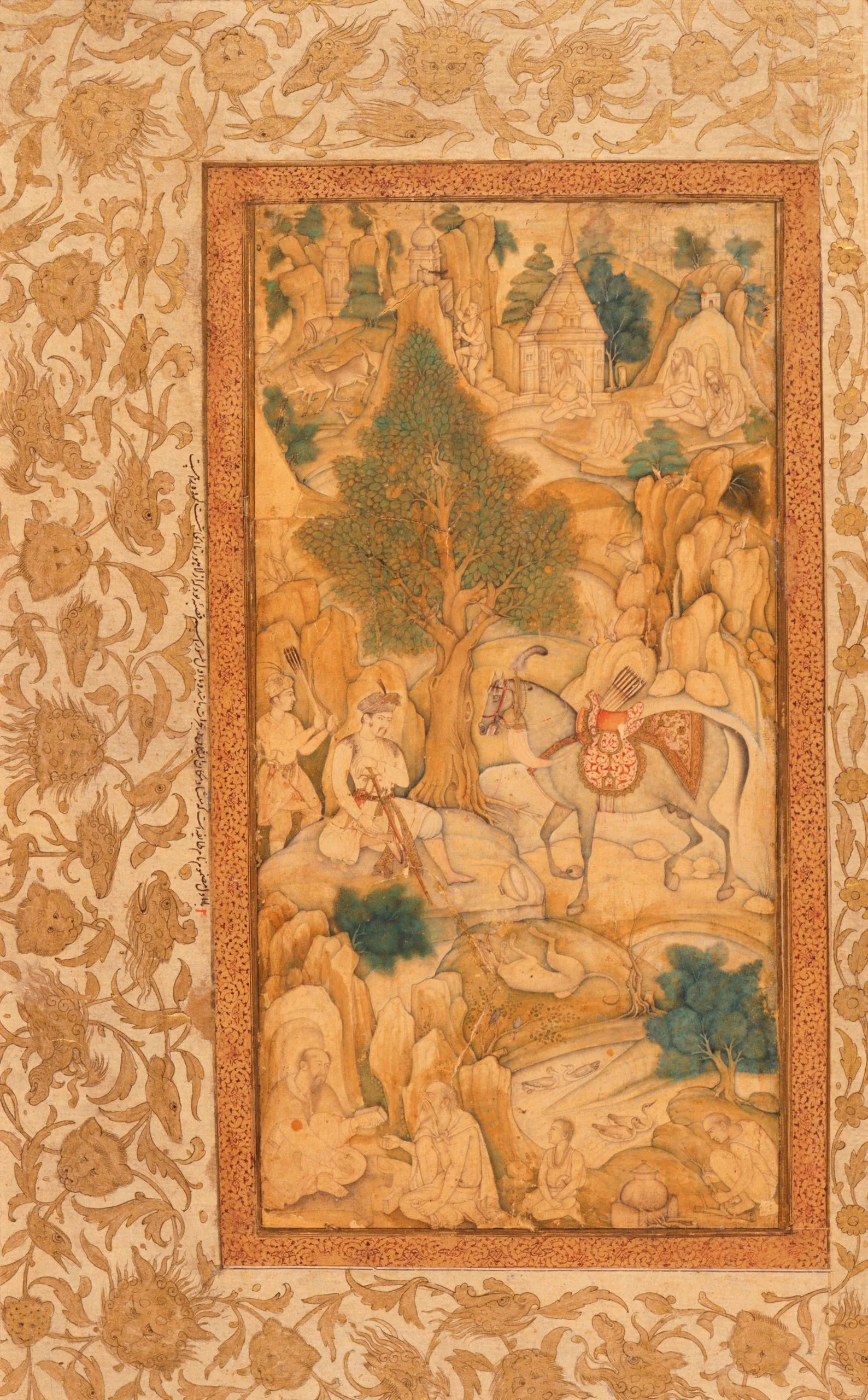
Attributed to Miskin
Prince at Restcirca 1600-1605 (border: circa 1608)

Not on view
Mughal-style painting on paper, vertical format, showing multiple robed figures, a saddled white horse, and a cypress tree amid golden rocky cliffs, with a wide floral border containing lion and demon faces and Nastaliq script in the margin
Artist or Maker
Attributed to Miskin
India, active late 1570s-circa 1604
Title
Prince at Rest
Place Made
India, Mughal Empire
Date Made
circa 1600-1605 (border: circa 1608)
Medium
Ink, opaque watercolor, and gold on paper
Dimensions
Sheet: 13 1/2 x 8 3/8 in. (34.29 x 21.27 cm); Image: 9 1/4 x 4 5/8 in. (23.5 x 11.75 cm)
Credit Line
From the Nasli and Alice Heeramaneck Collection, Museum Associates Purchase
Accession Number
M.84.32.7
Classification
Drawings
Collecting Area
South and Southeast Asian Art
Curatorial Notes

Attributed to the great Mughal painter Miskin (active late 1570s-circa 1604), this nim qalam (half-pen) lightly tinted drawing likely depicts Prince Salim (the future Emperor Jahangir, r. 1605-1627). Pratapaditya Pal (1993) has suggested that this folio may be from a Shikarnama (Hunting Album) prepared for Salim (see also M.83.137). Salim rests in a rocky landscape teaming with wildlife while he observes a dying or dead Saluki dog, perhaps injured in the hunt. His richly caparisoned steed waits beside him. A retainer hands him a bow and arrows. The remainder of the composition consists of genre scenes. In the left foreground, two European scholars converse while a young acolyte listens. In the right foreground, a man prepares kindling for his campfire. In the upper right corner, a group of Hindu ascetics sits outside of a temple and cave, while another mendicant climbs the stairs to a small shrine. There is a sprawling city in the hazy distance. In the upper left corner, a herd of antelope graze in a field below a mountain shrine.

This folio has been remounted within an elaborate gilded border with flowering vines festooned with the heads of fantastic beasts. It was originally part of a Farhang-i Jahangiri, a dictionary presented to Jahangir in 1608 (see M.73.5.535–.537). The Persian inscription along the left margin pertains to the dictionary, not to the drawing.

For a somewhat rote copy of this drawing attributed to the 19th century, see M.72.83.1.
Selected Bibliography
  • Schmitz, Barbara, ed. After the Great Mughals: Painting in Delhi and the Regional Courts in the 18th and 19th Centuries. Mumbai, India: Marg Publications, 2002.
  • Rosenfield, John. The Arts of India and Nepal: The Nasli and Alice Heeramaneck Collection. Boston: Museum of Fine Arts, Boston, 1966.
  • Pal, Pratapaditya. Indian Painting, vol.1. Los Angeles: Los Angeles County Museum of Art, 1993.
  • Heeramaneck, Alice N. Masterpieces of Indian Painting : From the Former Collections of Nasli M. Heeramaneck. New York: A.N. Heeramaneck, 1984.