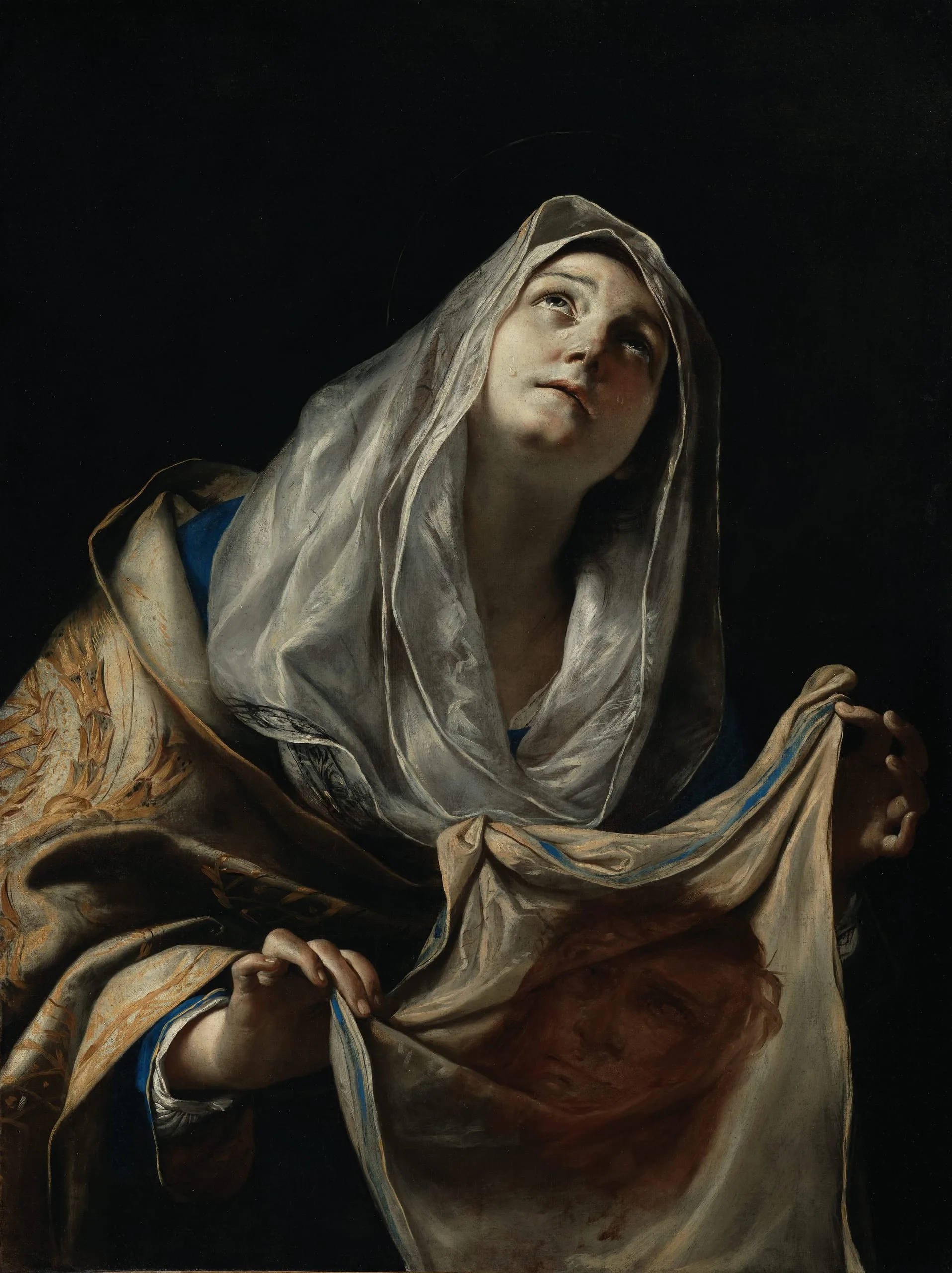
Tenderly portrayed by the Neapolitan painter Mattia Preti, Saint Veronica gazes heavenward, with tears softly streaming down her cheeks as she acknowledges the divine source illuminating her. According to Christian tradition, this pious woman from Jerusalem wiped Christ’s face with her veil as he passed her house on the way to his crucifixion. The cloth bore the imprint of his image, or “the Holy Face,” becoming a miraculous object of veneration throughout Christendom. Her name aptly derives from the Latin vera (true) and the Greek icon (image). The cult of Saint Veronica was particularly strong in Rome, where her veil was preserved in Saint Peter’s Basilica. Representations of the holy veil, revered for its healing powers, became widely popular in the early seventeenth century, prompting Pope Paul V to issue a decree in 1616 to prohibit its replication, unless executed by a canon of Saint Peter’s. A few years later, Pope Urban VIII went further, ordering the destruction of all existing reproductions of the veil. By asserting control over these representations, the Roman Catholic Church reinforced its authority in granting access to a vehicle to salvation, which would signify deliverance from sin and its consequences.
While commissions of Saint Veronica and her veil were scarce in the later seventeenth century due to these edicts, Preti nevertheless painted this intimate composition, one likely intended for private devotion. An inventory of the Palazzo Barberini in Rome indicates that Preti likely painted it on commission for Cardinal Girolamo I Colonna, a member of the ancient Roman nobility allied with the current pope, Urban VIII. Rather than circumventing the papal edict, Preti’s depiction of Saint Veronica could be seen as a reflection of his alliance with the pope. The di sotto in su (from below up) viewpoint intensifies the figure’s pathos and further engages with the viewer’s meditation.
2024